ایالات متحده «خلاء ابری» را بست: چند روز پس از خروج جنسن، قانون جدید اجاره تراشههای هوش مصنوعی به چین و پنج مرکز «انحراف» را مشمول مجوز میکند
به مدت چهار سال، واشنگتن ارسال بهترین تراشههای هوش مصنوعی آمریکا به چین را ممنوع کرده بود. برای بیشتر آن مدت، آزمایشگاههای چینی به سادگی آنها را اجاره میکردند.
US Closes The "Cloud Loophole": Days After Jensen's Exit, New Rule Puts AI Chip Rentals To China And Five "Diversion" Hubs Under License For four years, Washington has banned shipping America's best AI chips to China. For most of that time, Chinese labs have simply rented them instead.
On Monday, the Commerce Department finally moved to shut that door , issuing an interim final rule that limits remote access to advanced AI chips and servers , a move Bloomberg tied directly to the "increased scrutiny over semiconductor exports after an alleged espionage scandal involving Nvidia." The department's own framing:
"The rule is designed to ensure that existing restrictions on access to sensitive American technology cannot be circumvented through remote computing arrangements involving data centers in third countries. "
In other words, if you can't export the chip to Beijing, you can't export the compute either. And to make sure the point lands, the rule also slaps a license requirement on advanced AI chip shipments to Singapore, Malaysia, Indonesia, Thailand and Brazil .
*US ISSUES RULE RESTRICTING REMOTE ACCESS TO ADVANCED AI CHIPS
The timing is, shall we say, not coincidental. Four days ago Jensen Huang resigned as CEO of Nvidia following revelations about his relationship with Alice Huang, the former Megaspeed executive accused of being a spy (after Marco Rubio reportedly rewrote a CIA memo that did not come to that conclusion), and whose Singapore-based neocloud has long been suspected of funneling Nvidia compute to Chinese customers. Regular readers will recall that we started asking how DeepSeek got its hands on blacklisted Nvidia silicon all the way back in January 2025 (" Did DeepSeek Use Shell Companies In Singapore To Procure Nvidia Blacklisted Chips?", Jan 31 2025), followed a month later by " Singapore Probes Nvidia AI Chip Shipments By Middlemen To Malaysia Amid DeepSeek Scrutiny " (Mar 3 2025). Almost two years later, the regulation has caught up with the routing map.
The full interim final rule (RIN 0694-AK50) does four things:
A new end-use control on data centers anywhere in the world. Exporting advanced chips to a data center now requires a license if there is "knowledge" it will provide more than 12 million "aggregate TPP" of compute to companies headquartered (or whose ultimate parent is headquartered) in China, Macau or the rest of Country Group D:5. The tally counts compute across "linked data centers," explicitly including digitally -linked infrastructure, so splitting a cluster across three buildings in Johor won't cut it.
A destination license for five "diversion" hubs: Indonesia, Malaysia, Singapore, Thailand and Brazil, which the rule says present "a higher-than-normal risk of diversion." The Secretary of Commerce can add more countries.
Tighter rules for fabs and packagers making advanced-node logic chips for designers based in D:1/D:4/D:5 countries or the five new hubs, closing the "design it in Shenzhen, have it made in Taiwan" pathway.
The formal burial of Biden's AI Diffusion Rule , which BIS says "has never been enforced": the country tiers, the model-weights controls and the data center VEU program are all gone.
Crucially, the rule also goes after intermediaries . BIS says the "for an entity" language covers a non-Chinese cloud customer that is "in turn training SI models for, or participating in the training of SI models for, or providing SI models to" a D:5 company. Translation: the Malaysian shell renting GPUs on Alibaba's behalf is now explicitly in scope. BIS also helpfully reminds everyone that this was always the intent of the October 2023 controls, which, if true, makes one wonder why it took three years and a spy scandal to spell it out.
And for the data centers already in the business? Anyone currently providing significant compute to D:5-headquartered firms has 90 days from the effective date to get a license "or face future export restrictions."
(Yes, the document says "Super Intelligence" throughout: under Executive Order 14434, "Inaugurating the Era of Super Intelligence," the government no longer says "artificial intelligence." The chips are the same.)
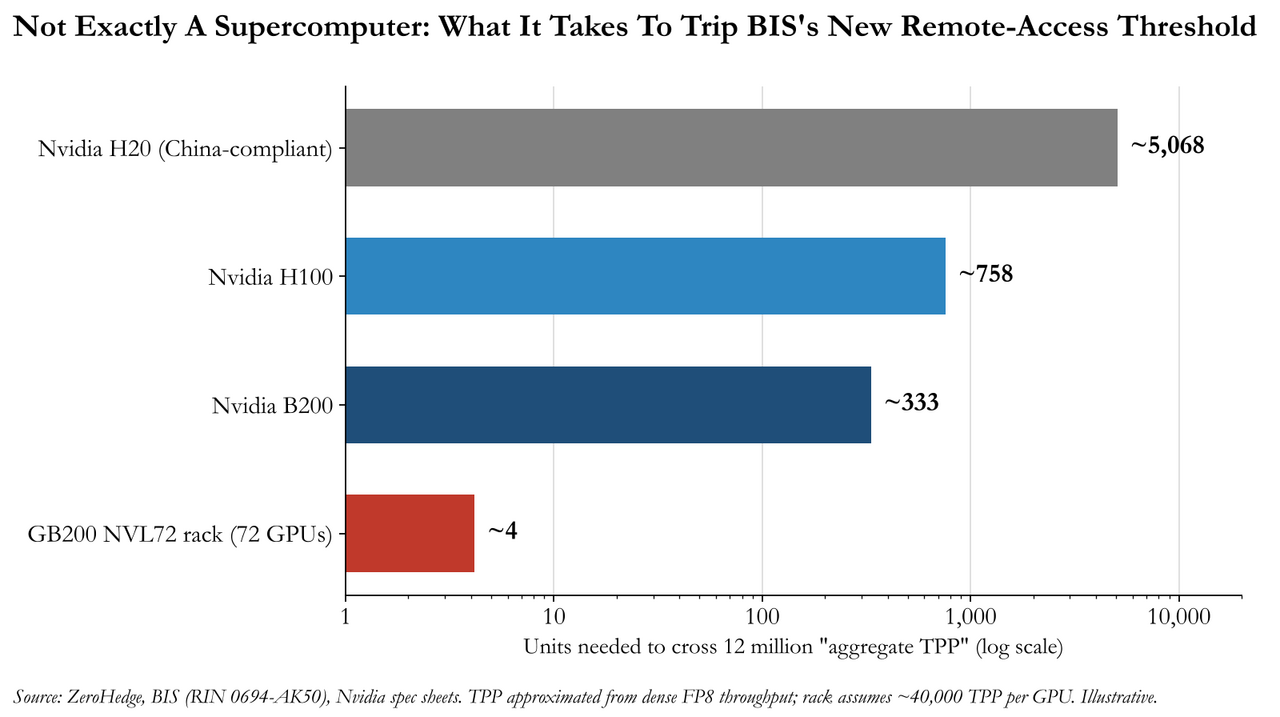
So how much compute is 12 million TPP? Less than you might think. TPP ("total processing performance") is BIS's chip-power metric, and doing the napkin math on Nvidia's published dense FP8 throughput, the threshold works out to roughly 760 H100s, about 330 B200s, or just over four GB200 NVL72 racks (these are approximate, since TPP depends on the exact SKU and precision).
Put differently, this is not a frontier-training-run threshold : a few racks of Blackwells sold to a Chinese customer is enough to require a license. For reference, Bloomberg reported last December that Megaspeed alone had imported at least $4.6 billion of Nvidia hardware since its 2023 founding. That is a lot more than four racks.
There is one conspicuous carve-out: "commercial recommender systems," defined as AI tools "exclusively designed and exclusively used to rank, filter, or suggest commercial products, services, or content." BIS says these "do not pose the same national security threat." So the compute that decides which TikTok video or Taobao handbag you see next is fine; the compute that writes the caption is not. Expect a sudden boom in Chinese "recommendation engines" at Southeast Asian data centers.
The five-country list is actually narrower than initially rumored. On Wednesday, The Information reported that a draft also covered Norway and South Africa; both are gone from the final text . Brazil, meanwhile, makes the cut alongside the usual Southeast Asian suspects. So - yay for Norwegian and South African compute merchants?
There is a big exemption: the new country license does not apply to chips going to companies headquartered in the US (or whose ultimate parent is), provided the exporter files new reports under §743.10 naming every party and the ultimate parent. Good news for the hyperscalers building in Johor and Batam. Less good for everyone else.
And the stick for host governments is explicit. Commerce says it will be "actively monitoring for countries that tolerate evasion" and will consider "import restrictions, new license requirements on advanced semiconductor exports, downgrading the country's status in the U.S. export control regime, and Entity List designations." Import restrictions , in an export control rule. Kuala Lumpur and Singapore have been warned.
Also notable: the BIS press release says the rule was written "by and at the direction of" the Treasury Department and the National Security Council , an unusual credit line for a Commerce regulation, and maybe a tell about who has been driving China tech policy since the Megaspeed revelations. The FT reported last week that Treasury and the Pentagon had pushed to put Megaspeed on the Entity List, only for its inclusion to be delayed.
The scandal that set all this in motion has moved at breakneck speed. As we reported , the New York Times first tied Jensen to Alice Huang in late October; Huang admitted the affair to employees on Nov 8; Trump then said the FBI was "looking into it" (Nov 10); and by Thursday Jensen was gone, with CFO Colette Kress named interim CEO. (For the full backstory, see " GPUs, Capri Sunsets, And A Detained Husband: Who Is Alice Huang? ")
Then we found that the 'spy' angle was invented by Marco Rubio, who rebuilt a classified CIA memo "in his own more assertive terms," according to the Washington Post .
Interesting: the Washington Post says that Jensen Huang's downfall was Marco Rubio's doing ( https://t.co/3rtFza8rje ), and it looks like the "spy" framing was directly his and not the CIA's.
As they write, Rubio took a CIA report and rewrote it in a memo "in his own more… https://t.co/hiJ8UOAvWW pic.twitter.com/cQ5mJR1sLE
— Arnaud Bertrand (@RnaudBertrand) November 14, 2026 The compute angle came into focus the same day, when The Information reported Alice Huang had promised Nvidia chips to none other than DeepSeek:
If you haven't set up your own open-weight system yet, you soon won't be able to.
Megaspeed is hardly the only channel . Three men tied to Supermicro have been charged over an alleged $2.5 billion scheme to move Nvidia-equipped servers to China, and on Thursday Semafor reported the DOJ is probing both Megaspeed and Supermicro, while Fortune noted both scandals allegedly run through Southeast Asia . Which is, naturally, where four of the five new license countries are.
Chinese buyers saw this coming. Reuters reported last Thursday that Chinese AI firms were racing to reserve Nvidia-powered capacity from overseas data center providers before the rule landed. That is precisely the stockpile the 90-day grandfather window now targets.
Nvidia, for its part, lobbied against the rule, arguing that cutting off remote access would only push China to build its own chips faster. It lost that argument, and with Jensen gone and three House committee chairs wanting answers this week, it has rather less political capital to spend on the next one. Nvidia is scheduled to report Q3 results tomorrow; expect "Southeast Asia" and "remote access" to come up on the call.
So does it work? The rule is clever on paper: it targets ownership, not geography, counts linked clusters, and reaches intermediaries. But remote access is far harder to police than a pallet of GPUs at Changi . It depends on cloud operators doing "robust due diligence" on who ultimately owns their customers, in jurisdictions where those structures are built to be opaque. Export lawyers have also long questioned whether BIS has clear statutory authority over remote access absent the Remote Access Security Act, which sailed through the House 369-22 in January but, as far as we can tell, has yet to become law. Expect that question to be tested in court.
Then there is BIS's own cost estimate. The paperwork section projects roughly 100 additional license applications a year, at an estimated added burden of... $1,900 , and deems the rule "not significant" under E.O. 12866. Not significant, for a rule aimed at a company that alone imported billions of dollars of Nvidia gear. Right.
Our take: the rule closes the most obvious door, and the 90-day clock will force some awkward conversations in Singapore and Johor. But demand for compute doesn't disappear; it relocates , to the next jurisdiction not on the list, to "recommender systems" that do a lot more than recommend, and to Huawei's Ascend roadmap, which Beijing will happily accelerate. Washington has finally caught up with the routing map of early 2025. The question is where the map is now.
We'll know more after Nvidia's earnings tomorrow, and after Commerce decides which country is number six.
منبع: ZeroHedge — متن کامل از فید رسمی منبع، با ترجمهی ماشینی عنوان و خلاصه