مسئله هستهای: تحلیلگر ارشد دفاعی وال استریت میگوید استفاده هستهای ایالات متحده در ایران را «نمیتوان ۱۰۰ درصد رد کرد»
به مدت هشت ماه، هر تیتر خبری درباره ایران با دو سناریو همراه بوده است: توافق صلح در روز دوشنبه و «آماده برای درگیری» در روز جمعه. این هفته نیز از این قاعده مستثنی نبود: دوشنبه، ۹ نوامبر، تاریخی بود که برخی گزارشهای رسانهای برای از سرگیری حملات بزرگ ایالات متحده تعیین کرده بودند.
The Nuke Question: Wall Street's Top Defense Analyst Says US Nuclear Use In Iran "Cannot Be 100% Ruled Out" For eight months, every Iran headline has come with the same two-way trade: peace deal on Monday, "locked and loaded" by Friday.
This week was no exception: Monday, November 9 was the date that a handful of media reports had penciled in for the resumption of major US strikes (a new moon, three carriers on station, the midterms safely in the rearview mirror). Instead, President Trump walked out of a meeting with Qatar's prime minister and told reporters that military action against Iran does not seem necessary at this point , one day after telling CNN that new bombing is "highly unlikely" if talks progress. Stocks responded with an everything rally, with the S&P closing up 2.4%, while Brent slid back below $95, extending what was already its biggest weekly drop since the Covid crash.
And yet, in the same 72 hours the US carried out what Trump called "minor" strikes on Qeshm Island (which have continued since), the IRGC reported three more tankers ablaze in the Strait of Hormuz (with more tankers catching fire through Friday), a Houthi missile damaged an Aramco tower in Riyadh , Saudi Arabia's East-West pipeline was hit in the Medina region , and Secretary of State Rubio said no breakthrough was in sight. Peace, in other words, is going great.
Which brings us to the best single piece of sell-side work we have seen on where this war goes next. In a note published on election day and titled " Lots of Variables in Resumption of Middle East War. The Nuke Question " ( available to pro subs ), Capital Alpha's veteran defense analyst Byron Callan does something that very few of his peers have been willing to do: he admits he has no idea whether the US and Israel hit Iran at scale again in November or December, and then explains why the answer may matter less than what the next round would cost . As he puts it:
Maybe the U.S. and Israel strike Iran at scale again in Nov.-Dec. 2026, and maybe they don’t. Markets seem to have fainting spells every time there is hope of a peace deal, but there is precedent for negotiations being abruptly cut off as strikes commence.
In other words, the market keeps pricing the last headline, while the people with the bombers keep their options open . Regular readers will recall that negotiations were also "progressing" in late February, right up until the morning of February 28.
And then there is the part of the note that gave it its title. Callan very much doubts that Washington would ever use a nuclear weapon on Iran's deepest bunker, but in his words the possibility "cannot be 100% ruled out." When the dean of Washington defense research feels the need to put that sentence in writing, well, it is probably worth reading the rest.
Start with what the US and Israel can actually bring to bear. Callan's read is that the balance of forces has barely changed since the spring campaign:
Two US carriers with roughly 96 combat aircraft , plus submarines and destroyers that add cruise-missile capacity. (It may be three now: Trump told CNN on Sunday he has three carriers in the region, although Goldman's Rich Privorotsky notes the USS Theodore Roosevelt is not expected before mid-November. Pick your source.)
The Israeli Air Force has the same number of combat aircraft and tankers as in February and March , and has probably rebuilt some, but not all, of the strike weapons it burned through.
Bombers and tankers are available, but where they would be based is an open question , as is whether the Pentagon is willing to park F-15Es at bases in Jordan, Saudi Arabia, Qatar, the UAE and maybe Israel that lack shelters against missiles and drones.
That last point is hardly academic: when Iran fired about 20 ballistic missiles at Muwaffaq Salti Air Base in Jordan on September 8, aircraft on the ground were damaged despite a salvo of more than 70 interceptors.
What about boots on the ground? Callan does the arithmetic for anyone still entertaining the idea: two Marine Expeditionary Units, each with a Battalion Landing Team of about 1,200, plus elements of the 82nd Airborne, are not marching on Iranian cities and installing a new government. Trump seems to agree.
*TRUMP: DON'T SEE TROOPS ON THE GROUND IN IRAN https://t.co/zqri56JU7O
— zerohedge (@zerohedge) October 16, 2026 So that leaves the air campaign, and here the Capital Alpha analyst is blunt:
We have also been extremely skeptical that a strategic air campaign alone would lead to regime change. A strategic air and missile campaign could make life miserable for Iranians, impose costs on the Islamic Republic and IRGC, and further reduce its economic capacity, but the bulk of the Iranian military and IRGC is likely to survive.
Put differently, a second Epic Fury can make Iran poorer and angrier, but the bulk of the Iranian military and the IRGC probably survives it . This is the same conclusion US intelligence reached two weeks into the war , and it is why Treasury Secretary Bessent pivoted in August to collapsing the regime through economic warfare instead. Trump's own pitch on Sunday was that the US has picked out 38 bridges it can drop in an hour, and that Iran is running 301% inflation.
The second leg of Callan's argument is that Iran gets a vote. Tehran has promised a widespread response to any new campaign, and while the US and Israel have partly restocked their air-defense interceptors, he reads the Houthi strikes on Saudi Arabia as evidence that the shortages remain significant . Iran's own missile and drone inventories are smaller than they were in February. They are not zero.
Sunday's hole in the side of an Aramco office tower, in a kingdom that spent $83 billion on defense last year, makes his point better than any spreadsheet. So does the September 8 attack on the Jordan base, where US forces fired 60 to 70 Patriots (about $4 million each) and more than a dozen THAADs ($12 million to $15 million each) to defend a single target. On our napkin that is roughly half a billion dollars of interceptors for one night's work , against an industrial base the Pentagon's own inspector general says has run into "strategic inventory shortfalls."
From there the note turns into a list of five things Callan says he cannot assess, which doubles as the most honest summary of the war's second-order effects we have come across:
How many more U.S. air defense interceptors and strike weapons would be consumed?
Whether it’s possible to further increase production rate targets in 2029-32 for U.S. weapons?
What will countries in the region do if they can’t get timely resupply of U.S. interceptors and possibly ground control units and radars? Where else do they turn to?
How does further depletion of U.S. weapons inventories shape risk-taking by China, North Korea, and Russia in 2027-32?
Translation: every interceptor fired over Riyadh or Azraq is one that is not sitting in Guam, Seoul or Poland , and Beijing, Pyongyang and Moscow can count. The Gulf states can count too, and if Washington cannot resupply them on time, the question of who they call next (Seoul? Ankara? Kyiv?) will shape defense order books for a decade.
On energy, Callan declines to forecast what a strike on civilian and energy infrastructure would do to the world in 2026-28, since it depends on what gets hit and by whom. He does offer two observations. First, any further jump in energy prices is more worrying now that global reserves have been drawn down. Second, he has never bought the idea that the Strait of Hormuz is open in any pre-February 28 sense: the UK's maritime trade office would hardly be logging near-daily reports of merchant ships struck by unidentified projectiles if the waters were safe.
He also cites a recent post by Radigan Carter putting VLCC day rates at $30,000 before the war and $600,000 now , or 20 times higher. Having tracked the tanker rate crisis since February 20 , before it was cool, and all the way to the $1 million tanker , we would only add that the number moves by the day and the direction of travel depends entirely on who mined what that morning.
Today's news fits the pattern. The East-West pipeline, the kingdom's main Hormuz bypass, was hit again, and while the energy ministry says the fire was small and flows were unaffected, this is the same line the Saudis had to shut in September . We have been warning since March, when Fujairah was in flames , that the bypass routes would become targets in their own right.
So how is the Street handicapping the next move? JPMorgan's Market Intelligence desk ( available to pro subs ) relayed this morning how the bank's Center for Geopolitics frames Washington's menu:
An Epic Fury 2.0 that revisits the kinds of military targets struck in the spring
A “final blow” aimed at a nuclear target, a largely performative strike that would allow Washington to declare “mission accomplished.”
The team also noted that Washington has had these same options on the table since the MOU collapsed in June without reaching for them, given all risk Iranian retaliation and an escalatory spiral sending energy prices even higher and inflicting considerably more economic and psychological damage across the Gulf
The third item on that list, a largely symbolic strike on a nuclear site that lets Washington declare victory and go home, is the one to remember when we get to Pickaxe Mountain below.
As for odds, JPMorgan's commodity traders went into the weekend with a coin flip: 50% that more strikes come (followed by a declaration that the military phase is over), and 50% that diplomacy gets more time . Within the strike branch, they put 75% on the US staying to police Hormuz and keep the blockade, and 25% on a full exit.
The diplomacy branch called for a $4 to $5 drop in Brent and a 7 to 10 point fall in volatility as January length gets dumped, which is the direction the tape took this morning, with WTI down almost 3% (helped along by hedge funds that had already puked $6.6 billion of Brent into the midterms). It is also a long way from the 90% odds of "Round 3" that were doing the rounds on October 20.
Goldman's Rich Privorotsky, for one, is not convinced that the calm survives the week. In his morning note ( available to pro subs ), the head of the bank's EMEA one-delta desk flagged the mixed messages from Trump and Rubio and then offered a calendar:
The USS Theodore Roosevelt is not expected in the region before mid-November. Absent tangible diplomatic progress, I’d expect escalation premium to return to oil by Wednesday/Thursday ahead of the weekend.
Which is the Monday de-escalation, Friday re-escalation pattern we have been pointing out for months, now with a Goldman stamp on it. It also squares with the bank's commodity team, which last week found that a roughly $27 risk premium explained most of October's crude rally, and with the physical market, which has since flipped from bidding war to fire sale .
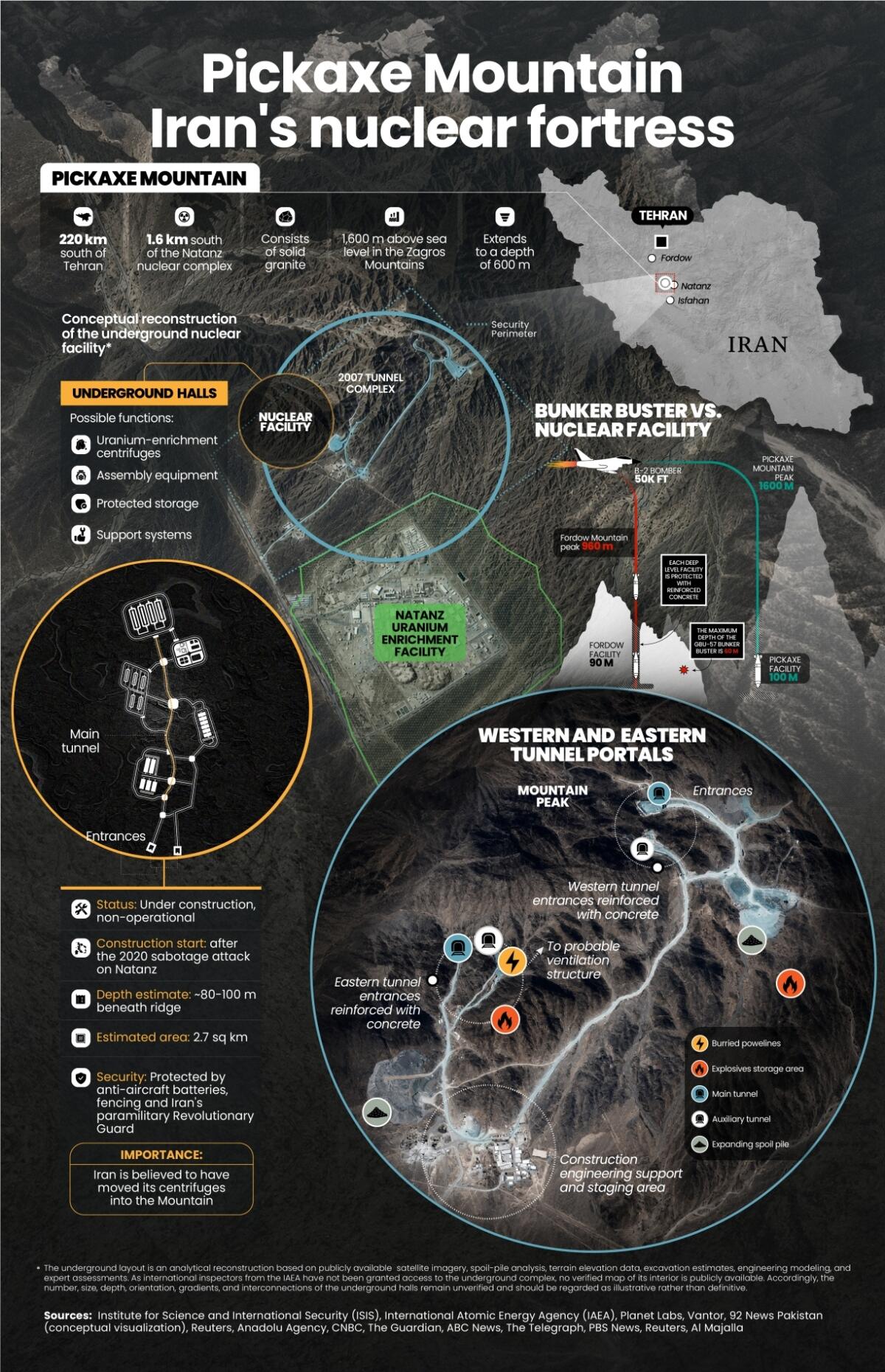
The speculation has been building since mid-October, when the Pentagon was reported to be eyeing the "Mother Of All Bombs" for the next round and Trump, asked directly, said he would not go nuclear. It went into overdrive on election day when Tucker Carlson claimed, without evidence, that the administration was days away from a nuclear strike on Pickaxe Mountain (the White House waved it off), and again last Friday when The Times reported that Iranian authorities were handing out iodine tablets near nuclear sites.
Iranians said to be preparing for a US nuclear attack on Pickaxe Mountain: The Times https://t.co/g5fXSKQBUg
— zerohedge (@zerohedge) November 6, 2026 We covered the iodine story in detail on Friday , and have been writing about the site itself since July . Callan's contribution is to treat the question like an analyst instead of a pundit: he does not expect it, he will not say the odds are zero, and he walks through what the weapon would actually do.
The target first. Pickaxe Mountain (Kuh-e Kolang Gaz La) peaks at 1,593 meters, sits about 2 km from the Natanz complex and roughly 100 km north of Isfahan, a city of about 2 million people .
Then the weapon. The B61 is a gravity bomb that comes in several versions, one of which is an earth-penetrator that a B-2 can deliver. Its yield can be dialed down from a maximum of 400 kilotons . For context, the two bombs dropped on Japan in 1945 came in at 15 to 20 kilotons.
The penetrating version has a hardened nose that lets it dig several meters into soil and rock before it goes off, and most of the damage to anything buried underneath comes from the shockwave, which could collapse tunnels and halls.
And here is the catch. "Several meters" is nothing like an underground test. Callan presumes a risk that radioactive material gets out, and points to Brookings for the comparison: US underground tests in Nevada were buried between 600 and 5,000 feet below the surface. The halls under Pickaxe are reported to sit 80 to 100 meters down.
In other words, a bomb with up to 27 times the yield of Hiroshima would be going off about as deep as a basement, two kilometers from Natanz and upwind of somebody. Which is presumably why Tehran is handing out the iodine.
Radiation aside, Callan lists three more reasons the idea is a bad one, and for a defense analyst the second is the most interesting:
Using a nuclear weapon could remove a prohibition that has existed since 1945. It could raise the possibility that Russia uses nukes against Ukraine. It could also prompt other countries to seek their own nuclear weapons.
An administration decision to use a nuclear weapon could radically polarize U.S. domestic politics and relations with other allies. That’s probably not positive for the DoD/DoW budget or for U.S. defense exports.
Without independent verification, there would be no way to determine whether everything under Pickaxe had been destroyed and unsalvageable if a weapon was used.
Take them in turn. A taboo that has held since 1945 goes away, which Russia would notice in Ukraine and every would-be proliferator would notice everywhere (Trump himself said in September that he would not have bombed a nuclear-armed Iran , which is about the most effective advertisement for getting a bomb ever recorded, and Iran's hardliners have been listening ). US politics and alliances would be polarized to a degree that is probably negative for the Pentagon's budget and for US arms exports . And with no inspectors on the ground, nobody could confirm that whatever was under the mountain was destroyed.
That last one is the killer. The entire point of the third option on JPMorgan's menu is to be able to say the job is done. A weapon that breaks the biggest taboo in warfare and still leaves you unable to prove it worked fails on its own terms, and that is before Iran told the IAEA today that it does not consider itself bound to full monitoring while under threat of US attack.
So what does any of this mean for the stocks? Callan's answer is that the implications cut both ways, and his broad views are unchanged: whatever happens in November and December probably matters less than i) how Iran is perceived as a military threat in 2027-35, ii) whether the US is still seen as a reliable security partner, and iii) what Middle East governments decide to do about their own security .
That is a longer horizon than the market has been using. Defense names sank after the Democratic sweep , with Lockheed (LMT) and Northrop (NOC) down 3% and Goldman's European defense basket falling as much as 4.1%, as TD Cowen's Roman Schweizer called the result the toughest outcome for defense spending and warned of a flat to low-single-digit FY27-28 topline and a new War Powers fight. That came on top of a sector that had already fallen out of favor in September.
Goldman's trading desk thinks the selling has gone too far. Privorotsky calls the derating extraordinary and sees a path for Washington to hold the topline anyway:
More interesting is the extraordinary derating in defense. In the U.S., Washington could ultimately maintain top line defense spending as part of a lame duck compromise with Democrats on healthcare. Meanwhile, European defense looks increasingly asymmetric: ceasefire headlines and EU fiscal debates have driven multiple compression, yet structural NATO 2%+ GDP commitments and multi year order backlogs mean a lot of bad news is already priced in.
And the bank's industrials specialist Ryan Novak, in a note this morning titled " A&D from here " ( available to pro subs ), makes the fundamental case that maps most directly onto Callan's interceptor math:
We also come away positive defense primes as well though acknowledge the very recent outperformance in the bid to “defensives” creates a slightly higher bar than we wish. However, taking a step back, we remain in the middle of geopolitical turmoil working down munitions stockpiles amongst other areas, DoW continues to have interests aligned with higher volume output, Q3 is the cleanest quarter across the board we can remember – LMT GD NOC LHX RTX – nothing is perfect but Q3 was as close as we’ve seen in recent memory. The path on the budget appears, with some noise, likely higher not lower over the short and medium term.
In short: stockpiles are being run down faster than they can be rebuilt, the Department of War wants more volume, the third quarter was about as clean as the primes ever get, and the desk sees the budget drifting higher despite the noise, with L3Harris (LHX) and RTX (RTX) the names it highlights. So Goldman says the budget goes up, TD Cowen says it goes flat, and Capital Alpha says to stop staring at this year's budget and ask who the Gulf buys from in 2030.
Meanwhile, the Treasury has already cast its vote. As we showed in our breakdown of the worst October budget deficit on record , US national defense outlays did something we still can’t quite explain: they hit $128.9 billion in a single month, blowing past every prior peak, none of which had cleared much more than $100 billion. Somebody is paying to refill those interceptor racks, and maybe this is what it looks like.
Which makes the flat-versus-higher topline debate look a little quaint: the checks are going out before Congress has decided anything.
There is one scenario where all three agree, at least implicitly. As Callan notes, a nuclear strike would probably hurt the defense budget and export orders alike. It would be the rare case where the biggest bomb in the inventory is bearish for the people who make bombs.
Callan concedes up front that he cannot pin down consensus because it changes daily, with the market leaning toward post-election strikes one week and a settlement the next. JPMorgan's commodity desk calls it a coin flip. Goldman's Privorotsky expects the escalation premium back by Thursday. And the president says the war ends "fairly soon," as he has, give or take, since March.
If we have to pick a side (and we do), it is with the skeptics on all three counts. Air power alone will not bring down the Islamic Republic, so any closing strike is a performance. The performance most likely to be staged is a conventional one on Pickaxe, sometime after the next round of talks stalls, since it is the only item on the menu that lets everyone declare victory. And the nuclear version stays where Callan puts it: remote, self-defeating, and impossible to dismiss entirely with carriers in theater and iodine tablets going door to door.
In the meantime, the interceptors keep getting fired, the tankers keep burning and the bypass pipelines keep getting hit , whatever the S&P thinks on any given Monday.
more in the full Capital Alpha note " Lots of Variables in Resumption of Middle East War. The Nuke Question .", Goldman's " GS Basics " and " A&D from here " desk notes and the JPMorgan Market Intelligence morning briefing, all available to pro subs .
منبع: ZeroHedge — متن کامل از فید رسمی منبع، با ترجمهی ماشینی عنوان و خلاصه