بهترینها هنوز از هم نپاشیدهاند
ارسال شده توسط QTR's Fringe Finance ستون امروز شامل دو بخش خواهد بود. ابتدا، بسیاری از مطالب نوشته شده در این وبلاگ را در دو هفته گذشته مرور خواهم کرد. سپس، دیدگاه خود را درباره آینده Nvidia، بازار، سایر بخشها و سایر مسائل ارائه میکنم.
The Best Is Yet To Come Undone Submitted by QTR's Fringe Finance
Today’s column is going to be two parts. First, I’m going to review a lot of what I’ve written about on this blog the last two weeks. Then, I’m going to offer my take on where Nvidia, the market, other sectors, and everything else is going forward.
Punk band Lit had a great song called “The Best Is Yet To Come (Undone).”
After Friday’s market crash and headlines suggesting that the SEC could be investigating Nvidia’s accounting, I can’t think of a more appropriate title for my column this weekend.
Because if there’s one thing I’ve been trying to communicate to readers over the last four months, it’s that the unraveling of the AI bubble was never going to be a single event, a single bad earnings report, or a single afternoon of panic selling. It was going to be a chain reaction, one in which deteriorating sentiment, increasingly questionable financing arrangements, political uncertainty, and scrutiny of the companies at the center of the boom could begin feeding on one another.
And as much as Wall Street has wanted to declare the worst over at virtually every opportunity over the last two weeks, my argument has consistently been that the next shoe probably hasn’t even dropped yet.
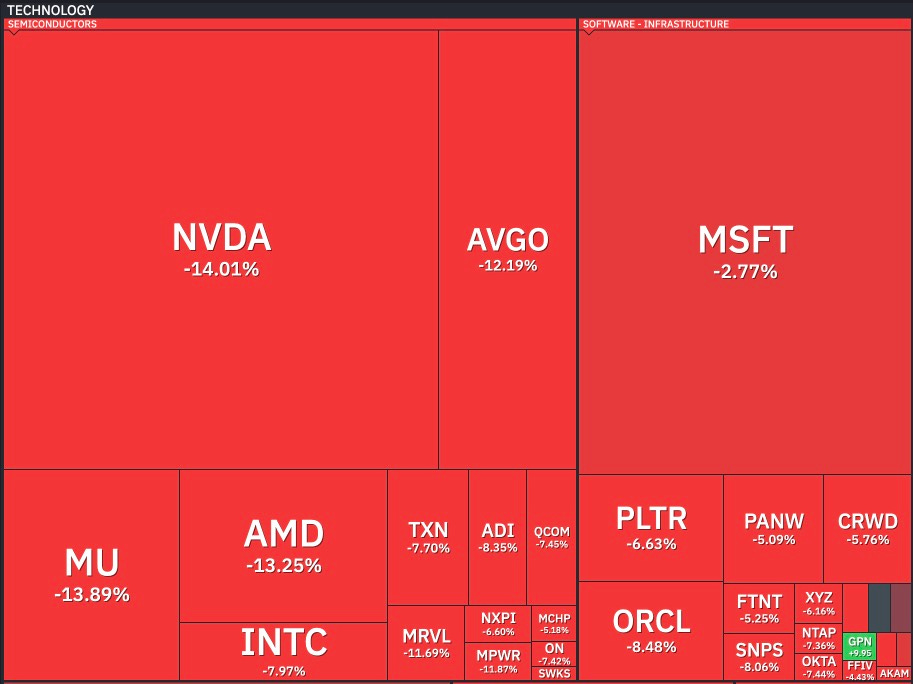
Meanwhile, over on CNBC in just the last two weeks, it appears to have been a love-fest for Nvidia while it’s been plunging -43% in the last month and -20% in the last week alone:
Preliminary list compiled using AI; individual statements have not been independently verified against original CNBC broadcasts.
And it appears to have been a love fest for the overall market as well…
Preliminary list compiled using AI; dates, programs and statements have not all been independently verified against original CNBC broadcasts.
Now before getting into where I think Nvidia and the broader market go from here, I want to spend a few minutes reviewing just how on top of things we’ve been over the last four months.
Not because I feel compelled to take a victory lap every time the market takes a shit, but because in my initial call for an AI crash this year in August , I also made a prediction about timing, which I almost never do. I’m sure I’ll be wrong and/or humbled again at some point soon, but as for then, the bond market spiking had my conviction through the roof, and here we are 4 months later looking like we were ahead of the game: The Real AI Crash Will Start This Year
I’ve been laying out, in real time, why I thought this trade was vulnerable (noting eight specific bear cases from eight of my favorite investors heading into Fall), what could cause it to break, and why the initial selling would likely be followed by developments that investors hadn’t even begun to consider.
And while plenty of people have been happy to tell me I’m too bearish, a fearmonger, or simply beating a dead horse, I think the last several weeks have offered a pretty compelling answer to those criticisms. As I said back in July, your delusion doesn’t make me a doomer . And said more recently, let the morons eat cake …I’m done trying to convince the world they’re staring into the abyss.
On August 17, I published The Real AI Crash Will Start This Year . It was the first time all year that I had made a serious attempt to call the timing of the AI bubble bursting.
I argued that the end of 2026 and beginning of 2027 could finally mark the point at which years of speculative excess, extraordinary valuations, and increasingly circular investment arrangements began to unwind. More specifically, I was concerned about the enormous amount of capital being committed to AI infrastructure, the questionable economics underpinning some of that spending, and the extent to which global financial markets had become dependent on a handful of technology companies continuing to deliver perfection.
One of my central arguments was that investors had confused the extraordinary potential of artificial intelligence with the idea that every dollar being spent to develop it would necessarily generate an attractive return.
As I wrote at the time, the technology could be transformative while the capital cycle supporting it had already moved far beyond what the economics could reasonably justify. I pointed to the railroads, fiber optics, and the dot-com bubble as examples of how genuinely revolutionary technologies could produce extraordinary financial destruction for investors who paid the wrong price or financed too much infrastructure too early. The internet ultimately changed the world, but that didn’t stop the Nasdaq from losing roughly 80% of its value after the technology bubble burst.
I also focused specifically on Nvidia and the increasingly circular financing arrangements supporting the AI ecosystem . My concern was that the company had become so central to the market, and its chips so central to the investment plans of other companies, that any serious shock to Nvidia could produce consequences far beyond its own shareholders. Here’s what some of that web looks like, courtesy of Zero Hedge :
When the same ecosystem of companies is investing in, financing, buying from, and depending on one another, the distinction between organic demand and capital being recycled through the system becomes critically important. And when enormous portions of the global equity market are priced around the assumption that this arrangement can continue indefinitely, a loss of confidence in the company at its center can become a much bigger problem than a single stock declining.
I warned that such a shock could cause sentiment to change almost instantly across millions of trading desks. Four months later, Nvidia has reportedly fallen roughly 40% in a month, and the market is being forced to reconsider many of the assumptions that seemed untouchable when I published that piece.
I wasn’t arguing that AI was fake, that Nvidia didn’t make extraordinary products, or that the technology wasn’t going to change the world. I was arguing that the financial structure built around the boom had become dangerously vulnerable to disappointment. Something to remember when looking at how the stock has performed over the last month…
In late September, stress was showing up in the credit markets and Oracle was cancelling data center projects and trying to convince the public it was all totally normal and everything was fine, which I noted it obviously wasn’t .
By October, the Nasdaq was beginning to show signs of weakness, and I started writing repeatedly about how the approaching midterm elections could introduce another major catalyst for a market already looking increasingly fragile. On October 20th, as the market was starting to show some weakness, I urged my subscribers to remember that “knives keep falling” as CoreWeave, which I had started warning about in July 2025 , specifically came under pressure: Sometimes, Knives Just Keep Falling
On October 31, I published Could Democrats Crash This Market? , arguing that investors were underestimating how dramatically the regulatory and political environment could change if Democrats took control of Congress. The market had enjoyed years of relatively accommodating regulatory conditions, particularly in technology, banking, cryptocurrency, and private credit. I thought a Democratic victory could change that calculus quickly, even without a single piece of new legislation being passed.
My argument was that congressional control meant subpoena power, committee investigations, hearings, and the ability to put corporate executives and previously unquestioned business practices under a microscope. I specifically pointed to the possibility of increased scrutiny of AI financing arrangements, data-center subsidies, corporate conflicts of interest, and opaque private-market valuations.
These were precisely the types of arrangements I had already been questioning for months, and I believed the political environment could become another source of pressure on an already overstretched trade. The election didn’t need to cause the bubble to burst on its own. It simply needed to introduce another reason for investors to reassess the extraordinary assumptions embedded in stock prices.
Then Democrats swept the midterms, and the market initially reacted with a remarkable reversal . Nasdaq futures plunged more than 2% overnight before reversing sharply higher, with investors apparently deciding that political gridlock was something to celebrate.
On November 4, while Wall Street was busy trying to interpret the rally as bullish, I published Bearish Beyond This ‘Blue Wave’ Market Bounce . I argued that the enthusiasm was missing the much bigger picture: the election had potentially made the political and regulatory backdrop considerably less favorable for the very companies investors were rushing to buy. I called the rally a fake-out to its face here: Bearish Beyond This ‘Blue Wave’ Market Bounce
I was particularly concerned about the implications for AI infrastructure, including the possibility of permitting delays and higher capital costs for data-center projects in Texas. I also warned that Democratic control of Congress could bring greater scrutiny to the technology, cryptocurrency, banking, and private-credit sectors, all of which had benefited from a relatively favorable political environment. My point was that investors were celebrating the initial bounce without adequately considering what the election could mean for the businesses and valuations underlying the market.
The very next trading day, the Nasdaq collapsed more than 5%. As it was happening, in a mid-day update to subscribers , I wrote:
For all intents and purposes, this is exactly what I have been expecting since I started calling for a crash in August.
As my paid subscribers know, this was my most likely scenario heading into the midterms: Democrats would win, and the resulting political pressure on data centers, combined with forthcoming scrutiny of industries like crypto and banking, would become a decisive headwind for markets.
There’s going to be a lot more to talk about in the coming days and weeks, but for right now, I’m fairly certain we’re seeing a combination of everybody heading for the exits at once, together with forced liquidations , margin selling, and an abrupt reassessment of just how much growth investors were willing to pay for.
I will have plenty more to say in the coming hours and days. For now, I think the most important thing is recognizing that the psychology may finally be changing. And once that happens, the market can travel a very long way before the fundamentals have even had time to catch up.
What followed since then has beeen a brutal stretch for technology stocks, as the market began repricing risks that had been accumulating for months.
I don’t pretend that every point of that decline was attributable to the election, nor that any single article explains every subsequent market move. But the larger warning was clear: the market was far more vulnerable than the post-election rally suggested, and investors were making a mistake by interpreting a temporary bounce as evidence that the underlying problems had disappeared.
The following morning, November 6, I published After The Crash, Another Wave Of Bad News Will Be Coming . This was an especially important piece because I wasn’t merely arguing that stocks could continue falling.
I was arguing that the initial crash could set off a series of financial, corporate, and political consequences that had not yet had time to become public. This was 15 days ago.
I said I expected enormous volatility in both directions, potential policy responses, and greater scrutiny of the AI industry’s increasingly questionable valuations and financing arrangements. As I wrote :
The market’s reaction to yesterday’s crash is not nearly as important as what yesterday’s crash may have set in motion.
I continued by warning that the most important question wasn’t whether stocks could bounce, but how many companies, investors, and lenders had built their plans around the assumption that the market would never stop going up.
That, to me, was the real danger. A violent selloff doesn’t simply change the prices on a screen. It changes the assumptions lenders use to extend credit, the collateral values supporting financing arrangements, the willingness of counterparties to take risk, and the confidence investors place in companies that had previously been treated as virtually invincible.
I also made a point of warning readers not to confuse violent rallies with durable bottoms. In that November 6 article, I wrote:
The VIX is up about 40% since that, and is up 115% to 35.89 in the last month:
It was an important distinction because I expected the market to produce exactly the kind of violent countertrend rallies that would convince investors the worst was over, even as the underlying problems continued to develop. I wrote this piece to remind readers that the pops can look seductive, but to be careful: The Seduction Of Market Bounces On The Way Down
My thesis was that the initial selloff would be followed by more information, more questions, and potentially more unpleasant surprises. And almost immediately, that is what began happening.
Then came the granddaddy of all AI stocks…the one with its fingerprints on virtually every company on Earth, its DNA woven into every ETF, retirement account, and investment portfolio on the planet. The undisputed golden child of Wall Street took center stage at the school play… and promptly pissed itself in front of the entire class.
Readers may recall that I first began questioning what a black swan event at Nvidia could do to broader financial markets as far back as 2023 , when it was becoming increasingly apparent just how much of the market’s fortunes were being tied to one semiconductor company at the same time critical questions were being asked of Nvidia’s relationship with CoreWeave. I followed up again in 2024 , ridiculing the almost religious, cult-like status Nvidia had.
On November 8, as controversy surrounding Jensen Huang and allegations involving Chinese intelligence began emerging, I published Could Nvidia’s Spy Scandal Force Jensen Huang To Resign? . At the time, the idea that Huang could be forced out of the company he built was treated by many investors as almost unthinkable. I received plenty of shit talk on social media for even raising the possibility.
Nobody wanted to hear that the man who had become the face of the AI revolution might suddenly become a source of enormous uncertainty for the company at the center of the trade. Days before the news broke in late October, I reiterated that Nvidia had become so central to financial markets that an extraordinary amount of the world’s financial fortunes now hangs in the balance of what happens to it.
When the Alice Huang story broke, my concern was never limited to Huang’s personal future. It was about the broader implications of a serious controversy involving the leadership of a company upon which so much of the global technology trade depended.
I had been warning for years about the risks of concentrating so much financial-market confidence in Nvidia, and suddenly we had that black swan…an entirely unexpected development that threatened to call the company’s governance, customer relationships, and regulatory exposure into question. Nvidia disputed the underlying espionage allegations, and those allegations should not be confused with established findings of wrongdoing. Nevertheless, the potential implications were serious enough that I thought investors needed to consider scenarios they had previously dismissed out of hand.
Just two days later, on November 10, I published Why Nvidia’s Nightmare May Be Just Beginning . By then, reports had raised additional questions about Huang’s relationship with a Chinese businesswoman and allegations involving Nvidia chip shipments to Chinese customers.
These were still allegations, not established violations, but they introduced an entirely new set of questions about export controls, the company’s China business, and the integrity of its customer relationships.
In that piece, I reiterated a concern I’d raised earlier about what could happen when a major executive departure or governance crisis forces a company to confront issues that previously received little scrutiny. As I wrote:
New leadership, new scrutiny, and changing incentives have a way of revealing things that were previously swept under the rug.
I also made a much more specific prediction: that Huang’s resignation was a plausible, and in my view increasingly likely, outcome:
I think the likely outcome at this point is that Jensen Huang resigns, at a minimum.
But I thought the more important issue was what a broad examination of Nvidia’s operations could uncover. I wrote that I was increasingly concerned about what greater scrutiny could reveal about Nvidia’s books.
I had noted in the days prior that short seller Culper Research was raising related concerns back in May, alleging that more than 20% of Nvidia’s fiscal 2026 compute revenue remained driven by Chinese demand through Southeast Asian intermediaries and illegal GPU diversion. Culper also questioned Nvidia’s customer due diligence, alleged hidden Chinese financing behind major chip purchasers, and warned that China’s push toward domestic semiconductors could leave a substantial hole in Nvidia’s forward revenue expectations.
I was not alleging accounting fraud or asserting that the company’s financial statements were inaccurate. I was saying that when one of the most important companies in the world becomes embroiled in allegations involving national security, export controls, major customers, and its chief executive, investors should expect journalists, analysts, regulators, and short sellers to begin looking much more closely at every part of the business.
That was the point I kept making in articles and in our subscriber chat. The scandal wasn’t necessarily the end of the story. It could be the beginning of a process in which people started asking questions they hadn’t bothered to ask while the stock was going straight up.
And when I suggested that more bad news was likely to emerge, I was again told that I was fearmongering, beating a dead horse, and refusing to acknowledge that the worst was over.
When Nvidia reported earnings, the usual cast of Wall Street cheerleaders came out almost immediately. Jim Cramer and seemingly everyone else wanted investors to believe the company had delivered another definitive answer to the bears.
Revenue and earnings beat expectations, guidance was strong, and the stock initially rallied. The familiar narrative was back: Nvidia had done it again, AI demand was unstoppable, and anyone questioning the company was simply refusing to recognize greatness.
I had a different take. On November 18, I published Why Nvidia’s Earnings Beat Is A Meaningless Distraction Right Now , because I couldn’t help noticing that the actual questions surrounding the company hadn’t been answered.
Nvidia had not yet filed its corresponding 10-Q, and the company had indicated that the filing would come in the following weeks . A delayed filing is not, by itself, evidence of accounting wrongdoing, but it meant investors still lacked the full quarterly disclosure package at precisely the moment when the company’s business practices and governance were facing extraordinary scrutiny.
But now, the numbers may be the least interesting part of Nvidia’s story.
That was the entire point. Another spectacular quarter did not resolve the questions surrounding the company’s China operations, the allegations involving its former chief executive, the quality of its customer relationships, or the financing arrangements supporting the broader AI ecosystem.
And without the complete 10-Q, investors were still being asked to make judgments about the company’s financial condition without the full set of disclosures normally available alongside its earnings: Why Nvidia’s Earnings Beat Is A Meaningless Distraction Right Now
Every step of the way, I had been arguing that Nvidia’s accounting, disclosures, and underlying business relationships deserved greater scrutiny. I wasn’t saying the numbers were necessarily fraudulent. I was saying that the market had spent years treating the company’s reported growth as almost beyond question, while increasingly complicated arrangements were developing around the AI buildout.
An earnings beat didn’t make those arrangements any less complicated, and it certainly didn’t mean that the underlying questions had been resolved.
The stock initially rallied before reversing into the red. And just two trading days after earnings, with Nvidia having traded around $155 following the report, shares were changing hands closer to $120…nearly 20% lower….amid reports raising the possibility of an SEC accounting investigation.
And once again, the important point wasn’t simply that the stock had fallen. It was that the process I had been describing for months appeared to be moving into another phase.
The questions surrounding financing arrangements had not gone away. The issues involving China and export controls had not been fully resolved. The governance controversy had created additional uncertainty, and a comprehensive review of the company’s financial disclosures and business relationships could potentially raise further questions. I don’t know what such a review would ultimately reveal, and I have no interest in pretending that allegations are proof.
But I do know that declaring the worst over before those questions are answered strikes me as an extraordinarily optimistic assumption.
All along, I’ve been warning readers and subscribers that the chain reaction here was only getting started. Over the last four months, I think we’ve been remarkably accurate in identifying the vulnerabilities in the AI trade, recognizing the political and regulatory catalysts that could accelerate the unwind, warning against premature declarations of a market bottom, and anticipating that the initial selloff could invite additional scrutiny and bad news. The timing and sequence of events have reinforced much of what I’ve been arguing, even if the ultimate consequences remain uncertain.
Consider Michael Burry, whose warnings I’ve highlighted on more than one occasion . Burry remained steadfast in his skepticism of the AI trade, even as the ridicule directed his way over the past two or three months reached a fever pitch. He was sounding the alarm as far back as 2025: Burry Breaks His Silence
He was mocked, dismissed, and treated like a relic of another era by a market convinced the laws of financial gravity no longer applied to artificial intelligence. Then we learned gravity has a funny way of reasserting itself.
Now, as Nvidia and semiconductor stocks take the elevator down, Burry is reportedly cashing in on the bearish positions that so many people were laughing at just weeks ago. There’s something satisfying about watching an investor endure months of ridicule for refusing to abandon his convictions, only to see the market begin validating his warnings.
That doesn’t mean he’ll be right about everything. But when someone identifies structural vulnerabilities, withstands extraordinary pressure to capitulate, and watches those risks materialize, perhaps the lesson is obvious: The next time Michael Burry starts waving a red flag, pay attention before the building catches fire.
And at this point, however, I think it’s time to change how I describe what’s happening. I would no longer characterize the chain reaction as just getting started . I would characterize it as underway .
We’re no longer talking about hypothetical vulnerabilities. We’re watching confidence deteriorate, valuations compress, and previously overlooked risks become central to the market’s assessment of one of the most important companies in the world.
And I don’t think the consequences will necessarily be confined to Nvidia, semiconductors, or even the technology sector.
The snowball isn’t sitting at the top of the hill anymore. It’s rolling downhill, gathering mass, and picking up speed.
So, with that history established, here’s where I think Nvidia and the broader market are heading, what I’d need to see before believing either has established a durable bottom, which companies and sectors remain particularly vulnerable, and where opportunities may finally be emerging.
I had a great conversation with my friend Mark Spiegel the other day, and he made a point about the broader market that I think is worth considering carefully. Let’s start there, then move into Nvidia and other parts of the market.
Mark’s been watching the S&P 500 through the lens of its historical price-to-sales ratio, rather than relying exclusively on earnings-based valuation measures.
His reasoning is straightforward: earnings can become a lot less reliable during periods of financial stress, particularly when margins are unusually elevated, accounting judgments are receiving greater scrutiny, and investors are beginning to question the assumptions underpinning corporate profitability.
Given everything I’ve just written about Nvidia, I hardly need to explain why that argument resonates with me right now.
The S&P 500 is still trading at roughly three 3x annual sales, compared with a longer-term historical norm closer to 1.8x.
Mark’s point to me last week was that a return toward historical valuation levels could imply another roughly one-third decline in the index from here, even after everything we’ve already witnessed. And if the market overshoots those historical norms, as markets often do during periods of panic and forced liquidation, the downside could be considerably greater.
To be clear, the exact calculation depends on the starting multiple, and a decline from precisely 3.0x sales to 1.8x would imply a 40% drop with sales unchanged. But the broader argument is the same: there is still an enormous amount of valuation risk embedded in this market even as people think we have already “crashed”.
I will, however, add one qualification. We live in what increasingly feels like a permanent quantitative-easing market, where investors have been conditioned to expect monetary intervention whenever financial conditions become sufficiently uncomfortable: Modern Chickenshit Monetary Theory
Between that and the S&P’s increasing concentration in high-margin technology businesses, I’m not convinced historical valuation averages should be treated as some kind of immutable law of nature.
But Mark made another point that I thought was even more important: people have completely forgotten how far this market has come. After years of extraordinary appreciation, investors see an index down 10% or 15% and instinctively assume that stocks must be cheap. They aren’t necessarily cheap. They may simply be slightly less expensive than they were at valuations that were completely detached from historical norms.
I agree with him. And when I look at the S&P 500 and Nasdaq right now, I don’t see anything that convinces me we’ve established a durable bottom. A violent decline isn’t a valuation argument, and a reflexive bounce isn’t evidence that the problems responsible for the decline have been resolved. Here’s the S&P 500 over the last 5 years. It doesn’t look like any type of major trend has been broken, at all:
It’s worth remembering…I’ve written repeatedly the real pain often arrives after the initial selling, when margin calls start coming due, lenders reassess collateral, leveraged investors are forced to reduce positions, and institutions begin discovering where their counterparties have been caught offsides. These things take days and weeks to play out , they don’t all happen in an hour while the market is crashing and then stop when we temporarily find a mid-day bottom in the NASDAQ…
Friday was a perfect illustration of why I remain concerned. The market had finally begun showing tentative signs of stabilization before the Nvidia accounting headline hit, and suddenly the rug was pulled out again . My suspicion is that there are still investors, funds, and lenders spending this weekend figuring out how much exposure they have, how much liquidity they need, and what they’re going to have to sell when markets reopen.
That doesn’t mean Monday necessarily has to be another bloodbath. It means the conditions for additional forced deleveraging, unpleasant headlines, and sudden volatility remain very much in place. The market hasn’t yet had the time to fully assess the damage, much less repair it.
I don’t think the bottom is in yet, although I will concede that the stock looks considerably more interesting around $120 than it did around $155 just a couple of trading days ago. My buddy JBulltard had this move nailed when Nvidia was still above $140, highlighting the 200 week moving average around $124. We touched it Friday near close and then bounced slightly after hours to about $130.
My concern remains that we haven’t seen the full extent of the bad news, and that investors are underestimating how long these situations can take to play out.
I wrote on November 12th that from what I can tell from following these things closely…it goes something like this…a controversy erupts, management tries to contain it, investors hope the damage is isolated, and then additional questions emerge.
Sometimes those questions ultimately lead nowhere. Other times they reveal serious problems. But either way, the process of restoring confidence can become considerably more complicated than anybody initially expected, and the uncertainty itself can weigh on the stock for a while. I find stocks usually don’t “bottom” until the findings from the investigation come out. Here’s how it appears to me to usually take place. No guarantees going forward, however:
That’s why I continue to suspect there may be more information under the carpet at Nvidia that has yet to see daylight. The first bad headline rarely reveals the full extent of a complex corporate crisis…
I’m not saying the company is necessarily a top-to-bottom fraud like some other bears are…some even saying Jensen should be going to jail and calling Nvidia the next Enron. I’m not at that mindset with where the facts stand today and I’m certainly not claiming that every allegation being thrown around will ultimately prove true.
Trump is still President. Trump loves Jensen Huang and Nvidia. And Nvidia definitely makes real products, has an enormous technological advantage in important parts of the AI ecosystem, and operates a business that has generated extraordinary amounts of revenue and cash flow.
There may very well be a price at which the stock becomes attractive despite all of the uncertainty. I’m just not convinced we’re there just yet. One area I’d be watching is the neighborhood of the April 2025 lows, roughly $95 to $105, which would represent another meaningful leg lower from current levels.
And if materially worse information emerges, even that range may not prove to be a floor. Anybody who has lived through situations like Wirecard, Valeant, or other major corporate controversies knows that the deluge of bad news can continue long after investors become convinced the worst is behind them.
I’m not suggesting Nvidia is another Wirecard, or that the underlying allegations are comparable. I’m saying the pattern of uncertainty can be similar.
One headline produces another investigation, which raises another question, which prompts another disclosure, which leads another analyst or regulator to start looking somewhere else.
What initially appears to be a discrete controversy can become an extended process of discovery, during which investors have to keep revising their understanding of the company. Sometimes that process ultimately vindicates management. Other times it reveals problems that were far more extensive than anybody initially appreciated. The point is that we don’t know yet, and I don’t see much reason to pretend we do.
But remember: Nvidia is not some obscure mid-cap company whose problems can be contained to its own shareholder base. This company sits at the nerve center of the entire AI trade and, by extension, a substantial portion of the global equity bull market.
Nvidia is connected, directly or indirectly, to hyperscaler capital spending, data-center construction, semiconductor equipment, power infrastructure, networking, private credit, and an increasingly elaborate ecosystem of companies financing the buildout of AI capacity.
Its products are central to the investment plans of some of the largest corporations on earth. Its stock has also become an enormous component of major indexes and investment portfolios. A sustained shock to Nvidia therefore has the potential to affect not only the valuation of its shares, but also the willingness of investors and lenders to finance the broader ecosystem that depends on its continued success.
The companies I’d be particularly concerned about are any debt-laden neocloud providers and AI infrastructure businesses that have financed enormous capital expenditures on the assumption of persistent demand, ready access to capital, and favorable collateral values.
If Nvidia’s problems cause lenders to reconsider the economics of the AI buildout, or if falling equity valuations make it harder for these companies to raise fresh capital, the consequences could become self-reinforcing.
Also don’t forget that Nvidia itself may become a political issue. On Friday, President Trump was publicly praising Jensen Huang even as the accounting-related headlines were weighing on the stock. I posted a note in our subscriber chat warning that I wouldn’t be surprised to see the administration or SEC leadership feel pressure to comment on the situation over the weekend, perhaps in an attempt to reassure investors before Monday’s open.
That may sound like a stupid thing to be watching, but given Nvidia’s importance to the market and the administration’s interest in American AI leadership, I don’t think it’s completely outside the realm of possibility.
Of course, the SEC is supposed to operate independently, and political praise would tell us nothing about the merits of any accounting questions. But I wouldn’t underestimate the political incentives to calm markets if the selling accelerates. Any reassuring statement might produce a sharp rally without necessarily resolving the underlying issues.
While Nvidia has understandably consumed most of the financial media’s attention, I’ve also spent the last two weeks warning readers not to lose sight of cryptocurrency, which is taking a massive shit along with the market:
This is despite an incessant chorus of TV personalities and online personalities constantly heaving out hail mary price targets for Bitcoin and the likes over the last year. Here’s a great video of what I mean:
And so on November 13, I published Keep One Eye On Tech...But The Other On Crypto , arguing that crypto could be where the next shoe drops if liquidity continues tightening and leveraged investors are forced to unwind positions.
My reasoning was that Bitcoin and the broader crypto complex sit near the very tip of the market’s risk spear. They are highly liquid, trade around the clock, attract speculative leverage, and are particularly sensitive to changes in risk appetite. When financial conditions deteriorate, they can provide an early indication that investors are beginning to scramble for cash.
I returned to that subject on Friday in Missing The Forest For The Bitcoin Trees , where I discussed the increasingly popular tendency among Bitcoin bulls to lean on mathematical models, particularly the Bitcoin Power Law, to argue that the asset must eventually return to a predictable upward trajectory using fancy charts and graphs:
My point wasn’t that Bitcoin has no value or that long-term adoption is irrelevant. Quite the opposite: I think adoption is the central issue, and I remain open to the possibility that Bitcoin plays a meaningful role in the future financial system.
But I worry that investors are allowing elegant mathematical models to distract them from the much more immediate question of what happens to a highly speculative asset during a major contraction in liquidity and risk appetite. A model telling you an asset ought to be worth substantially more doesn’t do much good when the people holding it are being forced to sell.
And that concern extends beyond crypto. In A Dark Storm Is Gathering Over The Housing Market , published November 15, I laid out why I also think housing could become another area of significant weakness heading into 2027.
My argument was that financial stress tends to move through household balance sheets in stages. People generally sell liquid investments first, then draw down savings, rely more heavily on credit, and eventually begin making difficult decisions about larger assets. Housing often reacts later because homes are illiquid, expensive to transact, and typically the last thing people want to sell. But when pressure persists long enough, the effects can begin showing up in rising listings, missed payments, increased borrowing against home equity, and eventually forced sales.
I was pointing out that affordability remains stretched, financing costs remain high, and several emerging data points deserve attention precisely because the broader financial environment is becoming less forgiving.
The potential interaction between falling stock portfolios, weakening consumer confidence, tighter credit, and an already strained housing market is something I think investors would be foolish to ignore. The real danger is not necessarily that every asset class collapses simultaneously. It’s that stress migrates from one part of the financial system to another, with each successive problem making the next one harder to absorb.
And all of this is unfolding against a macroeconomic backdrop that I find particularly uncomfortable. As I’ve been talking about for what seems like forever , the Fed is stuck between an inflationary rock and deflationary depression hard place.
Inflation has remained stubborn enough that Federal Reserve officials have been discussing the possibility of further rate hikes rather than the aggressive easing investors would ordinarily expect during a major market selloff.
That is a decidedly negative development for risk assets at precisely the wrong time. Higher rates put additional pressure on equity valuations, make refinancing more expensive, undermine housing affordability, increase the burden on commercial real estate borrowers, and create even more difficulties for private-credit structures that are already dealing with questionable marks and deteriorating underlying fundamentals.
Think about how much of the last decade’s investment landscape was built around cheap money, abundant liquidity, and the expectation that the Fed would ultimately come to the rescue whenever asset prices came under serious pressure. Now imagine that some of those same structures are being forced to confront falling collateral values and reduced access to capital at the exact moment the central bank is warning that inflation may prevent it from easing.
That’s not a particularly attractive combination. And while I wouldn’t rule out a policy reversal if financial conditions deteriorate badly enough, I also wouldn’t build an investment thesis around the assumption that the Fed will immediately ride to the rescue. The central bank’s ability to support asset prices is considerably more complicated when inflation remains a problem.
And it’s always worth remembering that virtually everybody in the financial industry has some incentive to tell
منبع: ZeroHedge — متن کامل از فید رسمی منبع، با ترجمهی ماشینی عنوان و خلاصه
گفتوگو