"Neither Does It Seem To Be The Last": Bank Of England Hikes For First Time Since 2023, Sees Inflation Near 5%
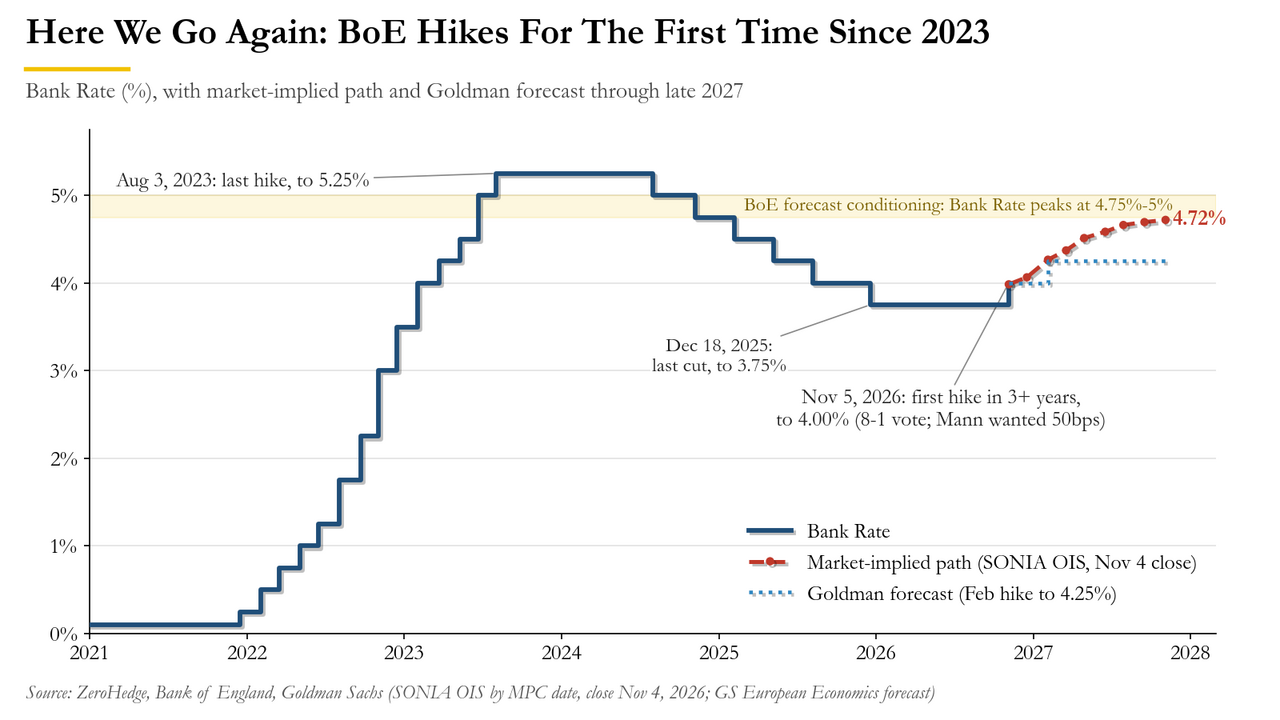
"Neither Does It Seem To Be The Last": Bank Of England Hikes For First Time Since 2023, Sees Inflation Near 5% For the first time in 1,190 days, the Bank of England has raised interest rates.
On Thursday the BoE's Monetary Policy Committee voted 8-1 to lift Bank Rate by 25bps to 4.00% , the first hike since August 3, 2023, when the BoE topped out at 5.25%. And the lone dissenter was no dove: external member Catherine Mann wanted a half-point move to 4.25%. Put differently, not a single one of the nine MPC members voted to keep rates on hold , which is a little more hawkish than consensus: Goldman and JPMorgan both expected a 7-2 vote (Goldman's STIR desk had Swati Dhingra and Alan Taylor as the holdouts), while Deutsche Bank's UK economists were looking for a 6-3 split.
Even the doves came along, if grudgingly. Alan Taylor, one of the most dovish members of the committee, called it " a risk management, 'one-for-now' insurance hike ," while Governor Andrew Bailey, in his own written paragraph, went a step further:
"I can see the argument for a further increase in rates and thereafter taking a more conditional approach... Today's increase shouldn't be seen as the first in an inevitable long sequence of hikes. But, unless the conflict in the Middle East is resolved, neither does it seem to be the last increase. "
In other words, December is live , and traders took the hint: according to Bloomberg, the market now prices roughly a 50% chance of another quarter-point hike next month, and almost three more 25bp hikes by the end of 2027. Two-year gilt yields rose 3bps to 4.77%, and the pound steadied around $1.3472.
Regular readers won't be surprised. Back in March, just weeks into the Iran war, a 9-0 "hawkish hold" sent UK gilt yields exploding higher on a surprise BoE rate-hike threat , with 2Y yields jumping 30bps in a day. And in September, when the BoE held at 3.75% in a 6-3 vote (Mann, Huw Pill and Megan Greene already voting to hike), we warned that the decision would " leave a near-term hike firmly in play ," so we'll allow ourselves a modest victory lap.
The Bank of England held the Bank Rate at 3.75% in a 6–3 vote, as expected, but shifted closer to further tightening. Energy prices have risen sharply since July, lifting the Bank’s early-2027 inflation forecast above 4%, while…
— zerohedge (@zerohedge) September 17, 2026 With today's move, the BoE joins a club that is getting crowded: the Fed hiked for the first time since July 2023 back in September, the RBA has been hiking into a housing slump , and with Euro area headline inflation at a 3-year high of 4.0%, the ECB probably isn't far behind. Which, as Goldman put it last weekend, makes central banks the market's last "source of calm"... "good luck."
The reason for the hawkish turn is in the BoE's new November Monetary Policy Report . CPI inflation, which was 3.5% in September, is now projected to peak at 4.9% in Q2 2027 , the highest since September 2023. Just three months ago, in the July forecasts, the BoE saw inflation peaking at a much more benign 3.2%. That's quite a revision for one quarter, even by central bank forecasting standards.
Most of the overshoot is mechanical: household utility bills and motor fuel accounted for around 60% of September's overshoot of the 2% target, and it's about to get worse. The Ofgem price cap is expected to rise to around £2,150 in Q1 2027 from £1,723 in Q4, a ~25% jump in household energy bills in January , with another increase likely in April. Direct energy effects alone are projected to add around 1.4 percentage points to CPI in Q1.
The BoE admits there is "limited evidence" so far of second-round effects in wages and prices, but it suspects that is a timing issue: firms have been shielded by "hedging and long-term fixed price contracts," and the MPC fears pass-through will come once those expire. And the scenarios are not pretty. In the adverse case of repeated escalations in the Iran conflict, CPI hits 6.2% in Q3 2027 ; in the "weaker demand" scenario, inflation instead collapses to 1.2%, which would, ironically, require rate cuts.
Meanwhile the economy has been more resilient than the BoE expected (or maybe just more resilient than it wanted): the 2026 GDP forecast was upgraded to 1.6% from 1.1%, and 2027 to 1.3% from 1.1%, although 2028 was cut to 1.2% from 1.7% on the assumption that the energy shock lingers. The MPC's verdict: while "policy was still restrictive" before Thursday's hike, " it was less clear that this would impart sufficiently disinflationary pressure to bring inflation back to target in a timely manner."
Bailey had been laying the groundwork for weeks. Here was the Governor a month ago:
*BAILEY: INFLATION RISKS RISE LONGER HIGH ENERGY PRICES PERSIST
*BAILEY: EVIDENCE OF INFLATION PASS-THROUGH SUBDUED AT MOMENT
— zerohedge (@zerohedge) October 8, 2026 Hiking Into An Oil Crash
There is just one small problem with the BoE's inflation math: the oil price it's built on no longer exists.
The MPR's projections are conditioned on energy futures averaged over the 15 working days to October 27, during which front-month Brent averaged $108 per barrel , around 70% above pre-war levels, while UK gas futures over the forecast horizon were some 120% above their pre-conflict levels.
Then the US midterms happened. As we detailed yesterday, crude crashed as the "Blue-nami" sparked market chaos , with Brent plunging 8.7% on Wednesday to close at $94.62, beneath $100 for the first time since September, after Vance boldly admitted that "the reason we lost is the war." Physical markets were already flashing the same signal, flipping from bidding war to fire sale as Gulf barrels flood back .
That's roughly 12% below the oil price the BoE plugged into its forecast (napkin math, and Brent is a moving target). Deutsche Bank's Jim Reid noted in his Early Morning Reid that the oil slide "significantly dampen[ed] fears over inflation," and the market agreed: the Euro 1-year inflation swap plunged 25.9bps on the day to a two-month low of 3.10%.
JPMorgan's Federico Manicardi was even more explicit in his morning briefing ( available to pro subs ), writing that the market reads the Democratic sweep as a " flatter geopolitical risk curve on Iran ," and that "lower Brent/Gas risk premia with the global oil balance already back in surplus (+1.4 mbd in October vs ~+1.3 mbd on avg last year) should ease pressure on central banks ."
Good news for UK households, maybe. Less so for the credibility of a forecast that was stale before it was even published. To be fair to the BoE, the MPR itself warns that inventories are thin, European gas storage is below average and a cold winter could send prices spiking again. And Iran just rejected the latest draft proposal to end the war , so nobody should be declaring the energy shock over just yet.
Goldman: One More In February, But The Market Is Getting Ahead Of Itself
So where does Bank Rate go from here? Going into the meeting, Goldman's European economists led by Sven Jari Stehn had already pencilled in a second hike, writing in their BoE preview, " A Hike with Noncommittal Guidance " ( available to pro subs ), that they "now expect a second Bank Rate hike to 4.25% in February given continued upward pressure on energy prices and the stronger recent activity and labour market figures." But there is a big caveat:
" We continue to think that market pricing for over 100bp of tightening over the next year looks too high given that second-round effects into wages look contained and consumer spending growth is likely to slow over the winter."
Goldman's STIR trader Daryl Li was even blunter in this morning's GS Morning note from Adam Crook ( available to pro subs ). With the December, February and March meetings pricing a cumulative 36bps (down from 41bps the day before), he thinks "this pricing has more to come out with or without de-escalation, mainly because the data has been good but not exponential - we should be pricing between 0-1 hikes per quarter, not 1-2 ." His take on December:
"With the war still unresolved, receiving it is a short vol trade and probably can only get down to a 4bps minimum. It feels like the right trade and we need a re-escalation, with gas pushing towards 120+, before Dec MPC is truly on the table ."
Well, after Bailey's "neither does it seem to be the last" line, December pricing went the other way, to roughly a coin flip. Goldman FX salesman Matt Atherton had flagged exactly this risk in his FX Morning Update ( also available to pro subs ), writing that the desk saw "a greater risk of an 8-1 vote rather than a tighter call," and that the key tell would be in the individual paragraphs: " greater emphasis on risks points to a December hike while greater emphasis on evidence points to more gradual hiking ." Bailey's paragraph leaned a lot more toward risks than evidence.
Here's the thing though: the BoE's own staff sort of agree with Goldman. The MPR's illustrative policy paths, which the BoE stresses do not "translate mechanically" into decisions, show that the central projection requires a restrictive stance, but that " a somewhat looser policy stance than implied by the market curve is appropriate on average ." In fact, the BoE's own projections, which assume Bank Rate peaks somewhere in the 4.75% to 5% range, get CPI below the 2% target by 2029, implying just one or two more hikes are needed.
That leaves the BoE with a familiar dilemma. Hike too little, and the 2022 nightmare repeats, when an energy and food shock bled into wages and services prices and kept inflation above target far longer than the Bank expected (the MPR itself warns that five years of high inflation may have made firms and workers quicker to raise prices and demand higher pay this time around). Hike too much, and the MPC is tightening into a supply shock just as UK households absorb a 25% jump in energy bills, with the "weaker demand" scenario showing inflation crashing to 1.2%. We asked back in March whether an oil supply shock really warrants central bank hikes ; eight months later, the BoE has decided it does, just as oil is collapsing.
Our take: Taylor's "one-for-now" label is probably closer to the truth than the market's three-more-hikes path. If Brent holds below $100 and the Middle East keeps de-escalating, the BoE's 4.9% peak will be revised down by February, and the second-round effects the MPC is insuring against may never show up in the size it fears. If, on the other hand, Iran re-escalates and gas heads to 120+, then Goldman's trader is right that December is truly on the table, and the BoE will look prescient for hiking before the second shock rather than after it.
Either way, Bailey has managed something quite impressive: hiking rates the day after Brent crashed below $100 . Then again, after showing up famously late to the 2021-22 inflation party, maybe the BoE just decided that being early is the lesser evil.
Much more in the full Goldman BoE preview, " A Hike with Noncommittal Guidance ," and the "GS Morning" note, both available to pro subs .
همین رویداد در منابع دیگر:
بررسی خودکار: مقایسه با خبرهای ۷۲ ساعت اخیر منابع دیگر و اعتبار پایهی منبع؛ جایگزین داوری انسانی نیست.منبع: ZeroHedge — متن کامل از فید رسمی منبع، با ترجمهی ماشینی عنوان و خلاصه