جهش ۲.۵ درصدی معاملات آتی ناسداک در بازگشت تکنولوژی در بلک فرای데이 با ورود «تیم ملی» پکن
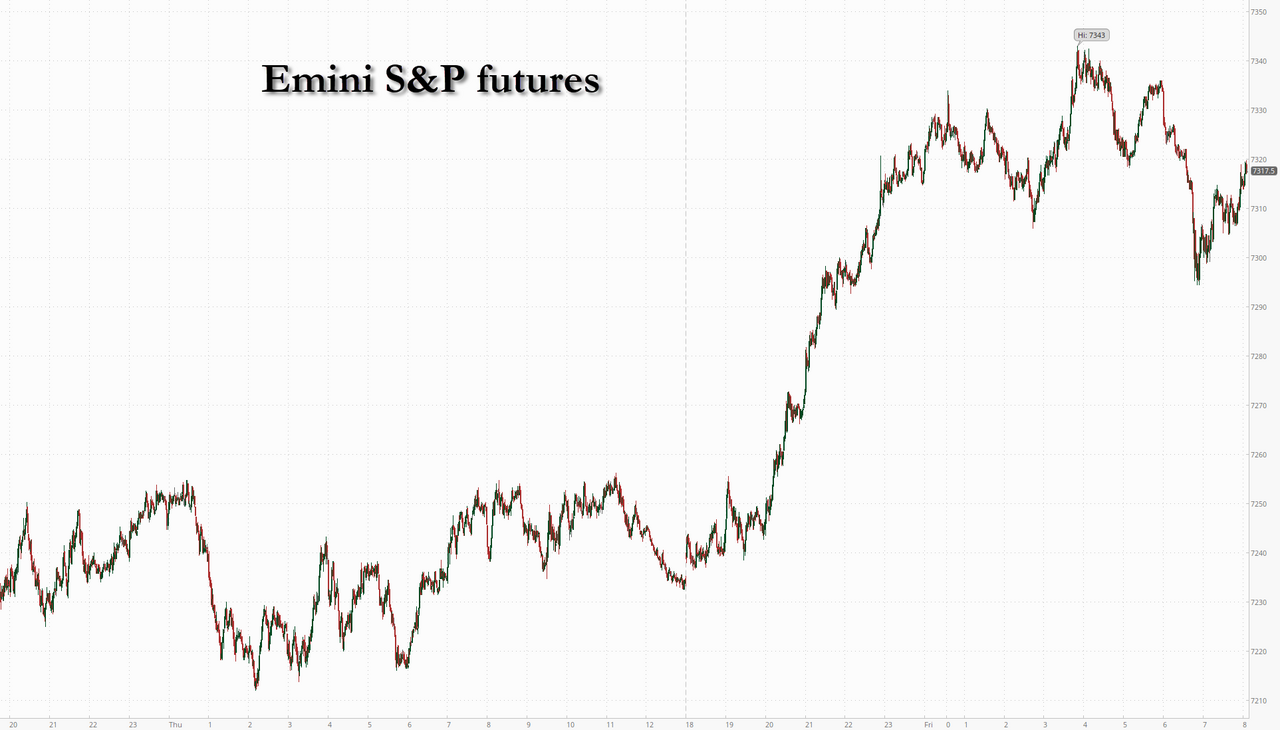
با بازگشت معاملهگران از تعطیلات روز شکرگزاری و مشاهده احیای معاملات هوش مصنوعی، انتشار بیانیه نادر میانوقت شورای دولتی توسط پکن برای ورود «تیم ملی» به بازار، و دور جدیدی از حملات به زیرساختهای انرژی خلیج فارس که قیمت نفت را به چهارمین رشد متوالی رساند، قراردادهای آتی ایالات متحده افزایش یافت؛ در نتیجه اوراق قرضه خزانهداری...
Nasdaq Futures Jump 2.5% In Black Friday Tech Rebound As Beijing Unleashes The "National Team" US futures are higher as traders return from Thanksgiving to find the AI trade rising from the ashes, Beijing unleashing its "national team" in a rare midday State Council statement, and a fresh round of attacks on Gulf energy infrastructure pushing oil to a fourth straight gain; as a result Treasuries slide on reopening, with the 10Y yield up 6bps to 4.92%. As of 8:10am ET, S&P futures are 1.7% higher at 7,320 while Nasdaq futures are up 2.4% and Dow futures are 1.3% higher; Russell 2000 contracts rise 1.5% and the VIX slides to 25. Cash equities trade for just three and a half hours today with a 1pm ET close, so holiday-thin liquidity could amplify moves either way. The rebound builds on Wednesday's dramatic reversal , when the S&P tumbled to 6,970 intraday before closing at 7,183, and Thursday's overnight bounce ; the Nasdaq is still down 8% in November and on pace for its worst month since December 2022. In premarket trading, the Mag 7 is solidly higher with Nvidia (+3.7%) and Meta (+3.8%) leading, while memory and optical names rip: Sandisk +11.2%, Coherent +9.6%, Lumentum +9.3%; at the other end, defensive staples are bleeding (Kraft Heinz, Mondelez, Campbell's all down about 1%), confirming our note on the safety trade losing its fizz . The day's driver is AI (again): sentiment got a lift after Singapore said it is in talks with Washington to keep access to advanced US chips, while Trump said he has not spoken with Jensen Huang yet but probably will soon. In rates, haven demand is reversing as equities stabilize and Brent holds near $97; gilts lag with the 10Y yield up 5bps to 5.20%, while Bunds hold up better after French and Spanish inflation undershot badly. In FX, the dollar is little changed with the DXY in a 103.63-103.87 range; the Aussie leads G10 with a 0.6% gain to 0.6672 while the yen and franc lag. In commodities, WTI rises 2.1% to $85.42 after Houthi militants hit Saudi Arabia's Jazan refinery and Iran claimed a tanker hit a mine near Oman's Ghanam Island while trying to slip through the Strait of Hormuz; metals are on fire with copper posting its biggest jump since January, gold up about 3% near $3,670 and silver up 6.5% above $44. Bitcoin rises 1.4% to about $61,600. US economic data slate includes October advance goods trade balance, wholesale and retail inventories (all 8:30am). There are no Fed speakers ahead of the blackout, which begins Saturday; stocks close at 1pm ET and bonds also close early.
In premarket trading, Mag 7 stocks are all higher: (Meta Platforms (META) +3.2%, Nvidia (NVDA) +2.4%, Alphabet (GOOGL) +2.6%, Amazon (AMZN) +2.6%, Tesla (TSLA) +2.1%, Microsoft (MSFT) +1.9%, Apple (AAPL) +0.7%)
AI-linked stocks (ANT +3.1%, NBIS +7.1%, BE +7.5%) are rallying, continuing a rebound that began in technology stocks on Wednesday.
Altria shares (MO) fall 1.9% after news that the company is considering an offer for British cigarette maker Imperial Brands, potentially in partnership with Japan Tobacco.
Copper mining stocks rose (FCX +5.9%, SCCO +5.2%) as the industrial metal used in data centers surged the most since January, gaining with a rebound in AI-linked stocks.
Vertex Pharmaceuticals shares (VRTX) tumble 7.6% after the FDA delayed its decision on the firm’s application for a drug to treat a rare autoimmune kidney disease.
In other corporate news, Altria and Japan Tobacco are exploring a joint takeover of Imperial Brands, which has a market value of £26 billion, in what would be the biggest tobacco deal in more than a decade (because nothing says "growth strategy" like consolidating a shrinking market); Altria slips 1.4% while analysts eye its AB InBev stake as a funding source. Vertex slides 7.3% after the FDA extended the PDUFA date for povetacicept in IgA nephropathy by up to three months. SpaceX rises 4.6% after Musk said he'll give US children another SpaceX share every year, as we first reported , and Palantir gains 3.6% as Poland signs an agreement with the company today. In Europe, SAP is preparing to cut at least 10,000 jobs in an AI-era restructuring. Meituan posted a second straight quarterly profit with revenue of 115.56 billion yuan topping estimates of 113.37 billion; Uber has secured about 87% of Delivery Hero shares; Japan's Jera aims to build data centers for Anthropic and Meta, per Nikkei; HSBC is consolidating support functions in India; KKR plans to withdraw its take-private proposal for Sankei Real Estate; and Tim Hortons China operator TH International is exploring a stake sale. Meanwhile, Microsoft Outlook users have reported problems since 1:01am ET per Downdetector, not the first such outage this week .
The global story this morning is a relief rally in everything AI after weeks of anxiety: Nasdaq 100 futures are extending Wednesday's recovery, Asian tech surged led by Korea and China (see " China's National Team Sparks A 15% Rip ") China's National Team Sparks A 15%, and European chip names are up for a second day, while investors rotate back out of bonds, reversing the haven trade that dominated earlier in the week . And with gold, silver and copper all ripping alongside equities, the "markets doing what they're not supposed to" award goes to a cross-asset tape where stocks, metals, oil and yields are all rising at once. As we noted yesterday , the Nasdaq narrowly dodged a bear market; today's bounce comes as Goldman's Rich Privorotsky fears AI is becoming self-cheapening .
Some of the fuel looks technical, according to Bloomberg, the Nasdaq 100 flushed below 25,000 on Wednesday before reversing to close near the top of its range, and momentum indicators remain deeply oversold, leaving room for a short-term bounce even as the broader trend stays weak .
“ The rebound can have some staying power after such a sharp correction, but the burden of proof has clearly increased ,” said Santiago Mateo at CaixaBank AM. “The debate is moving from AI adoption to AI economics: whether the extraordinary amount of capital being deployed can generate adequate returns.”
JPMorgan's quant team says its Global Equity Sentiment Indicator is at depressed levels that fundamentals don't yet justify, and strategists including Nikolaos Panigirtzoglou expect AI stocks to recover over the next two months, helped by depressed positioning and continued retail buying , comparing the collapse in breadth and depth to the April 2025 tariff capitulation and the pandemic. The longer-term picture is less rosy: JPM warns slower growth is being masked by strong PMIs, EPS revisions have peaked, and if upgrades keep fading markets could drift to new lows with defensives back in charge.
Mizuho's Evelyne Gomez-Liechti says that if equities keep stabilizing while oil holds its premium, yields have room to consolidate higher , though a break above 5% on the 10Y would probably require either another oil shock or a more durable improvement in risk appetite. CGS International's Angela Cheng is less convinced, telling Bloomberg TV that investors still need to be very cautious since this is likely not the bottom , even if she is optimistic on tech and China.
On the credit side, Bloomberg echoes what we first reported, noting that the gap between Nvidia's equity volatility and its CDS, flagged back in August, has finally closed , with the stock's implied vol catching up to credit about four months late.
Goldman's Rich Privorotsky opens his morning note with Asia, where Beijing finally hit its pain point : domestic stocks had sunk to a 16-month low before the State Council called for a bigger role for Central Huijin , sending the CSI 300 up almost 4%, with copper and gold back on the bid. He points to the reason Beijing may be nervous: consumer loans including mortgages fell by Rmb1.6tn in the first nine months, more than 3x the decline in all of 2025, and mortgage balances are 8% below their 2023 peak. In the US, he says 7,000 on the S&P was the line in the sand : the index fell to 6,970 on Wednesday before closing at 7,183, sentiment is washed out (fear/greed at 15, the Bull/Bear spread at -8, index puts outnumbering calls, VIX near 28), and from here he thinks vol compression can lead spot , with rich December premium giving overwriters a reason to put gamma back into the street; lower vol helps spot, and firmer spot helps vol come in.
On AI, Privorotsky is tactically bullish but has long-term questions he would love to see falsified . The Street models AI efficiency gains as gradual, he argues, yet the evidence suggests running models became roughly 3x to 15x cheaper and faster over the past year, and smarter AI writes leaner code, making the technology self-cheapening. He compares it uncomfortably to telecom in 2000, when traffic exploded as forecast but fiber tech multiplied capacity, bandwidth prices collapsed and the cable-layers got crushed: the danger is not that people stop using AI, it's that compute gets so cheap so fast that data-center capex fails to earn its return , and for Jevons Paradox to save infrastructure ROIC, demand elasticity must exceed the pace of unit-cost deflation. On China chips, he flags the new BIS licensing rule for overseas compute serving Chinese firms, Nvidia telling partners to halt server shipments to Malaysia, Singapore, Thailand and Indonesia, and Asian neoclouds shopping B300 capacity once earmarked for China to Western buyers ( as we discussed earlier this week ); a shift to issuing permits and a more realpolitik stance could do a lot for sentiment . His key tell: AI CDS widened even as stocks got their relief rally, so he is watching broader credit to see whether the bounce has legs; meanwhile levels have held, so let vol compress and let the systematics buy, and the market can overshoot to the upside even with every structural AI worry intact.
Elsewhere at Goldman, Jonathan Luey on the EU vol desk sees a tradeable low around 7,000 on the S&P , after the SPX and NDX retested and bounced off last Friday's panic lows; reclaiming the 200dma near 7,350 would trigger CTA covering and flip dealers flat or long gamma, which he says would go a long way toward healing the tape. Goldman's CTA models show the trend followers max short the Nasdaq 100 and Russell 2000, with first buy triggers about 3% above spot , although a Goldman estimate predating the bounce said systematic investors still had roughly $100 billion of global stocks to sell. Prime brokerage data show AI net exposure as a share of global net exposure at its lowest since September 2025, while Vincent Lin notes last week saw the third-largest weekly increase in hedge fund ETF shorts in a decade. Cosimo Codacci adds that the S&P forward P/E has de-rated 25% this year to 16x even as Q3 EPS grew more than 30% , but cautions positioning is cleaner rather than washed out, with $150 billion of US equity fund inflows in a month, and that it is too early for a Fed pivot with financial conditions about 95bps tighter than the early-September low. Bobby Molavi notes the B-vs-CCC spread hit 8%, something that has happened fewer than five times since 1996, each time with the S&P falling at least 11.5% from its high (this time: 10.7%).
JPMorgan's US Market Intel desk is out until Monday, but its last word (Nov 23) was a shift back to Tactically Cautious, with the team admitting it whiffed on its tactical bull call ; it expects a bounce but no bottom yet, with 2018 the best comp. The International Market Intel team was more upbeat on Thursday, calling for a tactical, technical tech bounce led by US and APAC semis after six straight weeks of hedge fund selling in US semis, while Positioning Intel noted HF net exposure is down more than 30% from its 12-month high, comparable to late 2018 and March 2020, and that the S&P has rebounded an average 6.9% from its pre-December low through year-end in 16 of 17 periods; the catch is the current path most resembles 2007, the one exception . For the bulls' version, see Deutsche's S&P 9,000 call ; for everyone else, Hartnett's bust-or-bubble 2027 .
In Europe, the bond story is about inflation finally cooperating: French HICP slowed to 3.2% in November against 3.6% expected and Spain's to 4.1% versus 4.7%, prompting Goldman to cut its euro-area November headline forecast to 3.74% from 3.89% , even as French Q3 GDP was revised to a 0.2% contraction. Still, the ECB's consumer survey showed 1-year inflation expectations jumping to 3.5% from 3.1%. French bonds await S&P's review after the close, with the OAT-Bund spread holding below 150bps, and Spain votes on Sunday ( our full preview here ), where Mizuho warns a fragmented result or a surprise Sánchez win could widen the 10Y spread to Bunds toward 75-80bps.
In Europe, the Stoxx 600 rises 1% to 643.05, on pace for a weekly gain as investors return to risk after weeks of AI jitters, with 439 members up and 151 down. Mining and technology lead while food, beverage and tobacco lag: ASM International (+5.4%) and ASML (+5.3%) pace the chip names, Glencore (+4.9%) and Anglo American (+4.3%) ride copper's surge, while Sanofi (-2%), Diageo and Pernod Ricard drop. Thursday's session set the tone, with the Euro Stoxx 50 up about 2% for its best day in two weeks on volumes 20-30% below average, according to Goldman's Ioannis Blekos, though Goldman's models still show CTAs long and de-risking in Europe. Rheinmetall cut its 2030 guidance but plans an AI platform with Deutsche Telekom, and Eurozone economic confidence fell to 95.8, below the 97.2 estimate. Here are the biggest European movers:
MP Evans shares rise as much as 13%, the most in six months. The palm oil producer announced a further £2 million in share buybacks and reported strong growth in the second half of its fiscal year.
Bekaert shares climb as much as 9.5%, their biggest jump since April 2025, after the fabricated metals company reported a rise in third-quarter sales and upped its full-year outlook.
Entain shares rise as much as 4.7% after the gambling company’s Australian subsidiary reached a preliminary agreement with the Australian Transaction Reports and Analysis Centre to resolve the civil penalty proceedings commenced against it in December 2024.
Andritz AG rises as much as 3.9% after Goldman Sachs initiated coverage of the Austrian hydropower equipment and services firm with a buy recommendation, citing a backlog of orders and improving revenue visibility.
Hypoport shares pare losses after the company responds to a publication by Germany’s financial regulator BaFin regarding its 2023 financial statements. BaFin’s findings “have no impact whatsoever on Hypoport’s current financial metrics, financial position or ongoing operating performance,” the firm says in a statement.
Elia Group shares fluctuate between gains and losses after the Belgian electricity transmission company lifted its full-year net income forecast and said higher interest rates support remuneration in both Belgium and Germany.
Securitas AB falls as much as 2% after Barclays reinstated coverage of the Swedish security services stock with an underweight recommendation, citing risks for the firm in a transition away from guarding to technology-enabled solutions.
Bachem shares fall as much as 4.4%, extending Thursday’s decline, as RBC downgrades the Swiss producer of peptides to sector perform from outperform, saying yesterday’s capital markets day contained guidance that was well below consensus and RBC estimates.
Asian stocks rallied for a second day and are set for a weekly gain as the AI trade stabilized, with the MSCI Asia Pacific Index rising as much as 2% led by TSMC and SK Hynix. South Korea's Kospi jumped 4.3% to 4,915.68 after a report that regulators are considering expanding the 10.76 trillion won stock stabilization fund, confirming our report that Seoul's plunge protection fund was running low on firepower . Chinese stocks exploded after the State Council reaffirmed its support in a rare midday statement, pledging a bigger role for the national team and Central Huijin, more long-term funds in stocks, and more dividends and buybacks: the Shanghai Composite rose about 3%, ChiNext surged more than 10% and the STAR 50 jumped by double digits, while the Hang Seng gained 2.1% and the Hang Seng Tech index more than 6%. Goldman's Henry Luo notes afternoon turnover more than doubled to Rmb1.1tn from Rmb0.5tn the day before , and that this was the first time "National Team" appeared in a State Council memo. Japan's Nikkei rose 2.1% to 58,711 and the Topix about 1.7% (Advantest +7.1%), while Tokyo core CPI accelerated to 2.9%, a 16-month high but a touch below the 3.0% estimate; markets see roughly a 75% chance of a BOJ hike in December. Japan Tobacco rose more than 4% on the Imperial Brands news, and WiseTech soared as much as 20% in Sydney. Taiwan raised its 2027 growth forecast to 6.51% but set a conservative export outlook on AI buildout concerns.
In FX, the Bloomberg Dollar Spot Index is down 0.1% and the DXY is near flat for the week as the haven bid that lifted the greenback earlier in the week fades. The Aussie leads G10 with a 0.6% gain to 0.6672, its first weekly advance in five weeks, on risk appetite and the metals rebound; the kiwi rose as much as 0.6% to 0.5505, recovering from an earlier drop after official election results confirmed a hung parliament. EUR/USD is little changed near 1.0970, USD/JPY holds just below 159.50 and the yen and franc lag, while the yuan erased losses and USD/CNH broke below 6.66 as the State Council measures improved local sentiment. Goldman's FX desk says its long-dollar bias has eased on negative December seasonality.
In rates, Treasuries slide across the curve on reopening after Thanksgiving, with the 10Y yield up about 6bps to 4.92% and the 2Y at 4.69%, as the equity rebound saps haven demand while elevated oil keeps inflation fears alive ; Treasury futures are down just over 10 ticks but remain modestly higher on the week. Bunds fall for a second day on the retreat from havens but outperform as Dutch TTF slides more than €3/MWh and French and Spanish inflation undershoot, while gilts underperform with the 10Y yield up 5bps to 5.20% at the open. Meanwhile, somebody is betting against the bond rout: an options trade targets the 10Y yield dropping toward 4% by late January. With the Fed's blackout starting Saturday, attention turns to the December 9-10 FOMC, where markets price about 25bps of tightening (because nothing builds credibility like hiking into an equity drawdown).
In commodities, oil is up for a fourth day and heading for its first weekly gain this month: WTI rises 2.1% to $85.42 (in a $83.16-86.60 range) while Brent for January is up 0.2% at $96.80, as escalating attacks on Middle East energy infrastructure and tankers revive supply fears : Houthis attacked Saudi Arabia's Jazan refinery, Kuwait blamed Iran for a deadly drone strike (Tehran denies it), Iran's navy commander said orders are to keep the Strait of Hormuz closed, and tens of millions of barrels of Iraqi crude due to load this month have been delayed. Privorotsky puts the delayed Basrah volumes at 20-30mn barrels, with Asian refiners scrambling for prompt replacements. OPEC+ meets Sunday and has reportedly agreed in principle to keep Q1 2027 output targets unchanged, while Russia extended its jet fuel export ban through March. European gas is lower, with TTF slipping below its 50DMA. In metals, spot gold is up about 3% near $3,670, rebounding from a 15-month low, silver soars 6.5% to $44.25, and LME copper rallies almost 5% back above $12,000/t, its biggest jump since January.
US economic data slate includes October advance goods trade balance, wholesale inventories and retail inventories (all 8:30am). There are no Fed speakers. Cash equities close at 1pm ET and bonds also close early; S&P's review of France comes after the close and the CFTC Commitment of Traders report is delayed to Nov 30. Black Friday kicks off the holiday shopping season, with early spending reads in focus.
Iran claimed a tanker hit a mine north of Oman's Ghanam Island, according to Iranian state broadcaster IRIB: BBG
Tehran-backed Houthi militants attacked Saudi Arabia's Jazan refinery on the Red Sea, temporarily halting some operations: BBG
Russia extended its jet fuel export ban to March as Ukrainian attacks hit its refineries: BBG
US President Trump said approved emergency relief funding for Florida: Newsquawk
Hackers breached a US Air Force cloud computing platform: Reuters
Altria and Japan Tobacco are exploring a potential takeover of Imperial Brands, in what would be one of the biggest UK acquisitions in a decade: BBG
SAP is preparing a plan to eliminate at least 10,000 positions to transform its software business for the AI era, people familiar said: BBG
China's securities regulator CSRC will study new policies to stabilize capital markets: BBG
Brazil's real jumped 2.3% on the open after Trabuco was named finance minister: BBG
Moody's upgraded Vietnam to Ba1 from Ba2, while S&P raised Sri Lanka to B- from CCC+: BBG
Euro-area economic confidence fell to 95.8 in November, below the 97.2 estimate: BBG
Singapore said it is in talks with the US to retain access to advanced semiconductors after Washington tightened export controls: BBG
Taiwan set a conservative export outlook on concerns about the AI buildout: BBG
A more detailed look at global markets courtesy of Newsquawk
APAC stocks were higher as risk sentiment picked up following the holiday lull stateside due to Thanksgiving Day and as authorities in the region continued to pledge support and market stabilisation measures. ASX 200 was led higher by tech and mining stocks, with the latter boosted amid a rally across the metal complex. Nikkei 225 shrugged off early indecision and reclaimed the 58,000 level, with strength seen in semiconductor and heavy industry stocks, while Tokyo CPI data printed softer-than-expected despite an acceleration in the core reading. KOSPI spearheaded the advances in the region from early in the session amid tech strength and with authorities pledging to maintain the response posture of taking market-stabilising measures if needed. Hang Seng and Shanghai Comp advanced with further momentum seen after China's Cabinet pledged to implement existing capital market policies, plan new incremental measures, and strengthen the national team's role in stabilising markets.
Hong Kong is reportedly planning to extend proposed tax breaks to sovereign wealth and pension funds as part of a wider effort to attract global asset managers, according to the FT citing sources.
China’s cabinet said it will implement existing capital market policies and plan new incremental measures, while it will strengthen the national team’s role in stabilising markets and further improve stock market stabilisation mechanisms. Will step up safeguards against imported risks in capital markets. Renew efforts to encourage listed companies to raise dividends and repurchase shares. Will expand Huijin’s role in supporting market stability; Huijin is a unit of sovereign wealth fund CIC. To prepare additional policy measures. Will tailor IPO support more closely to technology companies. To prevent companies from overstating earnings ahead of IPOs.
New Zealand PM Luxon said a strong, stable government would require them to work with the Opportunity Party and that New Zealanders want more cross‑party collaboration, adds negotiations may be challenging and take time.
New Zealand ACT Party leader Seymour said government formation could happen rapidly, while Opportunity Party leader Wong said will speak to the party with the most seats and will talk to National first. Wong said all options are on the table, including cross-benches.
New Zealand's official election results reveal a hung parliament with the National Party on 40 seats and Labour Party on 36 seats, while the National-led ruling coalition fell short of a majority with 65 seats.
Japanese Finance Minister Katayama said supplementary budget will be limited to necessities, adds still in discussions on revised defence strategy.
European bourses (Stoxx 600 +1.0%) are firmer across the board on the final trading day of the week, taking advantage of the thin liquidity with the US still celebrating Thanksgiving (a shortened trading session ahead). Sectors have a slight positive bias. Basic Resources lead, as metals rebound from the recent selloff (Copper +4.9%, Gold +3.2%). Tech and Banks round out the top 3 sectors. To the downside lies Food, Beverages & Tobacco, Optimised Personal Care and Health Care. Key movers include: Rheinmetall, cut its 2030 guidance but plans to develop an AI platform with Deutsche Telekom; Thales, set to acquire a controlling stake in Lumibird; Stellantis, planned further production stoppages at its European plants. US equity futures are set for a stronger open, with the NQ outperforming, +2.3%. The strength is facilitated by a rebound in the tech space, as sentiment gradually improves following the week's hefty sell-off. NVDA +5%, SNDK +10%, IREN +7%.
UK PM Burnham cabinet ally Alexander said EU deal is a floor, not a ceiling, in Brexit reset, according to FT.
European Commission President von der Leyen said a lot of work on the new EU budget still needs to be done.
G10s are mixed against the USD. The Antipodeans outperform given the risk tone, with outperformance in the AUD given the recent rebound in the metals complex. The typical havens (JPY & CHF) hold towards the foot of the pile.
DXY is flat and holds within 103.63 to 103.87 and is near-enough flat WTD. USD strengthened earlier in the week as the risk tone was hit by AI/tech woes but then slipped as the tone gradually improved. US PCE on Wednesday was above expected, but perhaps not quite as high as some had feared. Elsewhere, the geopolitical environment appears to be heating up once again; Kuwait claimed that Iran struck them, though Tehran denied involvement in the attack. Of course, Israel remains in the background with reports indicating their readiness to enter the Iran front with or without the US.
Antipodeans outperform today, given the risk tone and with the AUD buoyed by the rebound in the metals complex; 3M LME Copper +4.9%. The Kiwi has domestic politics to digest. The incumbent centre-right coalition failed to secure a majority, falling short by only one seat. Coalition talks with the Opportunity Party would see a government formed, but there are some major obstacles (related to policy clashes and previous rule outs), which could result in lengthy negotiations. ACT Party Leader Seymour (whose party is currently within the incumbent coalition), said that a government formation could happen “rapidly”; no doubt, lengthy negotiations could weigh on the Kiwi in the short term.
JPY is a touch lower this morning, with USD/JPY holding just shy of 159.50, within a 159.14 to 159.48 range. Pressure today comes from the risk tone, which outweighs a mixed Tokyo CPI report. Headline missed consensus and remained unchanged from the prior reading, whilst core and core-core metrics remained elevated. A report which further backs market expectations for a December hike at the BoJ; markets currently assign a c. 75% chance of a 25bps hike.
EUR is flat on the session. French and Spanish CPI reports were cooler-than-expected, pointing towards a softer EZ reading next week; the German jobs report also spurred little action. On the ECB front, the Survey of Consumer Expectations sees 1yr ahead inflation at 3.5% (prev. 3.1%) and 3yr ahead at 3% (prev. 2.9%). No doubt, respondents will want to see material progress on the Iran front and a sustained downturn in the energy space before winding down their inflation expectations.
BoJ Executive Director Kamiyama said technological innovation offers significant opportunities for money and payments but must be paired with trust, with central bank money remaining an anchor of confidence in the monetary system.
ECB Consumer Expectations Survey: 1yr-ahead inflation expectations rose to 3.5% in October (prev. 3.1%), 3yr expectations rose to 3.0% (prev. 2.9%), and 5yr expectations held at 2.5%. Income growth expectations fell to 0.6% (prev. 1.1%). Economic growth expectations improved to -1.3% (prev. -1.5%). Expected house price growth eased to 3.3% (prev. 3.5%).
European ECB Consumer Inflation Expectations (Oct) 3.5% (Prev. 3.1%).
PBoC conducts CNY 794bln overnight reverse repo operation for a net daily injection of CNY 223bln.
PBoC set USD/CNY midpoint at 6.7075 vs exp. 6.6604 (prev. 6.7096).
A bearish session for the space, with yields lifting alongside energy and the broader risk tone, while the modest FTQ seen at points this week for fixed has faded a touch. It is another limited session in the post-Thanksgiving period.
USTs lower by just over 10 ticks, at a 106-22 base, and while this pullback has erased the action seen above 107-00 earlier in the week, the benchmark remains firmer by a handful of ticks WTD.
EGBs somewhat more mixed, Bunds under pressure given the above, but faring relatively better as Dutch TTF sees downside in excess of EUR 3/MWh at the time of writing. Specifics for the region light. OATs are, by comparison, flat; awaiting S&P's after-hours update.
Currently, S&P scores France at A+/A-1, with a stable outlook. In October 2025, the rating was lowered due to fiscal uncertainty and an expected slowdown in the pace of budget consolidation. These items have only been exacerbated in the period since, and thus an outlook cut would not necessarily be a surprise; albeit, the OAT-Bund 10yr yield spread continues to hold below 150bps, despite the upcoming risk event.
Gilts in-fitting, at an 86.41 low, down by over 30 ticks as things stand. Specifics for the region, unsurprisingly, light, and as such the broader tone is dictating. Next week is also relatively quiet for the UK docket, therefore, it may be an opportunity for more scrutiny over the EU-UK preliminary agreement.
Japan sold JPY 499bln of 10yr, 20yr and 30yr JGBs in enhanced liquidity auction; b/c 3.89 vs. Prev. 3.77. Highest accepted spread -0.013% vs. Prev. -0.007%. Allotment of bids at highest spread 93.0649% vs. Prev. 87.9293%.
Australia sold AUD 1.0bln in 1.75% November 2032 bonds avg. yield 4.5776%, b/c 2.79.
Crude benchmarks are firmer, with WTI outperforming as it catches up after Thursday's Thanksgiving holiday, when there was no settlement. Prices are underpinned by the ongoing Middle East tensions: reports of a suspected Iranian drone attack on Kuwait remain in focus (Iran denied conducting any operations), while the Iranian Navy Commander said orders are to keep the Strait of Hormuz closed, according to Al Mayadeen.
WTI Jan'27 trades within a USD 83.16-86.60/bbl range (vs yesterday's USD 83.16-85.23/bbl range); Brent Feb'27 moves within USD 91.84-93.17/bbl (vs yesterday's USD 89.75-92.08/bbl range). Ahead, OPEC+ meets on Sunday, and has reportedly reached an agreement in principle to keep oil production targets unchanged in Q1 2027, sources say. Separately, the US administration is said to have urged Venezuela and Iraq earlier this year to consider exiting OPEC, Reuters reports citing sources.
Dutch TTF is lower within a EUR 83.93-88.66/MWh range (vs yesterday's EUR 86.39-89.62/MWh range), slipping beneath its 50 DMA at EUR 84.75/MWh, without a clear fresh catalyst and with selling potentially exacerbated by the Dec'26 contract's expiry today. As a reminder, prices fell on Wednesday after temperature forecasts turned milder and Norwegian exports to the continent were expected to rise, while EU storage remains low at c. 68% full.
Spot gold is sharply higher (+3.2%) within a USD 3,558-3,681/oz range (vs yesterday's USD 3,551-3,607/oz range), resuming its rebound from a 15-month low as momentum picked up across the metals complex once LME and Shanghai trade got underway, alongside the improved risk sentiment. The yellow metal remains beneath its 21 DMA at USD 3,834/oz. Spot silver leads the advances (+7%) within a USD 41.35-44.59/oz range (vs yesterday's USD 38.20-41.47/oz range), while platinum and palladium are also sharply higher.
3M LME copper rallies (+4.9%) within a USD 11,840.20-12,608.52/t range (vs yesterday's USD 11,826.00-12,092.53/t range), back above USD 12,000/t amid the broader momentum in metals and the positive risk tone. China's Cabinet pledged to strengthen the national team's role in stabilising markets, while Chinese Industrial Profits rose 20.1% Y/Y in October (prev. 14.4%).
OPEC+ has reportedly reached an agreement in principle to keep oil production targets unchanged in Q1 2027, sources say.
Iran and Turkey have reportedly extended their natural gas deal.
US administration is said to have urged Venezuela and Iraq earlier this year to consider exiting OPEC and blocked Venezuela’s membership fee payment, according to sources. The Trump administration reportedly encouraged Venezuela and Iraq to consider leaving OPEC and blocked Venezuela’s membership dues, Reuters reported citing sources. Washington sought greater oil production and investment, including by Chevron (CVX) and ExxonMobil (XOM), amid concerns over OPEC quotas. Saudi Crown Prince Mohammed bin Salman reportedly intervened to halt pressure on Venezuela, while Iraq’s oil ministry opposed withdrawal.
Russia extends jet fuel export ban through March 2027, according to IFX.
Indonesia may hike subsidised fuel prices in 2027 to ease fiscal pressures, although no final decision has been made yet, according to sources.
Japan is to impose anti‑dumping duties on bisphenol A from South Korea, Taiwan and China Steel.
India’s Trade Minister Goyal said a trade deal with the US is nearing completion, with the process and pathway that had delayed finalisation now taking shape.
Iran and Turkey have reportedly extended their natural gas deal.
Saudi fighter jets reportedly struck a fuel storage tank in Yemen's Saada, causing a fire, Tasnim reported citing Yemeni media.
Houthi media reported three airstrikes on Al‑Mokha district in Yemen’s Taiz Governorate, according to Al Jazeera.
US President Trump said he spoke with Israeli PM Netanyahu regarding Iran and warned of targeting Pickaxe Mountain if no agreement is reached.
US President Trump said most of the meeting with NATO Secretary General Rutte was about Russia and Ukraine, but also discussed Iran and Greenland, adds he believes that Russian President Putin would like to see the war end. He doesn't know if Russian President Putin will come to the G20 and that he would like Putin to attend the G20 if it were up to him. Spoke to Rutte about US troops in Europe.
US President Trump said the US is carrying out the greatest naval blockade in history and vowed continued Marine deployment in the Middle East, while he said he is not sure if Iran will seize the opportunity we're giving them to reach an agreement. We are trying to be flexible and give #Iran every chance to reach an agreement and save many lives.
Russia extends jet fuel export ban through March 2027, according to IFX.
Russia's Defence Ministry said they struck a vessel carrying military cargo in the Black Sea.
Drone attack injures three in Russia's Black Sea port of Novorossiysk.
Iranian Navy Commander said orders are to keep the Strait of Hormuz closed, Al Mayadeen reported.
IRGC has reportedly forced a US F-16 to leave Iranian airspace, fired warning shots at it.
Israeli artillery reportedly targeted Qantara and eastern Zawtar in southern Lebanon.
Explosion reported on a vessel near Oman’s port of Khasab, according to unofficial sources cited by Tasnim.
Latvian army said threat in airspace over Ludza municipality has ended.
Latvia's army issues airspace threat alert for eastern Ludza region.
Bitcoin is a little firmer and trades around USD 61.5k; Ethereum is a little firmer and holds around USD 1.7k.
8:30am: Oct Advance Goods Trade Balance, est. -$136.0b, prior -$134.9b (revised -$135.1b)
8:30am: Oct P Wholesale Inventories MoM, est. 0.5%, prior 0.7%
8:30am: Oct P Retail Inventories MoM, est. 0.3%, prior 0.3% (revised 0.4%)
8:30am: Oct Advance Goods Exports MoM, est. 1.1%, prior 2.6% (revised 2.5%)
8:30am: Oct Advance Goods Imports MoM, est. 2.0%, prior 2.4%
Happy Black Friday to those who celebrate. I hope the bargain you never knew you needed finds you today. I'm in a very cold Amsterdam after the DB annual outlook that's been running every Thanksgiving for as long as I can remember. It certainly doesn't feel like an El Niño winter at the moment, especially when I look at the webcams of where we'll be skiing over Xmas. There's more snow in the Alps at the moment than AI capex in Silicon Valley!
With Silicon Valley and the rest of the US on holiday yesterday, markets have been experiencing a quiet 24 hours. Without the US in it's difficult to take too many conclusions from the price action but there have been some signs that the tech selloff has stabilised for now, and that risk appetite is returning to markets. We’ve had a decent equity rally, with a sharp rebound in tech stocks pushing Europe’s STOXX 600 (+1.75%) to a one-week high and S&P 500 (+1.79%) and Nasdaq (+2.75%) futures rallying this morning with the former only up around +0.5% for most of yesterday’s European session, so the rally has accelerated overnight. Indeed the KOSPI (+4.81%) is continuing its wild ride with the Nikkei (+1.99%) also posting strong gains and 10yr US Treasuries are +6.4bps to just below 4.92%.
Even as I type Chinese equities are suddenly seeing a big pop higher after the State Council signalled renewed support for the market, including a bigger stabilising role for state-backed funds , measures to draw more long-term capital into equities, and encouragement for companies to increase dividends and buybacks. The Shanghai Composite is +2.95%, rising more than 2.5% since the announcement, while the tech-heavy Star 50 has jumped around 11%. This is also helping the Hang Seng (+2.17%).
Meanwhile, data released earlier this morning showed Tokyo’s core inflation accelerated to 2.9% year-on-year in November from 2.6% in October, marking its fastest pace in 16 months. That was inline with expectations, but headline inflation was three tenths below expectations at 2.8% and core-core two tenths below at 2.5%.
This all follows a good session in Europe yesterday with the risk-on tone clearly back. In fairness, much of that was a catch-up to the US recovery late in the previous session. But the rally gained steam in the afternoon, and the STOXX 600 (+1.75%) closed at a one-week high. Moreover, tech was the strongest sector in the index, and the strongest industry group within that were semiconductors & semiconductor equipment. So it was clear that the most AI-exposed assets were outperforming, and the financial stress was easing on multiple fronts.
That backdrop meant European bond yields moved higher, particularly at the front end as investors priced more hikes from the ECB. In part, that followed the latest ECB minutes, which had several hawkish undertones. For instance, they said that a “large number of members” could have supported an October hike, and it commented that “further tightening was likely necessary”. So alongside the recovery in AI stocks, that meant investors priced in more ECB rate hikes for the months ahead, with 2yr yields in Germany (+3.3bps), France (+0.8bps) and Italy (+1.3bps) all moving higher. Then further out the curve, the 10yr bund yield was only up +2.3bps, whilst 10yr OAT (-1.3bps) and BTP yields (-2.6bps) actually fell, consistent with the wider risk-on move. So that left the Franco-German 10yr spread (-3.6bps) at its tightest in two weeks, at 148bps.
Whilst all that was happening, it’s worth highlighting a new piece here from Mark Wall and Michael Kirker on the major overhaul
منبع: ZeroHedge — متن کامل از فید رسمی منبع، با ترجمهی ماشینی عنوان و خلاصه
گفتوگو