مایکروسافت در پی گسترش تبعات دیتاسنتر پس از انتخابات، اجاره هوش مصنوعی اورکل را متوقف کرد
اخبار بد بیشتری برای Oracle. حدود یک ساعت پس از آنکه با تیم روابط عمومی اورکل بررسی کردیم که موضوع «قوه قهریه امری عادی است» چگونه پیش میرود... پاسخ خود را دریافت کردیم، البته نه از سوی اورکل: به نظر میرسد نه...
Microsoft Pulls The Plug On Oracle AI Rental As Post-Election Data Center Fallout Spreads More bad news for Oracle.
About an hour after we checked in with Oracle's PR team on how that whole " force majeure is commonplace" thing was working out...
— zerohedge (@zerohedge) November 6, 2026 ... we got our answer, just not from Oracle :
*MICROSOFT IS WINDING DOWN ORACLE DEAL TO RENT AI CLOUD CAPACITY https://t.co/2MizsjS9yq
— zerohedge (@zerohedge) November 6, 2026 According to Bloomberg , Microsoft has spent recent months switching off the computing capacity it rented from Oracle after declining to renew the contract. The reason is about as unflattering as it gets for a company that has staked its balance sheet on AI infrastructure: the Oracle hardware ran on older-generation Nvidia chips and, over time, "no longer fit the company's specifications."
ORCL promptly slid 4%, which put it, in our words, below the $116 equity offering price it sold $10 billion in stock at just four days ago. Recall that the stock hit $248.15 on June 1. Investors who bought the "de-risked" story this week are already underwater on a deal that is barely four days old , and the stock has lost more than half its value in five months.
But the Microsoft headline is just the latest entry on a list that has grown every single day since Tuesday night, when voters handed governors' mansions in the states holding roughly 45% of planned US data center capacity to candidates who promised to pause them. Put the two together and Oracle has a problem at both ends of its pipeline: its old capacity is too old to rent , and its new capacity may be too blue to build .
Some history first. The Oracle-Microsoft deal was announced in 2023 to power the AI version of Bing, and at the time, Bloomberg notes, the idea of Microsoft renting servers from a direct rival was taken as early proof of just how short the world was of compute. (The full size of the deal was never disclosed.)
Three years later, the same arrangement is proof of something else: GPUs age, and the biggest buyer of rented compute in the world is no longer willing to pay for the old ones.
Oracle, naturally, disagrees. A spokesperson told Bloomberg demand for its AI infrastructure "remains strong, including for earlier-generation" GPUs, and reminded everyone that in September it said it was renewing contracts for four-year-old GPUs at a 20% premium to the original price. That 20% premium has been a staple of the bull case: just this Wednesday, Wells Fargo's Jerry Revich, in " Texas Policy Reset Adds Timing Risk to 20-30% of the Data Center Power Pipeline " ( available to pro subs ), cited Oracle's 97.9% AI infrastructure utilization and "20% average renewal/resale premium" as evidence that "token economics remain attractive."
Microsoft's retreat also fits a pattern we have been tracking for weeks. Microsoft committed more than $80 billion to rent capacity from neoclouds like CoreWeave, Nscale and Nebius, and per Bloomberg, key leaders there have grown frustrated over high costs and delays, tightened oversight of data center projects and debated whether to sign any new neocloud deals at all. In October, Microsoft walked from Nscale's UK deal ; on Thursday came the report that it won't expand its Texas deal with Nscale either , along with the disclosure that it spent $5 billion less on Q3 capex than projected due to delays at third-party capacity, including IREN's.
Translation: Microsoft wants new chips, on time, in its own specifications, and it is increasingly unwilling to pay landlords who can't deliver all three. Which is a problem for every landlord whose collateral is a rack of chips that gets one generation older every year the power doesn't show up.
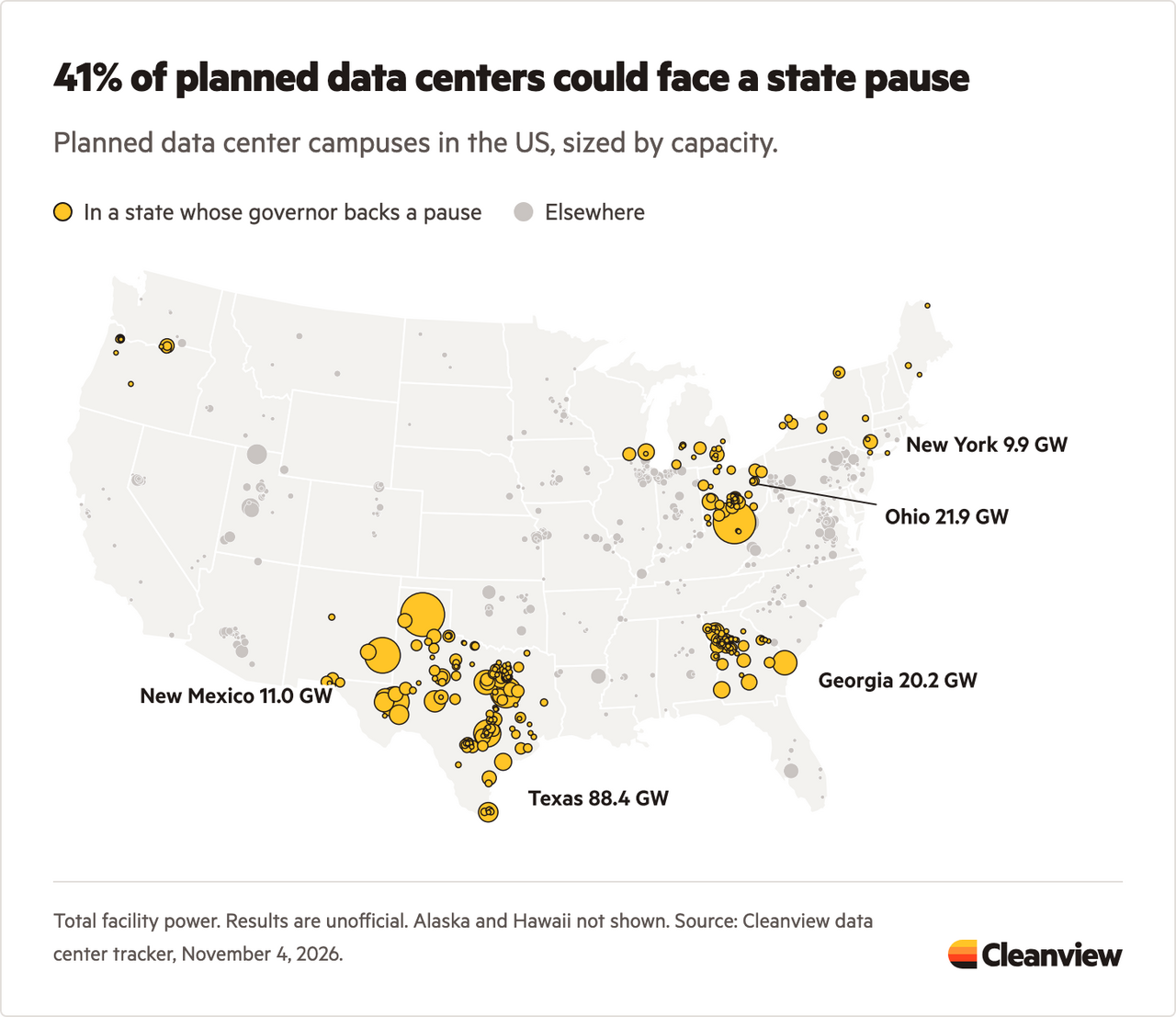
Cleanview counts nine states where the governor or governor-elect has promised or already imposed a pause on new data centers. Together they hold 158.6 GW of planned capacity, or 41% of the entire US pipeline :
Now look at who is most exposed. Every single gigawatt of OpenAI's planned capacity sits in a state whose new governor backed a pause on the campaign trail , as does 45% of Microsoft's:
Why does that matter for Oracle? Because OpenAI is Oracle. The $300 billion compute contract that sent ORCL soaring in September 2025 is being built across Texas (Abilene, Shackelford County), New Mexico, Wisconsin and Michigan, which is why OpenAI shows up at 100% above. Two of those states, Texas and New Mexico, delivered the most hostile results of the night.
Take New Mexico, home of Project Jupiter, the 2.45 GW Oracle-OpenAI Stargate campus that regular readers know all too well. Back on Sept 24 Oracle sent a force majeure notice to the Blue Owl unit developing the site, then insisted the notice was "commonplace" and meant nothing. We had a different reading at the time:
Hey guys, you are right: the force majeure by itself does not change delivery expectations. You just have to pay the rent until the delivery actually takes place. Contractually. https://t.co/GCPReT1OOt pic.twitter.com/rj721cRTu9
— zerohedge (@zerohedge) September 25, 2026 The more important detail came that night, when the FT reported that Oracle remains on the contractual hook regardless: if Jupiter isn't ready, Oracle still owes a "carry cost" in lieu of rent for up to three years, enough to cover the interest on the debt in full plus a set equity return for Blue Owl's funds. As one person familiar with the contract put it, "The power delivery risk sits with Oracle, not the investors." Here is the structure we mapped out at the time. Note who sits at the bottom of every arrow:
And for the record, here is what we wrote in that same Sept 24 post , six weeks before the vote: the construction delays "will only get worse if Democrats win back the house at the midterm elections." They won back a lot more than the House, so we'll allow ourselves a modest victory lap.
Two weeks later, Oracle was trucking compressed natural gas to its data centers because the Jupiter pipeline was running late, and the $18 billion of construction loans behind the campus were already quoted at 89-91 cents on the dollar (per the FT).
On Tuesday, New Mexico elected Deb Haaland, and the morning after, she told reporters her plan for day one : "a moratorium for large-scale data centers with the legislature passing a set of guardrails." As for Jupiter's gas plants specifically, Cleanview notes Haaland has written that under her watch they would "not exist." The fuel-cell air permit is still pending, with a Nov 23 decision deadline. Hey guys, any updates?
Texas is no better. As we laid out in " What's Next For Data Centers After The Blue Tsunami ", governor-elect Gina Hinojosa turns Abbott's audit-based freeze into one tied to legislation, which means at least through the May 31, 2027 session end. And the Goldman TMT desk noted this morning that part of today's bounce came from "benign comments from Texas governor-elect on datacenters." When "benign" is the bull catalyst, you know where the bar is.
Goldman's research department spent Friday pushing back on the panic, and in fairness, it has the numbers. In his " End of Week Market Intelligence: dc downside ?" ( available to pro subs ), Chris Hussey frames this week's debate as follows:
"At the core of market concerns this week is a debate around whether all of the compute power that has been ordered (semiconductors, servers, fiber optic cables) will have a place to be installed when it is delivered in the years ahead ."
Goldman's answer is mostly yes, at least through 2027. Hardware analyst Mike Ng " US Data Center Capacity update: Framing risks to our data center forecasts ", also available to pro subs) says capacity already under construction implies 22/24 GW-IT of net additions in 2027/28, matching his 20/24 GW forecasts, and calls the key risk "timing rather than cancellations." The catch is Texas, which accounts for 20% of 2027 and 27% of 2028 under-construction additions:
E&C analyst Adam Bubes went a step further and actually raised his US data center construction spending forecasts to $80 billion/$100 billion for 2026/27 (from $67 billion/$87 billion), introducing $125 billion for 2028. His reasoning: every project in Goldman's 2027 forecast has already broken ground. 2028 is another story, though: only about half of the 2028 projects on Goldman's watch list have broken ground , and beyond that it's almost all PowerPoint:
Note the light blue. That is the "announced" capacity, and it is exactly what a governor's moratorium hits first. Bubes concedes as much, arguing moratoria "would primarily impact projects that have not yet started" and would smooth the cycle into 2029/30 "rather than impacting the TAM."
Maybe. But today's Microsoft story shows why "timing" is not as harmless as it sounds. A project that slips two years gets delivered into a world where the chips ordered for it are two years older. For a hyperscaler, a delay is a timing issue. For whoever owns the GPUs, it's a depreciation issue. Microsoft just told Oracle which one it is.
And somebody is going to have to fund the wait. Goldman credit strategist Amanda Lynam estimates hyperscalers are financing 36% of this year's capex with credit (and 35% next year), while only 43% of the $687 billion of AI-related financing so far this year came from hyperscalers. Oracle has already done its share: as we noted on Monday, it blew through its entire four-year $20 billion "hard cap" in a single morning, five days after promising it. Which, as regular readers know, is why we have been calling AI a debt bubble since last October.
The Oracle news landed at the end of a week that saw the Nasdaq suffer its worst day since March 2020 on Thursday (-6.4%), while Goldman's AI data center-levered basket fell 12% in a single session. The headlines since then haven't helped much:
ING was said to be selling a $500 million data center loan portfolio (Thursday);
Bloomberg reported this morning that the ECB is mulling a review of bank loans to data centers , following the Bank of England's own probe last year;
and Nomura's Ting Lu argued that China's AI buildout "may benefit significantly" from a blue wave that slows US data center construction. Somewhere in Hangzhou, a capex budget just got revised higher.
Here is the updated ZH Casualty List , with Oracle as the newest entry:
Jefferies' Julien Dumoulin-Smith summed up the sellside consensus on the election in one line " The Blue Morning After: State-by-State Election Scorecard "): "Demand moves right, not away." Goldman says the same thing with more charts.
Perhaps they're right about demand. But capacity that moves right ages , financing that moves right costs more , and a landlord that moves right keeps paying for the slip (just ask Oracle's lenders on Jupiter). Today's Microsoft story is the first clear sign of what happens at the other end: the tenant with the deepest pockets in AI is choosing newer chips over older contracts , and that probably makes Oracle's 20% renewal premium look a lot more like an exception.
Which leaves Oracle squeezed on both sides: the older chips it already owns are losing their best renter, while the new campuses meant to replace them sit in exactly the states that just voted for a pause. Goldman hosted Oracle management today, of all days; we'd love to know what was said in the room. Until then, we'll keep asking the obvious question:
If Oracle has cash flow visibility all the way to 2029 maybe they can answer something far simpler: when will the force majeure on their massive NM data center be lifted?
— zerohedge (@zerohedge) October 29, 2026 Much more in the full Goldman " End of Week Market Intelligence: dc downside ?", and " US Data Center Capacity update " both available to pro subs .
منبع: ZeroHedge — متن کامل از فید رسمی منبع، با ترجمهی ماشینی عنوان و خلاصه