پس از سنگینی عرضه اولیه Anthropic و تبدیل شدن تعدیل هوش مصنوعی به یک ریزش جهانی، معاملات آتی سقوط کرد
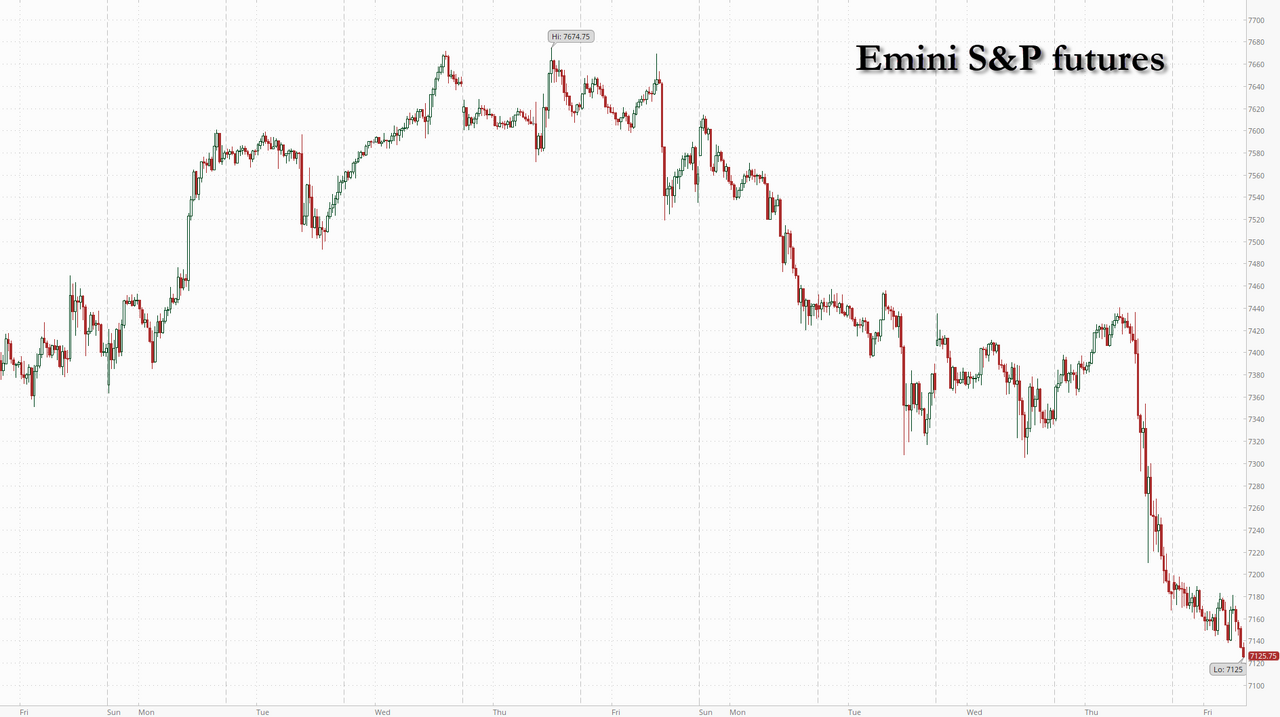
قراردادهای آتی ایالات متحده برای دومین روز کاهش یافتند؛ زیرا روند خروج از سهام هوش مصنوعی به یک فروش سراسری جهانی تبدیل شده است. سهام آسیایی بدترین هفته خود را از زمان سقوط ناشی از کووید در مارس ۲۰۲۰ تجربه کردند.
Futures Tumble As Anthropic IPO Hangover Turns AI Unwind Into Global Rout US futures are lower for a second day as the AI unwind turns into a global liquidation: a day after its record-setting debut, Anthropic is sliding in premarket trading as the biggest IPO ever turns into a sell-the-news event , Asian stocks just suffered their worst week since the Covid crash of March 2020 with Taiwan posting its worst week since 1991, and Europe is heading for its worst week since March; as a result, haven assets are bid across the board and the 10Y yield has slipped below 5% to 4.98%. As of 8:00am ET, S&P futures are 0.9% lower while Nasdaq futures slide 1.9% and Dow futures are down 0.4%, after the S&P fell 2% on Thursday to 7,175.83 for a sixth straight drop, its longest losing streak since April 2024, with 464 members down (the most decliners this year) and the VIX closing at 28.44, the highest since March. When (not if) we get a 7th fall today, that would make it the longest run of declines since the pandemic slump began in February 2020. In premarket trading, Anthropic crashes about 10% after soaring 17% on day one (when, as we noted , nearly half of the record retail volume was selling), Intuit plunges 9% after cutting its revenue outlook on the agentic AI threat to Credit Karma, and the Magnificent Seven are mostly lower, with Nvidia down 2.3% and Meta down 1.9% while Apple rises after Bloomberg reported it is building its own AI agent. The day's driver is AI (again): the hope that Nvidia earnings and the Anthropic listing would clear the decks is gone, and the selloff now spans chips, copper, gold and Asian EM. Treasuries rally across the curve on haven demand and a softer oil tape, with the 10Y down 7bps to 4.98%, while Bunds and gilts gain as well. The Bloomberg Dollar Spot Index is down 0.1% as the yen jumps 0.5% to about 158.9 per dollar on haven flows. Brent slips 0.6% to about $91.40, gold drops another 1% to around $3,588, near a 14-month low, and copper sinks to its lowest since March. Bitcoin trades around $61,800, near its lowest since early July. US economic data slate includes the final November University of Michigan sentiment and inflation expectations (10am) and the Kansas City Fed services survey (11am); Fed speaker slate includes Waller (8:25am) and Cook (12:15pm), and President Trump holds a press conference at noon after his Asia trip.
In premarket trading, Mag 7 stocks are mostly lower: (Apple (AAPL) +0.2%, Alphabet (GOOGL) -0.2%, Microsoft (MSFT) -1.6%, Amazon (AMZN) -1.7%, Tesla (TSLA) -2%, Meta Platforms (META) -2%, Nvidia (NVDA) -2.8%)
Anthropic (ANT) shares fall 10% on their second day of trading as the unwinding of the global AI trade overshadowed the optimism that had fueled a rally on its record-setting debut.
Gap (GAP) rises 3% after the apparel company reported better-than-expected revenue trends at both Old Navy and the core Gap brands, offsetting the weaker performance for other segments and a lowered year sales outlook.
Humana (HUM) climbs 2.5% and UnitedHealth (UNH) rises 1% after TD Cowen upgraded both health insurers to buy from hold, citing improved outlook as well as potential for further upsides.
Intuit (INTU) tumbles 9% after the software maker cut its full-year revenue forecast, driven by weak performance in Credit Karma, a personal finance platform that’s under increasing threat from agentic AI tools.
Ross Stores (ROST) falls 4% after the discount retail firm gave weaker-than-expected guidance for the fourth quarter, as higher costs continue to eat into corporate profits.
In other corporate news, Intuit's bad day comes with a consolation prize: Bending Spoons agreed to buy Mailchimp from Intuit at an enterprise value of about $3.68 billion. SpaceX sold $32 billion of bonds at yields topping 8% to pay for AI chips, a complex deal that may become the template for a wave of similar financings (because nothing says "peak cycle" like 8% paper to buy GPUs). DayOne Data Centers, whose biggest customer is TikTok owner ByteDance, put its multi-billion dollar US IPO on hold. Apple is developing an autonomous AI agent that can perform tasks for users, putting it in direct competition with Anthropic, OpenAI and Meta. California is investigating whether Nvidia's actions allowed advanced chips or confidential information to reach China, while The Information reports Nvidia is in advanced talks to buy Inception. Sanofi is said to be weighing an acquisition of Insmed, EQT agreed to buy Australia's Pickles Auctions, and the Advent/FedEx consortium finalized its InPost takeover. Gap rose after saying demand improved after a soft October, while Ross Stores fell on weak fourth-quarter guidance and Procter & Gamble plans to cut its manufacturing and logistics workforce by 20% to 30% by the end of the decade.
Every major asset class is now trading off the same shock: the unwind of the AI trade . AI equities are plunging, copper is falling on demand-destruction fears, gold is being sold to cover losses elsewhere, and the dollar and Treasuries are catching haven flows. What began as an AI valuation correction is now a global rout, Bloomberg's Neil Campling writes, and today will test whether investors are willing to rebuild gross exposure at all . A week ago, strong Nvidia earnings and a successful Anthropic debut were supposed to remove two big overhangs; instead the S&P has fallen six days in a row, and the US cash open itself has become a risk event on the scale of payrolls or CPI, Campling adds. Not that the warnings were lacking: the skeptics were lining up before the Anthropic debut, and Nomura's McElligott warned that if stocks can't rally with every systematic buyer primed to buy, it is not a positioning problem.
Bloomberg Economics' Anna Wong went further, arguing that the Anthropic IPO may mark the end of the AI trade because public-market scrutiny will expose cracks in the AI platform business model, starting with pricing power that is weakening rather than strengthening.
Barclays strategists led by Emmanuel Cau see the AI-driven selloff as overdone, but they say the bigger problem for equities is the absence of a perceived Fed backstop , and they draw a parallel with December 2018, when stocks fell about 20% before the Fed pivoted. Cue our 2018 playbook .
Monex trader Tsutomu Soma notes that because the US is the AI epicenter, the equity selloff is led by US stocks and that is dragging the dollar down , while the yen is being bought as a haven. Meanwhile, the Nasdaq 100's recent break below its 200-day moving average is now the more important test of whether the selloff has further to run, Bloomberg's Equity Insights team writes, overshadowing the S&P's shallower breach. Nothing good happens below the 200DMA, as we said earlier this week.
Goldman's Rich Privorotsky admits that, for many including himself, the week's catalysts were supposed to be supportive, but "instead we got a pretty violent liquidation." He points to the new BIS chip-export rules that took effect on Nov. 19, which tighten direct chip sales to China and, crucially, try to close the offshore compute loophole by covering advanced compute that Chinese entities access remotely through overseas data centers. The immediate issue is not the permanent loss of Chinese demand, he argues, but uncertainty over who can access what and under which licensing regime, which may be enough to freeze incremental investment. That helps explain the acute weakness in the Asian data center trade, with possible knock-on effects into copper and gold. Technically, the S&P reversed 3.3% intraday and took out almost every support level, with only 38 constituents up, and negative gamma into expiry likely amplified the move. More disturbing to him was the failure of the defensive bid , as utilities and staples sold off too, so that a rolling rotation now looks like outright equity liquidation. On macro, he says financial conditions have tightened extraordinarily quickly (with Waller's 50bp comments a shock), that the November/December 2018 parallels feel increasingly close, and that 2-year breakevens collapsing toward their lows leave real yields near highs just as equities signal weaker growth; the long end may already be pricing a policy mistake. His bottom line: the market likely pivots when central banks pivot ; receiving rates and owning duration remains attractive, and while the depth of pessimism and one-sided de-grossing hint at a tactical local low, the calendar is light until PCE next Wednesday, NFP and the December FOMC.
Goldman's Tony Pasquariello puts the damage in context: Nvidia's market cap has gone from a $5.75 trillion high to $3.5 trillion, US financial conditions are the tightest in 18 months, and the bond market discounts three more hikes over the next year. Positioning is washed out, with hedge funds net selling single stocks for nine straight weeks, the most underweight tech in five years versus MSCI ACWI, and CTAs meaningfully short NDX futures. He also notes that IT forward P/E has fallen from 24x to 16x over nine months while EPS rose 64%, the opposite of 1999-2000, as the market treats AI as a cyclical boom and wonders if we are over-earning . GS Prime data show Asia net leverage at the lowest in a decade and US net leverage below the 2nd percentile, while the derivatives desk notes spot VIX is more than 4 vols over the front-month future, the most inverted since April 2025.
JPMorgan's Market Intel desk notes that Thursday's premarket rally fully reversed and that the week's losses now span every sector, from about 2% in utilities to 7% in energy and staples. Ron Adler, co-head of JPM global high-touch trading, sums it up: "If everyone wants a clearing event, one might happen. If everyone needs one, it won't." Adler says it is a mistake to separate Thursday's trading from the AI story because "this is the same trade and has always been the same trade" , and he struggles to find a compelling reason to buy given rates, sticky inflation, slowing 2027 EPS growth, geopolitics and a divided Washington. The desk's published view (from Nov. 16) remains Tactically Bullish, arguing positioning is cleaner and entry points more attractive.
Commenting on the overnight selloff, “The midterm elections, Nvidia's strong results and Anthropic's successful IPO have all failed to serve as clearing events,” said Robert Scholtes at Singular Bank. “Technical selling pressures will likely need to run their course, potentially setting the stage for a short squeeze that could mark a bottom.”
“This looks less like an AI fundamentals crisis than a combination of crowded positioning, scarce liquidity and end-of-year fatigue... In the shorter run, simply exhausting the forced selling could be enough for a technical rebound,” said Florian Ielpo at Lombard Odier. Bloomberg macro strategist Skylar Montgomery Koning added, “When good news stops working and selling itself keeps investors from reengaging, it's hard to see what breaks the cycle.”
In Europe, the Stoxx 600 is down 1.2% at 630.93, with 464 members down and 128 up, as renewed doubts about the durability of the AI boom put the index on track for its worst week since March and on course to erase all of its gains for the quarter. Technology and industrial goods and services lead the declines, with European tech down for a seventh straight session, the longest losing streak since January 2022; ASML is down about 5.5% while personal care, food and health care are the only sectors in the green. JPMorgan says semis, electrification, momentum and software are among the worst baskets while defensives are modestly higher, and Goldman's EMEA desk notes European semis are down about 6% with hedge fund and long-only supply in ASML and Infineon (even as hedge funds keep shorting food, tobacco and household products). Privorotsky's broader point applies here too: the defensive bid is not providing absolute protection . Polish stocks drop after Russian missiles and a drone fell on Polish soil, while on the data front UK retail sales jumped 0.7% in October (vs. 0.0% expected) as Brits stocked up on emergency supplies and German PPI ran hotter than expected. The UK and EU said they reached a deal on closer ties ahead of Friday's summit.
Benefit Systems jump as much as 8.9%, hitting a record high, after the Polish fitness-center operator surpassed expectations with its 3Q results and gave an upbeat outlook for the rest of the year and 2027.
Freenet climbs as much as 3.4%, the most in more than a week, as Barclays upgrades the mobile service provider to overweight from equal-weight, seeing a more positive operating outlook ahead.
Sanofi shares are up as much as 1.7%, recovering some of yesterday’s 2.9% drop after the French drugmaker was said to be weighing the acquisition of US-based Insmed.
European tech shares fall for a seventh straight session, the longest losing streak since January 2022, tracking declines in US and Asian peers as doubts over the AI trade persist, overshadowing Anthropic’s trading debut.
UniCredit shares outperform their European peers after Deutsche Bank raised its recommendation on the Italian lender to buy from hold, citing a strong outlook following third-quarter results that are seen as a turning point.
Ubisoft declines as much as 15%, briefly hitting the lowest since 2003, as analysts say the video game maker’s projected third-quarter bookings will require a much larger contribution in the fourth quarter to achieve the unchanged full-year guidance.
Elior slumps as much as 11%, to the lowest since October 2023, as analysts note the French catering and food service company’s outlook suggests no improvement in underlying margins in 2027. Citi says Elior’s guidance would imply adjusted Ebita about 3% below current consensus.
Vallourec falls as much as 15%, the most since November 2021, after the French tube manufacturer’s fourth-quarter earnings forecast missed estimates, with analysts citing logistical challenges in the Middle East.
Deutsche Boerse drops as much as 1.8% after the stock exchange operator was cut to sell from neutral at UBS, with analyst Michael Werner saying valuations are approaching all-time highs.
Evonik Industries shares slip as much as 1.4%, extending Thursday’s record drop, as Oddo BHF downgrades the German specialty chemicals firm and says there’s limited upside to the stock after BASF ended its takeover offer.
Hemnet declines as much as 6.7% to a record low, with Scout24 also falling as much as 6.6%, the most since August, as JPMorgan says it remains “unconvinced” and actually sees conditions in the space to be worsening.
Asian stocks suffered their worst week since the pandemic-era selloff of March 2020, with the MSCI Asia Pacific Index down 3.3% on Friday and about 7.8% on the week as all 11 industry groups fell. Taiwan's Taiex plunged 6.2% to 36,033.29, taking its weekly loss to almost 18%, the worst since 1991, even after the regulator introduced new short-selling curbs ; Mediatek and Delta each fell about 10% and TSMC dropped 4.8%. South Korea's Kospi sank more than 5%, triggering a sidecar halt on program trading and posting its lowest close in about 10 months, as Samsung and SK Hynix tumbled after reports that Samsung and TSMC suspended some chip shipments to Chinese customers while seeking US export licenses. Japan's Nikkei dropped about 5% to below 56,500, with SoftBank (down 14.5%), Advantest and Tokyo Electron accounting for roughly 44% of the decline per Goldman. The Hang Seng fell about 1.9% and is in a technical bear market, down 20% from its January peak, while the CSI 300 slipped 0.8% and the ASX 200 lost 1.6%. India was a rare winner, with the Nifty up 0.9%. Goldman's flow data show foreigners sold another $6 billion of Taiwan stocks this week, taking YTD selling to $99 billion, including $75 billion of TSMC.
In FX, the Bloomberg Dollar Spot Index slips 0.1%, taking a breather after a strong week, as haven demand flows to the yen and Swiss franc. USD/JPY fell as much as 0.6% to 158.81, its lowest since Nov. 11, even as Japan's October CPI came in cooler than expected; the yen is the best G10 performer this week while NOK is the worst. The euro lags, EUR/USD is little changed near 1.0976, and the pound edges up to about $1.311 on the strong retail sales and smaller-than-expected budget deficit. The yuan reversed Thursday's losses after the PBOC set a steady fixing, the Indian rupee is Asia's best performer on the week, and the Polish zloty hit a three-year low against the euro.
In rates, Treasuries extend gains, with yields 4-7bps lower across the curve and the 10Y down 7bps to 4.98%, as the AI selloff drives haven demand and softer oil adds a tailwind; Newsquawk notes USTs are on course for a fifth straight daily gain, recouping about half of the selloff that followed last week's hot CPI and Waller's openness to a 50bp hike. European bonds lead: front-end German and French yields are down 7bps and the 10Y Bund yield drops 6bps to 3.34% as risk-off trumps the hawkish ECB chatter, with traders paring ECB bets to just two hikes by end-2027 after euro-area negotiated wages rose a tame 2.57% in Q3. UK 10Y gilt yields fall 4bps to 5.27%. Meanwhile, some traders have bought SOFR options that pay off if money markets price at least three Fed cuts by mid-2028, even as swaps still imply two to three hikes; apparently someone is betting the hiking cycle ends with a policy mistake , which is exactly what Privorotsky suspects the long end is starting to price. Fed speakers this week have been mostly hawkish, so Waller and Cook will be closely watched.
In commodities, oil drifts lower after an early rise in Asia: Brent is down 0.6% at about $91.40 after trading between $90.06 and $92.89, and WTI's January contract trades in an $80.78-83.25 range, with the December contract expiring today. Trump's comments that he is in no rush to decide on Iran cap upside despite more reports of vessels targeted in the Strait of Hormuz, Houthi threats to hit Saudi Red Sea ports, and a deal for Japan to buy 8 million barrels of Saudi crude for its reserve. Spot gold is down about 1% near $3,588 after hitting a 14-month low around $3,515, heading for its biggest weekly drop since March as investors sell to cover losses; Privorotsky calls gold a key coincident indicator of liquidation and real-rate stress (more here ). LME copper sank to its lowest since March and is down about 9% this week on doubts about AI spending.
US economic data slate includes the November final University of Michigan sentiment and 1-year and 5-10-year inflation expectations (10am) and Kansas City Fed services activity (11am). Fed speaker slate includes Waller (8:25am) and Cook (12:15pm). BJ's Wholesale, Moog and Frontline are among companies reporting before the open; President Trump holds a press conference at noon after his Asia trip.
House Democrats are backing away from using a December government funding deadline to force an end to the Iran war, arguing they’ll have more control over the process next year: Semafor
US Senate Republicans suspended the push for USD 350bln extra military spending to fund the Iran war and other defence priorities, as momentum fades ahead of Democrats taking control of Congress in January: WSJ
White House national cyber director Sean Cairncross is leaving the Trump administration, a White House official confirmed Thursday, in the wake of tech outages that hit both the private and public sectors: CNBC
Lawmakers in Washington are closing in on a deal to ban Chinese cars from the US, according to people familiar with the matter, following last-minute negotiations aimed in part at sparing Mercedes-Benz Group AG, which is nearly 20% owned by Chinese entities: BBG
Gains by Japan’s consumer prices inched up to the fastest pace this year, firming up the case for the Bank of Japan to raise its benchmark interest rate next month. Japan's consumer price index excluding fresh food rose to 2.2% in October compared with a year earlier, the biggest advance since December: BBG
Beijing’s flagship sovereign wealth fund has been leading a push to restart investment into US private equity funds, according to three people familiar with the matter, seeking to negotiate special terms that could herald a thaw in fundraising from crucial Chinese investors: FT
Bond sales in Europe topped €2 trillion ($2.2 trillion) for the first time, with hyperscalers and governments the biggest drivers: BBG
Apple Inc. is developing its own autonomous artificial intelligence agent that can get things done on behalf of users: BBG
Foreign purchases of US stocks surged to the highest in at least a decade in the first nine months this year: GS
UK government borrowing in Oct was a bit less than anticipated (GBP17B vs. the Street GBP18B): BBG
Tighter US export controls introduced Thurs are having a far broader impact on the global semiconductor supply chain than initially expected, extending beyond advanced AI chips tot hose used in everyday mobile and consumer applications and affecting developers beyond China: Nikkei
The tight correlation between oil and government borrowing costs that has defined global bond markets this year has broken down, as traders shift their focus to how central banks are tackling the energy-driven inflation already coursing through their economies: FT
Germany’s PPI for Oct came in hot at +8.1% Y/Y (vs. the Street +7.3% and up from +6.7% in Sept): BBG
Japan’s core CPI (ex-food/energy) cooled in Oct to +2.2%, down from +2.4% in Sept and below the consensus forecast of +2.3%: BBG
Taiwan’s export orders came in +78.3% Y/Y vs. the Street +64.6%: BBG
UK retail sales came in ahead of expectations at +0.9% M/M (vs. the Street +0.1%): BBG
A more detailed look at global markets courtesy of Newsquawk
APAC stocks were lower as the broad risk-off mood rolled over from Wall St, where all major US indices fell over 2%, despite Anthropic rallying during its record debut. ASX 200 was pressured with all sectors in the red and notable underperformance in tech, while mining stocks were also weighed down by a further drop in underlying metal prices. Nikkei 225 suffered hefty losses amid tech selling, with SoftBank the worst performer owing to its large AI exposure, while inflation data mostly accelerated but was not as hot as feared. KOSPI underperformed with the Korea Exchange forced to activate a sidecar, while index heavyweight Samsung Electronics slumped on the tech woes and after reports the Co. and TSMC suspended shipments of certain chips to Chinese customers while seeking US export licences under new restrictions. Hang Seng and Shanghai Comp sold off as participants digested earnings from today's laggards, including NetEase and Kuaishou Technology, while Alibaba bucked the trend after Q2 net rose over 200% Y/Y and its CEO confirmed next-generation AI models are being trained on internally developed chips.
Chinese President Xi met with Australian PM Albanese and said they share a stake in open, rule-based commerce in their meeting, as well as stated the relationship they are building is positive, calm and not defined by differences, but clear and frank exchanges for mutual interest. Furthermore, Australian PM Albanese said Canberra and Beijing are building a positive relationship focused on mutual interests.
China is preparing to resume US private equity investments following a pullback, according to FT.
China's securities regulator has reportedly informed some law firms that it will not approve overseas listing plans by young Chinese red-chip Cos. seeking to list outside mainland China, according to sources.
Japan's Economy Minister Kiuchi said underlying consumer inflation is accelerating as firms pass on rising costs from Middle East developments, adding that rising inflation expectations weigh on consumer sentiment.
Taiwan's Economy Ministry forecasted November export orders to rise 57.6–62.7% Y/Y.
European bourses (Stoxx 600 -1.5%) have joined in with the global selloff, with Anthropic's IPO failing to lift investor sentiment. In Asia, regional stocks slumped amid a sharp technology-led selloff, with Taiwan's Taiex falling 6.2% to cap its worst week since 1991. Japan's Nikkei 225 dropped to its lowest level since April, weighed down by double-digit declines in Advantest and SoftBank, while South Korea's SK Hynix and Samsung Electronics each fell over 7%. Hong Kong's Hang Seng Index also approached bear market territory. Sectors have a clear negative bias; however, there are some sectors gaining. Optimised Personal Care leads, with Food, Beverages & Tobacco and Health Care the only other sectors in the green. Unsurprisingly, Tech is the underperformer, with Industrials and Basic Resources rounding out the laggards. US equity futures are mixed, with the NQ underperforming. Anthropic shares are lower by over 7% pre-market, after a selloff on its debut that was characteristic of a profit-taking/long-liquidation move, after opening c. USD 30 above the IPO price. The ES is set for another week of losses and its biggest weekly loss since April 2025. With prices now at relatively cheap levels, the 7125 area could be a good area for buyers to support the index. Click for the session's European pre-market equity newsflow Click for the additional news
Snapshot: G10s are mostly stronger against the slightly softer USD; the JPY outperforms thanks to its haven status and despite a cooler-than-expected CPI report. EUR fails to make any headway this morning, and is the G10 laggard thus far.
USD is a touch lower this morning and trades within a 103.70 to 103.95 range. Taking a bit of a breather following this week’s strength, with WTD gains standing at c. 0.5%; the index is stronger by c. 2.5% MTD. Monthly strength which reflects the hawkish repricing at the Fed following Waller’s openness to a 50bps hike in December, a hot US CPI report and haven flows amidst the recent tech-rout.
Looking forward, for the USD, attention will increasingly be on a) the AI tech trade, and b) the US-Iran situation. For the first point, a continuation in the tech selloff may see some renewed demand for haven assets. This would weigh on yields, and potentially negatively impact the USD, in contrast to the haven flows it is currently receiving.
On the theme of the AI trade, the implications of a Democratic majority in both the House and Senate have tempered demand for commodities such as copper (due to woes of slowing the AI buildout), weighing on activity currencies such as the Aussie and Kiwi. A factor that has potentially buoyed the USD in recent days.
As for oil prices, spot Brent has fallen c. 7% WTD and a massive 21% MTD. The US-Iran situation probably needs an actual resolution for levels to at least hold at these lows and/or take another leg lower. A factor which has seen oil-exporting currencies sink against the USD; CAD -2.8% and NOK -6.5% on a MTD basis.
Lastly, havens. The JPY has received a fair amount of demand against most G10 peers (ex-USD). Haven flows have been facilitated by the ongoing AI-woes, and as global yields edge off recent highs. GBP/JPY has fallen c. 1.3% WTD, whilst USD/JPY has fallen only 0.4%.
USD/JPY currently trades within a 158.70-159.94 range, with pressure today attributed to the risk-off tone. The low for today has now breached its 100-DMA and 200-DMA by a handful of pips, and now eyes its 21-DMA at 158.50. The JPY has ultimately shrugged off its cooler-than-expected CPI report with the core-core figure cooling from the prior; nonetheless, a BoJ December hike remains the likely outcome.
Fed's Paulson (2026 voter) said they have more tightening to do and that moving at a deliberate pace of hikes gives the economy time to adjust, while she added that inflation is too high and the job market is at full employment. Paulson stated that lowering inflation is a main priority right now and that wage growth is consistent with 2% inflation, which is a good sign, and noted that steady long-term expected inflation shows Fed credibility.
A bullish start for fixed income, with the complex set to end the week at highs and firmer by nearly a point for USTs, recovering around half of the CPI/Waller induced selloff from last week.
Upside remains a function of the energy pullback (see Commodities) and an FTQ as the risk tone remains tepid with AI/Tech under pressure, and hit further by ANT pulling back after the record IPO.
USTs are currently firmer by just over 13 ticks, at a 106-12+ peak for the week. As mentioned, unwinding around half of the recent pullback. For today, we await the read across from the cash equity open, and Fed speak.
Bunds also bid, higher by over 70 ticks with the magnitude and narrative much the same as above. Gilts in-fitting, no real reaction to the domestic retail sales, as the government’s stockpiling message appears to have inflated activity somewhat into the holiday/seasonal period. Focus for the regions on the EU-UK summit, though many of the touted deliverables ahead of the 12:25GMT readout are very much as expected; however, the lack of progress on tuition fees could see the signings fall through.
Crude benchmarks are lower, having gradually drifted from Asia-Pac highs to slip beneath Thursday's troughs in European trade, without a clear fresh catalyst. Selling has potentially been driven by the tech-led selloff spilling over into Europe, while US President Trump's comments that he is in no rush to make a decision on Iran continue to cap upside for the complex despite further reports of vessels targeted in the Strait of Hormuz.
WTI Jan'27 trades within a USD 80.78-83.25/bbl range (vs yesterday's USD 81.66-83.91/bbl range), while Brent Jan'27 moves within USD 90.06-92.89/bbl (vs yesterday's USD 91.21-93.50/bbl range). Dutch TTF outperforms within a EUR 85.04-87.10/MWh range (vs yesterday's EUR 81.21-85.61/MWh range). Politico reported the EU confirmed it will scrap gas storage targets in a draft update of its security of supply rules.
Spot gold is lower within a USD 3,514.65-3,636.73/oz range (vs yesterday's USD 3,619.92-3,758.73/oz range), having slumped to a 14-month low before paring some losses to trade back towards USD 3,600/oz, despite the softer Dollar, as the risk-off tone and hawkish Fed rhetoric from Paulson and Goolsbee potentially weigh. The yellow metal remains well beneath its 21-DMA at USD 3,938/oz. Spot silver trades within a USD 41.11-43.23/oz range (vs yesterday's USD 42.75-45.89/oz range).
3M LME copper is lower within a USD 12,029.43-12,346.05/t range, pressured by the broad risk-off sentiment across Asia-Pac and Europe, although it has recovered from earlier lows.
Canada's Minister Responsible for Canada-US Trade Leblanc said they expect US tariffs to remain on autos and steel. It was separately reported that Canada is aiming for an interim trade arrangement with the US by year-end, according to CBC citing sources.
UK government said negotiations on the UK-EU summit deal have concluded and an agreement has been reached, with both sides agreeing on implementation dates outlined in a joint statement. Negotiations will continue in certain areas following the agreement.
The EU and the UK have a deal on visas, some food rules and tuition fees, according to Politico. The report added that the summit is expected to point to 2027 as the target for concluding negotiations on the re-entry into the EU single electricity market.
US Senate rejected a House-passed resolution to curb President Trump’s power to strike Iran by 48-51 votes, according to CBS.
Iran's Foreign Minister Araghchi said Tehran will make every effort to continue exporting oil and break the blockade, ILNA reported.
Israel's ambassador to Washington said US troops would return home once Iran was defeated, prompting Iran's Foreign Minister to question sarcastically whether the ambassador was now commander-in-chief of the US military.
Explosions were reportedly heard in Isfahan, Iran, according to Sabereen News. Furthermore, Sabereen reported that a vessel was being targeted in the Strait of Hormuz after allegedly violating transit restrictions.
Saudi-led coalition said two Houthi-launched drones targeting Riyadh and southern Saudi Arabia were intercepted and destroyed, Asharq reported.
US President Trump told European leaders that US envoys Kushner and Witkoff were meeting in Berlin and that Russian President Putin wants to end the war, according to Axios.
US floated NATO membership for Ukraine in recent meetings and US envoy Kushner discussed the idea with Ukrainian President Zelensky last week, according to WSJ.
Russian Foreign Ministry said no agreement has been reached on the next round of talks on Ukraine.
Russian Defence Ministry said Russian forces hit energy and transport infrastructure in Kyiv and several Ukrainian regions.
Polish Defence Minister said a Russian Kh-101 cruise missile likely fell on Polish territory.
Estonian government closed border crossings with Russia and will review the decision in six months.
Bitcoin extended on last week's trough of USD 62.03k, and currently resides in a USD 61.23k-62.55k range.
10:00 am: Nov F U. of Mich. Sentiment, est. 51.6, prior 51.0
10:00 am: Nov F U. of Mich. Current Conditions, est. 52.3, prior 51.0
10:00 am: Nov F U. of Mich. Expectations, est. 51.2, prior 50.9
10:00 am: Nov F U. of Mich. 1 Yr Inflation, est. 4.2%, prior 4.3%
10:00 am: Nov F U. of Mich. 5-10 Yr Inflation, est. 3.4%, prior 3.4%
11:00 am: Nov Kansas City Fed Services Activity, est. 9, prior 10
It’s been another hectic and negative week and one where even positive news is struggling to help the market stabilise. The only bright spot for me was hearing about one of my twins scoring 6 tries in the C team rugby. He hates rugby as he’s relatively small and doesn’t like to get hurt so I can only imagine he’s learnt to run as fast as he can to avoid the bigger boys. From small acorns!
Back to the negatives and the S&P 500 (-2.02%) has been colliding with tackles all week and yesterday saw the most number of decliners within the index in 2026 so far. It also fell for a 6th consecutive session, which also marked its longest losing streak since April 2024. And if we get a 7th fall today, that would make it the longest run of declines since the pandemic slump began in February 2020. So the pressure is becoming increasingly widespread, and that’s been felt across other asset classes too. In fact, the 10yr Treasury yield (-2.3bps) fell back to 5.05% given the risk-off tone and is trading around 5.01% this morning. However, European sovereign bonds struggled by comparison, with the 10yr bund yield (+3.5bps) rising to 3.40%, amidst a fresh rise in energy prices. The continued risk off in Asia will likely reverse some of that at this morning’s open.
When it came to the equity move, the selloff has become increasingly broad, with 464 decliners in the S&P 500, the most since December 31 last year. The equal weight index was down -1.77% as all of 24 of the S&P sector groups fell on the day. This included sizeable declines for traditionally defensive sectors such as Consumer Staples (-1.48%) and Health Care (-2.07%). Tech slightly underperformed, with the Nasdaq (-2.25%), Magnificent 7 (-2.67%) and Philly semiconductor index (-2.41%) all posting similar declines. So there was little respite all round, and the S&P 500 is now down -5.10% so far this week, leaving the index on track for its worst performance since the Liberation Day tariff announcements in April 2025. Meanwhile, the VIX volatility index (+3.88pts) rose to its highest since March at 28.44. Over in Europe it was a similar picture, with fresh losses for the STOXX 600 (-0.88%), FTSE 100 (-0.93%), DAX (-1.06%) and the CAC 40 (-0.81%).
Asian equities are extending the global risk-off sentiment this morning with the tech-heavy markets bearing the brunt of the declines, with Taiwan’s TAIEX (-6.23%) and the KOSPI (-5.44%) leading regional losses. The KOSPI has fallen to a nine-month low, while the TAIEX has slipped to a seven-month low amid broad-based selling in chipmakers. Japan’s Nikkei (-4.92%) is also sharply lower as persistent weakness across the semiconductor complex continues to weigh on investor sentiment. Elsewhere, the Hang Seng (-2.33%) is approaching bear-market territory, and nearly down -20% from its January peak, while the CSI 300 (-1.85%), Shanghai Composite (-2.10%), and Australia’s S&P/ASX 200 (-1.58%) are also posting notable declines. The downward momentum is continuing in futures with contracts on the S&P 500 (-0.50%), Nasdaq 100 (-0.98%) and Stoxx (-1.70%) all notably lower with Europe catching down.
The risk-off tone has also weighed on a wide variety of other asset classes, with gold (-2.68%) sliding to a 14-month low of $3,625/oz yesterday and down another -2.2% as I type this morning. Bitcoin (-1.25%) has fallen to its lowest level since early July, and US HY credit spreads (+6bps) reaching their widest level since May at 344bps.
Matters haven’t been helped by the latest geopolitical headlines, which helped push energy prices higher and added to fears about inflationary pressures. Among others, Axios reported that the White House had asked the Pentagon and intelligence experts for their view on how Iran would respond to the different strike scenarios prepared by the US military. So that echoed the previous evening’s report in the New York Times that President Trump was considering plans for further strikes on Iran. While oil prices settled little changed on the day given the demand concerns, European natural gas futures (+4.46%) moved up to €84.46/MWh. Meanwhile in Europe, the geopolitical headlines were also challenging after Russian President Putin promised to retaliate forcefully after Ukraine damaged Russia’s bridge to Crimea. So that dispelled hopes for some kind of de-escalation, given Putin said that the bridge strike ended talk of a partial ceasefire.
That backdrop helped to drive a selloff across fixed income, particularly in Europe. So yields on 10yr bunds (+3.5bps), OATs (+6.8bps) and gilts (+2.6bps) all moved higher. That came as near-term inflation expectations moved higher, with the 1yr Euro inflation swap up +1.1bps to 3.01%, while markets also priced a greater likelihood of further ECB tightening. For instance, the number of rate hikes priced by September 2027 was up +3.1bps on the day to 69bps. Meanwhile, Bundesbank President Nagel said that “We may need to take further action and tighten the interest-rate screw.” However, he did say that unlike 2022, there was a much lower risk of second-round effects, and said that he didn’t see a wage-price spiral either.
Over in the US, Treasuries fared relatively better, as the equity selloff put mounting pressure on fixed income. Indeed, the 10yr yield (-2.3bps) ended the session at 5.05%, while 2yr yields fell -4.2bps to 4.76%. Yields are 3-5bps lower again this morning across the curve. In addition, we also saw an unexpected rise in the weekly initial jobless claims, which rose to 203k in the week ending November 14 (vs. 198k expected). So that saw the 4-week moving average rise another +2k to 197.75k. However, in the greater scheme of things these numbers are just off the lowest since man first walked on the moon. So hard to get too concerned.
The pullback in US yields came despite continued hawkish Fed commentary. For instance, Chicago Fed President Goolsbee said that “we’ve now had multiple months in a row of borderline disturbingly high inflation” and suggested that he will consider all options at the December meeting. Meanwhile, Governor Barr saw further rate adjustments ahead, noting that “financial conditions are quite accommodative”.
Overnight in Japan, Core CPI, which excludes fresh food and energy, rose 2.2% YoY in October, slightly below the 2.3% consensus estimate but a
منبع: ZeroHedge — متن کامل از فید رسمی منبع، با ترجمهی ماشینی عنوان و خلاصه
گفتوگو