افزایش معاملات آتی در پی بیتوجهی خریداران کف بازار به رسوایی جاسوسی جنسن؛ افت قیمت نفت به دلیل امیدواریها به ایران
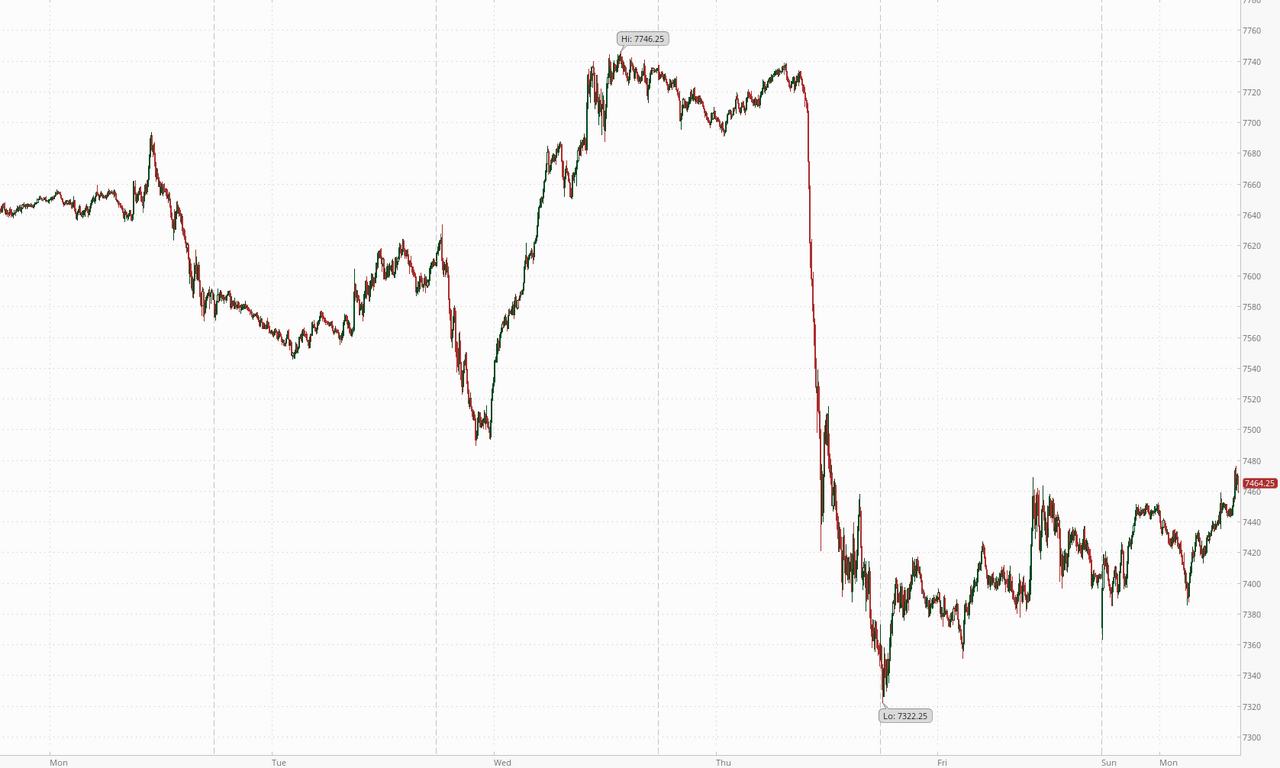
قراردادهای آتی ایالات متحده در حالی صعود کردند که خریداران در کف بازار پس از بدترین هفته S&P 500 از آوریل 2025 بازگشتهاند. نفت بزرگترین ریزش هفتگی خود از آوریل 2020 را به دلیل امیدواریهای دیپلماتیک پیرامون ایران ادامه داد و بازار به این نتیجه رسید که رابطه جنسی هوانگ با یک مظنون به جاسوسی چینی، دستکم تا زمان باز شدن بازارها، مشکلی مربوط به Nvidia است تا مشکل هوش مصنوعی.
Futures Rise As Dip Buyers Shrug Off Jensen's Spy Scandal, Oil Slides On Iran Hopes US futures are higher as dip buyers return after the S&P's worst week since April 2025, oil extends its biggest weekly drop since April 2020 on Iran diplomacy hopes, and the market decides that Jensen Huang's affair with a suspected Chinese spy is an Nvidia problem rather than an AI problem , at least until the open; as a result, Treasuries are little changed with the 10Y at 4.86%. As of 8:15am ET, S&P futures are 0.9% higher while Nasdaq futures gain 0.8% and Dow futures rise 1.1%, the latter a good read of where the money is going. Cash stocks closed Friday with the S&P up 0.31% and the Nasdaq 100 up 1.4%, but that barely dented a week in which the S&P lost 2.7% and the Philly semi index fell 12%. In premarket trading the Mag 7 ex-Nvidia is green, with Nvidia down between 4.4% and 4.9% after the board launched an independent probe , while KKR, IFF and Barrick are higher and Dole slides. The day's driver is oil (again): WTI is down 3.5% to $87.66 and Brent is down 3.8% to $94.59 after Trump told CNN that further strikes on Iran are highly unlikely if talks progress, with a further leg lower on an unconfirmed report that Iran softened its Hormuz demands. Treasuries are mixed and the curve is twist-flattening, with the 2Y around 4.53% as markets price roughly a 79% chance of a December Fed hike; bunds are slightly weaker. The Bloomberg dollar index is down 0.4%, with the kiwi leading G-10 after New Zealand's incumbent National Party emerged from the election with a path back to power. In commodities, gold is up 0.6% around $4,097, silver gains 1.3% near $52.60 and copper is firmer; bitcoin holds around $74,000. US economic data slate includes September final wholesale inventories (10am) and the NY Fed one-year inflation expectations (11am). Fed speaker slate includes Bowman (8:40am), Goolsbee (10am) and Barkin (12:15pm). The Treasury sells $58 billion in 3-year notes at 1pm; US bond markets are shut Wednesday for Veterans Day.
In premarket trading, Mag 7 stocks are mostly higher, with one very conspicuous exception: Nvidia is underperforming Magnificent Seven peers as the chip giant’s board launched an investigation into CEO Jensen Huang, following his admission of an affair with a woman identified in a series of reports as a suspected Chinese spy
Amazon (AMZN) +2.3%, Alphabet (GOOGL) +1.6%, Meta Platforms (META) +1.5%, Microsoft (MSFT) +1.3%, Apple (AAPL) +0.7%, Tesla (TSLA) +0.5%, Nvidia (NVDA) -4.9%.
Barrick Mining (B) rises 2% after the company reaffirmed its gold production forecast for the full year.
CECO Environmental (CECO) gains 28% after the manufacturer of water treatment equipment posted quarterly results.
Constellation Energy (CEG) climbs 2% after the company boosted its adjusted operating earnings per share guidance for the full year.
Dole (DOLE) falls 8% after the fruit producer’s adjusted Ebitda for the third quarter fell short of the consensus estimate and management cut its annual guidance for the metric, citing a “higher cost environment.”
DraftKings (DKNG) falls 2% as analysts cut their price target on the stock.
Greenfire Resources (GFR) rises 38% after Strathcona Resources agreed to buy the company at a total transaction value of as much as $2.9 billion.
JetBlue Airways (JBLU) gains 3% after executives reassured employees that the carrier has no plans to file for Chapter 11 bankruptcy protection.
KKR & Co. (KKR) rises 1% after reporting a third-quarter profit that beat analysts’ estimates as the “mini Berkshire” unit that holds long-term private equity bets mitigated a slump at its Global Atlantic insurance arm.
Monday.com (MNDY) falls 5% after the software company posted third quarter results and provided fourth quarter guidance.
NRG (NRG) rises 4% after entering into a definitive agreement to sell six natural-gas fired generation assets totaling 4.9 GW to LS Power, for a purchase price of $4 billion in cash proceeds.
In other corporate news, Nvidia's board opened an independent investigation after Huang told staff of the relationship, and Trump, in a rare moment of HR solidarity, said Huang should stay on; Microsoft is reportedly winding down its Oracle AI cloud rental deal (from Friday); OpenAI closed roughly $11 billion of initial funding at a $1.25 trillion valuation; Anthropic is reportedly targeting an IPO before Thanksgiving raising $80-100 billion; NRG will sell 4.9 GW of gas assets to LS Power for $4 billion in cash; CNH agreed to sell 70% of its construction equipment unit to a Kobe Steel affiliate; Brad Jacobs is said to be nearing a $1 billion investment in CKX Lands; Coca-Cola filed draft papers for an IPO of its Indian bottling unit; Children's Place filed for Chapter 11; Tesla will wind down Cybertruck production in about eight months, per Musk; Akamai plans $2.2 billion and Dropbox $1 billion of convertible notes.
Globally, stocks are stabilizing after last week's AI liquidation, with the rebound led by Asia and a Europe that never fell as far . Thursday's 4.8% Nasdaq 100 break below the 200-DMA was among the deepest on record, and Bloomberg notes that breaks of over 3% have historically taken about 25 trading days to reclaim. Almost $7 trillion of S&P and Nasdaq futures notional traded last week, a record, as we noted over the weekend ; the market's new problem is that the most important man in AI now has a Washington problem too.
Bloomberg Intelligence's Kunjar Sobhani says the board probe should not change near-term sales or product estimates but raises key-man risk , given Huang's unusually central role and no clear successor; Bernstein's Stacy Rasgon makes the same point. The bigger question from the midterms, namely whether a Democratic Congress slows the AI buildout , has not gone away, with Goldman's Alec Phillips estimating that up to around 40% of planned capacity could be affected by state-level wins in Texas, Georgia and Ohio.
The sell side is split on whether the bottom is in. JPMorgan's Dubravko Lakos-Bujas sees the selloff as nearly exhausted and reiterates his 8,000 year-end S&P target, arguing this was a deleveraging event with momentum crowding reset from the 100th to the 76th percentile; Morgan Stanley's Michael Wilson also sees the correction nearing an end. On the other side, Citi downgraded US equities and global tech in favor of Europe, and Panmure Liberum's Mark Taylor warns that flushing the election reaction does not make it the low.
JPM's Market Intel desk says the tech trade is stabilizing but the market prefers the ex-AI, broadening trade , with Europe outperforming and premarket action pointing to an everything rally that a weaker Nvidia may cap. Mike Feroli's team, meanwhile, sees the Fed on track for a December hike and looks for tomorrow's CPI at +0.25% headline and +0.23% core. Goldman's desks are less sanguine in the near term: models show another $25 billion or more of potential CTA S&P supply this week , and Mark Garrett's tally has $28 billion over a week and $45 billion over a month, while the high-touch desk has sold about $30 billion of tech since the decline began. Fundamental long/short net leverage is in the first percentile of the past year. Goldman's Jim Schneider calls semis clearly oversold after a 31% fall since Oct. 1, while Tony Pasquariello flags that the AI buildout is at its highest risk in four years. Goldman's specialist has flagged the level to watch , and credit, as we noted, has barely blinked .
In Europe, the Stoxx 600 is up 0.7% at about 653, led by basic resources, banks and health care as cheaper oil and stronger-than-expected Chinese PPI help; consumer products, telecoms and food and beverage lag. UniCredit jumped on record profit and raised guidance, while Credit Agricole's merger pitch sent Banco BPM up 11%. JPM's baskets show Defense, Ceasefire plays and Semis leading, with Homebuilders and Luxury lagging. Here are the biggest European movers:
UniCredit gains as much as 6.3% after reporting stronger-than-expected 3Q earnings and raising its 2026 profit outlook, supported by higher revenue and lower costs.
Sanofi rises as much as 2% after BNP Paribas analysts including Peter Verdult raised the recommendation on the French drugmaker to outperform from neutral, saying the near-term earnings power of its anti-inflammatory drug Dupixent is overlooked.
Valneva shares rise as much as 9.1% after the biotechnology company reported positive results from trials of its vaccine candidate against shigellosis.
Autostore gains as much as 10% as DNB Carnegie upgrades to buy on potential boost for the Norwegian warehouse automation firm from Amazon’s sub-same-day (SSD) network.
Hochtief shares slide as much as 7.1% after Spanish engineering company ACS SA said Saturday afternoon that it hasn’t considered a tender offer for its listed German subsidiary, nor a sale of shares in Hochtief-owned US builder Turner Construction Co.
Schott Pharma shares drop as much as 4.4% after UBS cut the German maker of syringes to neutral from buy, with analysts including Olivier Calvet citing the risk of weaker glass syringe demand.
Kingspan shares drop as much as 4.4% after the building materials company posted a trading update. Analysts said sales gained momentum in the third quarter compared to the first half, although JPMorgan said growth was still short of its expectations.
Kainos shares fall as much as 11% after the British IT services firm maintained guidance for the full year, which analysts see as conservative given better-than-expected revenue and bookings in the first half.
Asian stocks surged, with Taiwan's Taiex up 4.9% after authorities curbed short selling and put a NT$500 billion stabilization fund on standby, ending a seven-day slide; TSMC gained about 4.7% and MediaTek hit its limit. The MSCI Asia Pacific rose as much as 2.8%, the biggest gain since July. The Nikkei added 2.3% and the Topix 3%, though Goldman's Japan desk notes AI names faded late and investors remain unconvinced into year-end. The Kospi faded a 2% early rise to close down 0.6%, barely above 5,000; the Hang Seng slipped 0.1% as Goldman's HK desk saw liquidity drawn toward Taiwan, and China lagged after HSBC cut mainland stocks to neutral. China's PPI accelerated to 5.7% while CPI slowed to 0.7%. Singapore and Malaysia were closed.
In FX, the Bloomberg Dollar Spot Index is down 0.4% with the dollar weaker against all G-10 peers. The kiwi leads, up about 1.2% on the election result, sterling is up 0.5% to 1.3422 and the euro is up 0.4% around 1.1186. USD/JPY is down 0.3% near 158 after Japan confirmed three rounds of summer intervention totalling JPY 15.4 trillion. Korea's won jumped as much as 1.3% on exporter dollar sales.
In rates, Treasuries are mixed with the curve subtly flattening: front-end yields are up almost 2bps, the long end is lower by about 1bp, 2s10s is about 1.5bps flatter and the 10Y is little changed around 4.86%. Bunds are slightly weaker around 123.00 and gilts marginally outperform on lower energy prices, with attention on the race between Klaas Knot and Pablo Hernandez de Cos to succeed Lagarde. The $58 billion 3-year auction at 1pm comes with a 4.598% when-issued, about 34bps richer than October's stop; $42 billion 10-years follow Tuesday and $25 billion 30-years Thursday. IG issuance slate is empty so far, with dealers looking for about $40 billion this week, a modest ask after the hyperscalers blew through their full-year debt forecasts .
In commodities, WTI is down 3.5% at $87.66 and Brent down 3.8% at $94.59 after a very busy weekend in which Trump played down renewed strikes, Rubio called Iran's demands unacceptable, the IRGC insisted Hormuz stays closed and Houthi missiles damaged an Aramco building in Riyadh. An unconfirmed report that Iran eased its Hormuz demands added to the selling. Trump meets Qatar's prime minister at noon ET. Goldman's Tony Kim sees low to mid-80s Brent on a full resolution and 115 on the upside, while hedge funds have been dumping length . Dutch TTF is firmer after a drone attack halted Iraq's Khor Mor gas field. Spot gold is up around $4,097, helped by the PBoC's 24th straight month of purchases, silver is near $52.60 and copper is firmer around $13,800.
US economic data slate includes September final wholesale inventories (10am) and October NY Fed one-year inflation expectations (11am). Fed speaker slate includes Bowman (8:40am), Goolsbee (10am) and Barkin (12:15pm). KKR, Constellation Energy and Barrick report before the open, Take-Two and Trade Desk after the close; Mettler-Toledo holds an investor day.
Trump says further Iran strikes are "highly unlikely" if negotiations progress, while Rubio calls Tehran's demands unacceptable: CNN, Newsquawk
US and Iran are quietly negotiating a deal to avert a return to all-out war, though Washington is tempering hopes: CNN
Oil falls on an unconfirmed report that Iran eased its Hormuz demands: BBG
Houthi attack damages Aramco offices in Riyadh; Iraq's Khor Mor gas field halted after a drone strike: BBG, Newsquawk
Trump to meet Qatar's PM at noon ET on a new ceasefire and renewed nuclear talks: Axios
Nvidia's board launches an independent probe after Huang admits an affair with a woman identified as a suspected Chinese spy: BBG
Microsoft is winding down its Oracle deal to rent AI cloud capacity: BBG
Anthropic plans an IPO before Thanksgiving, seeking $80-100 billion at a $1.25-1.75 trillion valuation: FT
OpenAI secures about $11 billion in initial funding at a $1.25 trillion valuation: BBG
Alphabet has discussed offering Hong Kong and Singapore dollar bonds: BBG
China extends its suspension of the extra 24% tariff on US goods and port fees for two months: BBG
US warns China to fulfil the Busan truce, saying rare earth commitments are only two-thirds met: FT
China October PPI accelerates to 5.7% y/y, the fastest since June 2022, while CPI slows to 0.7%: BBG
Hedge funds sold global tech at one of the fastest paces on record last week; US Info Tech net allocation is 14.4%, near multi-year lows: GSPB, BBG
PBoC added 830,000 ounces of gold in October, a 24th straight month of purchases: BBG
Israeli opposition leader Eisenkot was tasked with forming a government, with up to six weeks to do it: BBG
House GOP leaders brace for enough defections to impeach Defense Secretary Hegseth this week: Axios
Trump tells 60 Minutes his deportation approach may have been too tough on longtime residents: CBS
Knot says he is open to new tools against a European debt crisis if named ECB President: FT
Lagarde tells Yomiuri that inflation will stay high for quarters to come: Yomiuri
Japan confirms three rounds of summer yen intervention, totalling JPY 15.4 trillion: MoF
New Zealand's National-led coalition is narrowly ahead after the weekend election: BBG
Fed's Daly says inflation remains too high and calls for further tightening: Newsquawk
Asia-Pac stocks started the week on a broadly positive footing, as tech names followed the price action seen in their US peers on Friday. Despite the bounce, analysts see this as short-lived, as flows suggested that investors used Friday’s bounce to cut risk on both sides. Leading gains across Asia was Taiwan, after the FSC announced short-selling restrictions while the Finance Ministry said it is prepared to deploy its TWD 500bln stock market stabilisation fund. ASX 200 was the slight laggard, spending the majority of the session in the red before managing to eke out mild gains. Another big bank reported earnings, with ANZ’s FY cash profit slightly beating estimates; however, shares are lower. Nikkei 225 followed Taiwan's TAIEX higher, printed gains of over 3% and regained the 59k handle. KOSPI was initially lower by as much as 1%, but managed to scale back most of that downside. Shanghai Comp. and Hang Seng opened higher, in line with the broader market sentiment. Inflation metrics were mixed for October, with headline CPI Y/Y printing at 0.7% (exp. 0.8%) while the PPI metric accelerated to 5.7% (exp. 5.3%).
Chinese banks have reportedly sharply increased USD deposit rates in recent weeks, with some rates exceeding 4%, while exporters are hoarding dollar cash, according to sources.
China's CPCA reported October passenger vehicle sales of 1.65mln units, down 27.3% Y/Y. Tesla (TSLA) exports 59,012 units. BYD (1211 HK) exports 165.2k units.
The Japanese government reportedly begins discussions on a subsidy programme to partially cover cybersecurity costs for regional banks, with a budget expected to total several billion yen, Kyodo reported.
Market stabilisation measures are evolving into a long-term component of the country's financial governance framework, moving beyond temporary responses to short-term market volatility, according to China Securities Times.
ECB President Lagarde told Yomiuri Shimbun that headline inflation in October was higher than the ECB expected a few months ago but in line with market expectations and that inflation numbers will remain high in the quarters to come . She reiterated that they currently do not see signs of second-round effects beyond what is incorporated in their projections. She highlighted that it is not appropriate to pre-empt inflation forecasts but noted that the energy futures curve has risen since their September projections. She reiterated data-dependence and a meeting-by-meeting basis. On the use of TPI, if necessary, she said they have multiple tools and a big toolbox. ECB Presidential candidate de Cos told Tages-Anzeiger that second-round effects haven't appeared so far but vigilance is needed regarding inflation risks. ECB Presidential candidate Knot said he is open to developing new tools to combat a potential European debt crisis if appointed ECB President, according to the FT. The EU and the UK are reportedly in the final stages of an agreement to link their emissions trading systems, with an announcement expected at a summit later this month, according to Bloomberg sources. The deal would allow cross-border trading of carbon permits, boost market liquidity and reduce carbon border taxes for companies, with negotiators having agreed on emissions caps, supply controls and free permits. UK Government's Milburn NEET review is to be published next week, Politico reported citing sources. US Secretary of State Rubio to meet with French President Macron at 17:45GMT/12:45EST. Morningstar DBRS confirms Germany at AAA; trend stable. S&P revises Poland’s outlook to negative; affirms ‘A-/A-2’ foreign currency ratings; lowers local currency ratings to ‘A-/A-2’.
German Trade Balance (Sep) 15.6B vs. Exp. 19.2B (Prev. 19.5B); German Exports (Sep MM) 2.0% vs. Exp. 0.5% (Prev. -0.8%); German Imports (Sep MM) 4.2% vs. Exp. 0.5% (Prev. 0.9%).
EU and UK are near a deal linking their carbon trading systems.
DXY is slightly softer within a narrow 101.81-102.28 range, consolidating after Friday's upside on the strong US jobs report; market pricing sees a 79% chance of a Fed hike in December. The index currently holds within Friday's 101.49-102.36 range, above its 50DMA (101.12). The US docket is relatively busy this afternoon, with Fed's Goolsbee and Barkin, the NY Fed SCE and the Atlanta Fed GDPNow, alongside a 3-year note auction.
EUR/USD is firmer at the top end of a 1.1134-1.1196 range. Outgoing ECB President Lagarde told Japanese press that inflation numbers will remain high in the quarters to come, while reiterating that the ECB does not see signs of second-round effects beyond what is incorporated in its projections. A light EZ docket, with German Trade Balance doing little to shift the currency this morning.
GBP/USD is firmer at the top of a 1.3340-1.3420 range, having bounced from 1.3340, and now sits above its 21 and 50DMAs (1.3348 and 1.3357), testing its 100DMA at 1.3392. EUR/GBP trades within a 0.8337-0.8349 range. Focus this week is on Thursday's UK GDP, while BoE Governor Bailey speaks later today at 17:25GMT.
USD/JPY is softer within a 157.87-158.53 range, holding beneath its 200DMA at 158.66. Japan's MoF confirmed three yen-buying interventions over the summer totalling JPY 15.4tln.
Antipodeans are firmer, supported by the upbeat risk tone in Asia and strength in precious metals. NZD/USD outperforms peers and trades within a 0.5554-0.5603 range, above Friday's 0.5599 high, helped by the weekend's elections, where PM Luxon's National Party-led coalition is narrowly ahead with 67 of 130 parliamentary seats after 97% of votes counted. AUD/USD is firmer within a 0.6854-0.6905 range, though beneath its 21DMA at 0.6983.
USD/CNH trades flat within a 6.6660-6.6744 range, with little reaction to China's October inflation metrics, in which CPI was softer at 0.7% Y/Y (exp. 0.8%), while PPI accelerated to 5.7% (exp. 5.3%).
RBA's Hunter sees limited AI productivity effects so far and flags financial stability risks.
ECB candidates Knot and de Cos both stressed vigilance on inflation and tools.
A modestly bullish start to the session, amid energy downside and some early equity pressure in Nvidia indications hitting the broader tech space, with NQ -0.9% at most. However, this has since moderated to a mixed/bearish performance, with fixed faltering somewhat as energy comes off lows and the NQ returns to unchanged.
USTs in relatively modest 106-30 to 107-07+ confines, but now essentially flat within that. The day ahead for the US features supply and a handful of data points, but it will primarily be focused on tech and geopolitics. See equities and commodities respectively for more.
For Bunds the narrative has been much the same, lower by about 15 ticks as things stand, holding around the 123.00 handle in 122.91 to 123.29 confines. Focus for the bloc is on a meeting of EU officials regarding the next ECB President; though, an announcement is not expected until the Council gathering at the end of the month. de Cos and Knot remain the two main contenders, the latter speaking to the FT overnight.
Gilts in-fitting, marginally outperforming on account of the pressure seen in energy and potentially in anticipation of the Milburn NEET review being published next week, a review that may signal some welfare changes during the Burnham premiership. Firmer by a few ticks, but off best and failed to breach 87.00 earlier in the session.
Crude benchmarks are lower and extending to fresh session lows, with Brent now beneath Friday's trough. The initial weakness at the open was driven by US President Trump's comments that further military action against Iran is highly unlikely if negotiations progress, while Secretary of State Rubio's downbeat remarks and reports of continued strikes in the Strait of Hormuz briefly limited the downside, before a fresh bout of weakness into the European open without a clear headline catalyst (see below for a recap of geopolitics). Focus later today is on Trump's meeting with the Qatari PM at 17:00GMT, centred on a new ceasefire and resuming nuclear negotiations with Iran.
WTI Dec'26 trades within a USD 89.29-91.42/bbl range (vs Friday's USD 89.07-92.53/bbl range), while Brent Jan'27 moves within USD 96.11-98.43/bbl (vs Friday's USD 96.67-100.83/bbl range).
Dutch TTF is firmer within a EUR 85.65-87.75/MWh range, potentially as Dana Gas confirmed production at Iraq's Khor Mor gas facility has been suspended after a drone attack, whilst traders keep an eye on weather heading into the winter.
Spot gold is firmer but has pared gains back beneath USD 4,100/oz, within a USD 4,054.49-4,134.18/oz range (vs Friday's USD 4,027.04-4,107.00/oz range), with earlier support from data showing the PBoC added 830K ounces of gold to its reserves in October, extending its buying streak to 24 consecutive months. The yellow metal holds above its 21DMA at USD 4,069/oz. Spot silver is firmer within a USD 51.41-53.46/oz range (vs Friday's USD 51.20-52.37/oz range), also off best levels.
3M LME copper is firmer within a USD 13,801.85-13,923.18/t range (vs Friday's USD 13,637.38-13,832.83/t range), though it has faded to the bottom of the range after benefiting from the constructive risk tone in Asia, whilst Chinese PPI printed hotter than expected.
In geopolitics, US President Trump told CNN it is highly unlikely the US will need to resume military action against Iran, provided progress is made in negotiations over Tehran's nuclear programme and reopening the Strait of Hormuz, while Secretary of State Rubio said talks with Iran are not productive as Iranian demands are unacceptable. This morning, the IRGC spokesman said the Strait of Hormuz is completely closed, and Iran's Army spokesman said its military doctrine is moving towards aggression. More recently, Iranian Foreign Ministry spokesperson Baghaei said Iran's two-day proposal is the most reasonable proposal on the table and that Iran will not compromise on its national interests, adding that the US must end its naval blockade and the war for diplomacy to proceed. Elsewhere, an oil refinery in Russia's Leningrad region was set on fire following a drone attack, according to the regional governor.
The Japanese government is to reduce the burden of LPG and kerosene use, Kyodo reported.
Dana Gas confirmed that the Khor Mor facility in Iraq's Kurdistan region was targeted in a drone attack and the production has been suspended while the damage is being assessed.
South Korea's Finance Minister said the USD 10bln remittance for a US nuclear project will only proceed after a full business feasibility review is completed. The project remains at a preliminary stage and will be carefully assessed.
China is to extend the suspension of export controls targeting US firms for two months, reports suggest.
The US warned China that it must immediately fulfil the terms of the trade truce struck by US President Trump and Chinese President Xi in Busan in October 2025, according to the FT. US officials said China is fulfilling only two-thirds of its rare earth commitments and has failed to increase supply.
China's MoF suspended the 24% additional tariff on US imports for two months, keeping the 10% tariff rate in place, effective November 10. Additionally, China's transport ministry said it is to continue suspending special port fees on US ships until January 10, 2027.
China's MOFCOM firmly opposed the sanctioning of two Chinese companies and urged the US to promptly correct its mistaken practices and said it reserves the right to take necessary measures and safeguard its legitimate rights and interests.
Canadian PM Carney said Canada will continue to work with the Americans to get a trade deal that works for Canada.
US Treasury Department added eight Canadian firms to its sanctions list for conducting business with Iran.
US CENTCOM said its commander directed the establishment of a task force on November 7 to support US government efforts to prevent Iran from transporting advanced weapons and other materials via ground routes.
US CENTCOM said its forces disabled a St. Kitts-flagged commercial vessel in the Gulf of Oman on November 7 after the civilian crew ignored repeated warnings and made multiple attempts to breach the US naval blockade against Iran.
Iran's Foreign Minister Araghchi said the outcome of the US elections requires time to assess before determining next steps, with intermediaries having had no contact in recent days due to the result. He added that conditions will need time to improve before mediation efforts resume, according to IRNA. In other comments, Araghchi said US voters have made their choice and that it is up to the White House to decide, while adding that Iran's "48-hour proposal" remains on the table.
Initial reports indicated that two missiles struck Qeshm Island in the Strait of Hormuz on Saturday, with no official information on potential damage, according to Tasnim News Agency. However, Iranian media suggested that the explosions were related to Iranian military activities, rather than US strikes. Separately, IRNA reported explosions in Iran's Qeshm Island and Bandar Abbas, with some sources attributing the sounds to warning shots at violating ships in Hormuz. Furthermore, launches targeting vessels in the Strait of Hormuz were reportedly heard from Sirik.
Iran's Navy said a tanker transiting a closed zone east of the Strait of Hormuz struck a mine and caught fire after switching off its navigation system, and added that the Strait will remain closed to non-compliant vessels until all threats are removed.
An Iraqi delegation reportedly visited Tehran and met Iranian officials to deliver a message from the US, according to Al Hadath citing sources.
Iranian Foreign Ministry spokesperson Baghaei said Iran's two-day proposal is the most reasonable proposal on the table; said Iran will not be compromising on its national interests.
Iran's Army Spokesman Akraminia said "Iran's military doctrine is moving towards aggression upon the order of the Commander-in-Chief".
China's Middle East envoy meets Iran's Deputy National Security Council Secretary during a visit to Tehran, Al Hadath reported.
An Israeli official said an additional attack on Iran will reduce its capabilities, Al Arabiya reported.
Clashes reported between government forces and the Yemeni Houthis in Taiz, Al Araby reported.
Recent Russian contacts with Iran came at the request of the US, which asked Moscow to mediate and persuade Tehran to hold direct talks with the US, reported Al Araby Al Jadeed.
Iran's military doctrine is moving towards aggression, under the orders of the Commander-in-Chief, reported SNN.
Iranian President Pezeshkian said they can negotiate and resolve issues with dignity.
IRGC Spokesman Mohebbi said the Strait of Hormuz is completely closed, Defa press reported.
IRGC Navy official said no vessels transited through the unauthorised route due to the destruction of navigational aid systems in Southern Hormuz, IRIB reported.
IRGC spokesman Brigadier General Hossein Mohebbi said the Strait of Hormuz is fully under Iranian Naval control and warns that non-compliant vessels risk hitting mines until Tehran's conditions are met, Press TV reported.
IRGC said it intercepted and destroyed a 16th US MQ-1 drone over Qeshm Island.
A Hormozgan provincial official said US forces struck targets on Qeshm Island, although the attacks caused no damage to residential or commercial areas or vital infrastructure, according to IRNA.
Iranian Foreign Ministry spokesperson Baghaei said the IAEA visited Bushehr in recent days.
Oil refinery in Russia's Leningrad region set on fire following a drone attack, according to the regional governor.
Russian Defense Ministry said a vessel carrying cargo for the Ukrainian armed forces was damaged in the Black Sea and a power substation near Cherkasy was damaged, IFX reported.
A Russian official said drones hit an industrial area in Kirishi in Russia's Leningrad region.
US President Trump tells CBS' 60 Minutes that he expects a different shape of Ukraine when the war ends. Political Changes. He will be making a few changes to the cabinet.
Bitcoin is a touch lower this morning, holding around the USD 74k mark. Ethereum underperforms, but holds on to USD 2.1k.
10:00am: Sep F Wholesale Inventories MoM, est. 0.6%, prior 0.6%
11:30am: $95 billion 13-week bills; $82 billion 26-week bills
Last week was certainly a week to remember — or forget — in markets, depending on your point of view and positioning. Usually we save the weekly recap until the end on a Monday but there were some big moves work highlighting as we start a new week. The S&P 500 fell -2.68% (+0.31% Friday), marking its worst weekly performance since April 2025. Moreover, the most AI-exposed areas saw even bigger declines, with the Philly semiconductor index down -12.15% (+4.21% Friday), whilst CoreWeave fell another -15.44% (+6.28% Friday). However rotation meant Consumers Discretionary (+2.68%) and Communications Services (+2.26%) led five sectors out of the 11 top level ones that rose last week, with Energy (-11.93%) actually performing worse than IT (-6.93%).
Outside the US, Japan’s Nikkei fell -9.25% (-5.96% Friday), marking its worst weekly performance since the pandemic turmoil in March 2020. However, Europe’s STOXX 600 managed to eke out a +0.24% gain (-1.00% Friday), reflecting Europe’s smaller exposure to the tech sector and a boost from falling oil prices.
Indeed, whilst AI fears gathered pace, there was a huge slump in oil prices as investor fears eased about a potential escalation in the Middle East. The current active Brent crude contract for January 2027 fell -13.32% (+0.03% Friday), taking it down to $98.32/bbl. So along with the risk-off tone from the AI selloff, that helped to bring down sovereign bond yields around the world. So the 10yr Treasury yield fell -7.2bps (+2.1bps Friday) to 4.86%, whilst the 10yr bund yield fell -6.9bps (+1.4bps Friday) to 3.25%. In part, that recovery on Friday followed the US jobs report for October, which showed payrolls rising by +165k (vs. +70k expected), along with +84k of positive revisions to the previous two months. So that brought the 3-month moving average of payrolls up to +137k, whilst the unemployment rate also fell to 4.1% (vs. 4.2% expected). Credit was actually fairly flat on both sides of the Atlantic but the risk-off tone in equities meant it was a good week for gold, which was up +5.06% (-0.42% Friday) in its best week since August.
We move on from payrolls to US inflation as the main macro focus this week, with October CPI tomorrow and PPI on Friday, alongside a busy slate of Fed speakers. Beyond the US, the key releases include China’s trade figures tomorrow, UK Q3 GDP on Thursday, and Japan’s October PPI on Thursday, while the corporate calendar includes Cisco, Applied Materials, Siemens, Allianz and SoftBank as Q3 winds down after another bumper quarter that’s been overshadowed by the recent market volatility.
Asian equity markets are rallying this morning after Wall Street's rebound on Friday, although concerns surrounding an internal investigation involving Nvidia CEO Jensen Huang are capping gains. The company is down around -3.5% on platforms that provide weekend prices.
The AI trade is trying to recover though this morning with Taiwan's Taiex (+4.94%) snapping a seven-session losing streak after the market regulator and finance ministry unveiled measures aimed at restoring investor confidence. Elsewhere, Japan's Nikkei (+2.63%) and TOPIX (+3.20%) are also trading sharply higher. The rebound follows a turbulent week that saw both Japanese and Taiwanese equities fall into bear-market territory. Meanwhile, South Korea's KOSPI (-0.61%) has just turned over after spending most of the session higher. Elsewhere the Shanghai Composite (+0.50%), CSI 300 (+0.31%), and Hang Seng (+0.08%) are edging higher. S&P 500 (+0.44%) and Nasdaq 100 (+0.25%) are continuing to recover some of Thursday's big losses. Meanwhile, the 10-year US Treasury yield is up +1bps at 4.87% and Brent down around a percent as I type.
Earlier this morning, data showed that China's producer inflation accelerated to its fastest pace in nearly four-and-a-half years in October, as higher global oil prices drove up manufacturing costs, even as consumer inflation softened amid weak domestic demand. Producer prices (PPI) rose 5.7% year-on-year, exceeding both September's 5.0% increase and expectations for a 5.3% gain. In contrast, consumer prices (CPI) increased 0.7% from a year earlier, slowing from 0.9% in September and coming in slightly below the consensus forecast of 0.8%. The divergent inflation trends highlight the challenges facing Beijing as it seeks to revive household consumption while maintaining momentum in the industrial sector. Although policymakers have introduced a range of measures to support spending and tackle excessive competition, a sustained recovery in consumer demand and prices remains elusive.
Going through the week ahead in more detail, in the US, tomorrow’s October CPI is the centrepiece. Our economists expect headline CPI to rise by 0.20% month-on-month, down from 0.65% previously, with core CPI also up 0.20% after 0.33% last time. Because October 2025 index levels were not produced during last year’s government shutdown, year-on-year inflation rates cannot be calculated for this release. Within core goods, our economists expect softer medical-care commodity prices to offset some strength in recreation and information-technology goods. In services, they expect owners’ equivalent rent to moderate from September, although recreation services could be firmer following streaming-price increases, while the annual health-insurance reset may provide a downward contribution.
Friday’s October PPI will be important for the read-across to core PCE inflation. Our economists expect producer prices to rise by 0.20% month-on-month, compared with 0.32% in September, leaving the year-on-year rate broadly steady at 3.1%. The inflation releases arrive alongside a heavy run of Fed commentary, with around two-thirds of officials due to speak during the week. You’ll see them listed alongside the other major events in our day-by-day calendar at the end as usual. Attention will be on how policymakers assess the recent tightening in financial conditions against still-solid economic and labour-market momentum and inflation that remains above target. Our economists continue to expect 25bp rate increases at the December and March FOMC meetings, absent a further material tightening in financial conditions. US bond markets are closed on Wednesday for Veterans’ Day.
In Europe, Thursday’s UK GDP report is the main event. Our economists expect September GDP to contract by -0.1% month-on-month but expect Q3 growth overall to reach 0.7% quarter-on-quarter. Norway and Denmark also publish October CPI tomorrow.
Japan’s calendar includes the October Economy Watchers survey and September household spending tomorrow, alongside the BoJ’s summary of opinions from its October policy meeting. October PPI follows on Thursday. Elsewhere in the region, New Zealand holds a general election tomorrow.
On the corporate side, the US earnings season is winding down, with close to 90% of S&P 500 companies having already reported. KKR reports today, followed by SoftBank tomorrow; Thursday brings Cisco, Applied Materials, Siemens, Allianz and Cerebras, among others. CoreWeave tomorrow and Cerebras on Thursday should also offer another read on AI-related demand and investment.
Our asset allocation team have reviewed the global earnings season here and highlighted how growth has remained remarkably strong in Q3 despite a very high hurdle after 38% year-on-year growth in Q2 and persistent upgrades ahead of the reporting season. Global earnings growth likely eased to 33%, still one of the highest rates on record, with Tech, Energy and Materials leading but growth excluding those sectors also a robust 12%, towards the top of its historical range, while record margins provided further support. US earnings growth likely held at 34%, with the median company growing 14% and growth excluding Tech, Energy and Materials at 13%, one of the strongest rates since the GFC. But Europe was arguably the standout, with growth accelerating from 22% to a four-year high of 28%, leaving the gap with the US at its narrowest in 3½ years, while Europe is now matching or exceeding US growth in 6 of 11 sectors. Japan (33%) and EM (39%) slowed sharply but remained very strong, and forward estimates continue to be upgraded, particularly in Korea and Taiwan. So although consensus sees some moderation in 2027, the striking feature of this earnings season has been how broad-based the strength remains even against an exceptionally demanding starting point.
منبع: ZeroHedge — متن کامل از فید رسمی منبع، با ترجمهی ماشینی عنوان و خلاصه