From Druckenmiller's Chip Dump To Aschenbrenner's $18.7 Billion Vanishing Act: What The "Smart Money" Was Doing Right Before The AI Trade Blew Up
From Druckenmiller's Chip Dump To Aschenbrenner's $18.7 Billion Vanishing Act: What The "Smart Money" Was Doing Right Before The AI Trade Blew Up Every quarter the 13Fs tell you what the biggest names in hedge fund land owned 45 days ago. This quarter they tell you something more useful: how those names were positioned 36 days before the Nasdaq's worst day since Covid.
The filings that hit EDGAR on Monday are a snapshot of Sept. 30. Since then, hedge funds have lived through an October that JPMorgan estimates cost the industry 3%, a historic Nov. 5 session in which the Philadelphia Semiconductor Index lost 12.25%, and the resignation of the AI trade's most famous CEO . According to Goldman estimates, tech-focused long/short funds that were up 24% at their June peak - largely thanks to high beta tech momentum stocks surging 125% through the endof Q2 - were back to roughly flat after that one Thursday, as those same high beta TMT momentum stocks plunged 56% since, for a grand YTD return of -1%... which is why we called it a round trip . Goldman's John Flood told Reuters the funds had been "selling back pockets of the market (hyperscalers)" that they had bought just a day earlier.
So the question we wanted answered when we went through ten of the most closely watched filings (Druckenmiller, Tepper, Lone Pine, Soros, BlueCrest, Situational Awareness, Pershing Square, Greenlight, Berkshire and, yes, Nvidia) was simple.
The short answer: three of the four chip-heavy books were already heading for the exit in the third quarter, one was pressing the bet, and the company at the center of the whole trade was selling a quarter of its Intel stake.
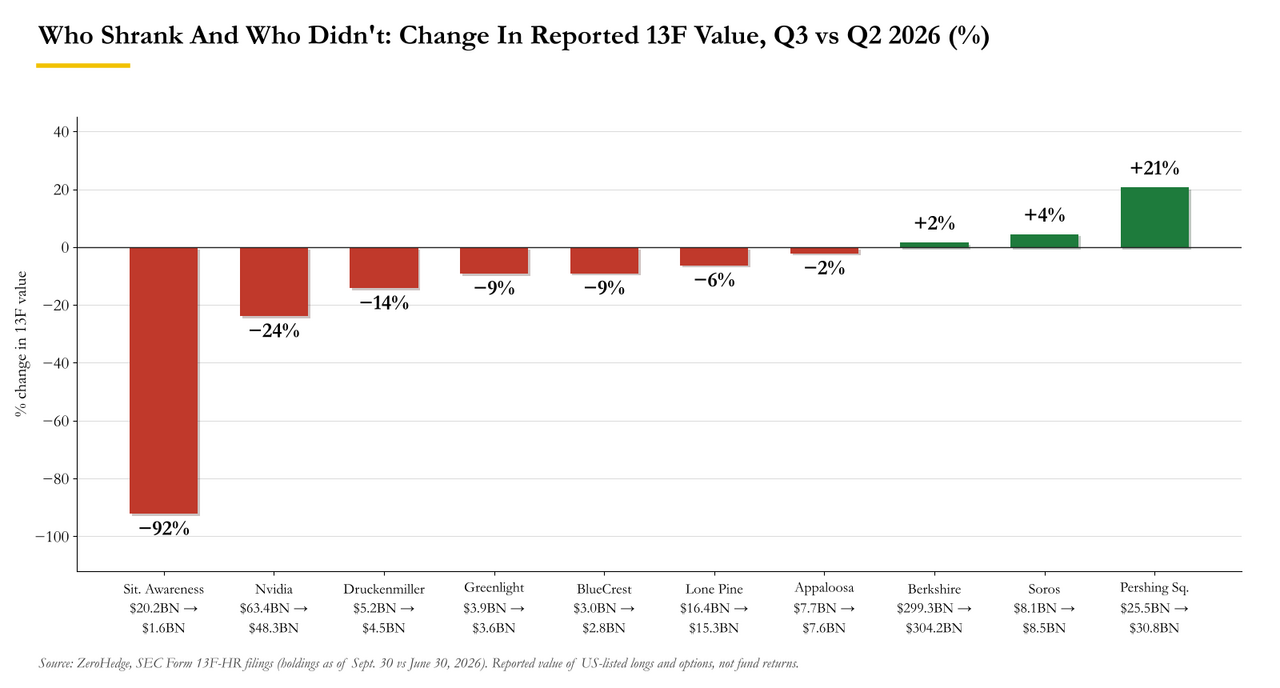
Start with size. Of the ten filers, seven reported a smaller 13F book at the end of September than at the end of June, and the three that grew did so mostly for reasons that have little to do with risk appetite (Pershing Square's jump is almost entirely one position, on which more below).
The usual caveats apply, and this quarter they matter more than usual. A 13F shows US-listed longs and options, with calls and puts carried at the value of the underlying shares. It shows no shorts, no swaps, no bonds, no Korean memory stocks. And it is, by definition, stale: everything below happened before October.
We isolated the stock positions in semiconductors, chip equipment, memory and storage in the four books where they mattered most. Three of the four cut. One added.
Stanley Druckenmiller did what Druckenmiller does, which is leave early. Duquesne cut TSMC (TSM) by 94%, from 589,680 ADS to 32,700 ($282 million to $15 million), halved STMicro, and sold AMD, Sandisk, Lam Research, Arm, Entegris, Rambus, Qnity and Navitas outright. Chip and storage names went from 16% of the book to 10%, and most of what is left is one stock: Seagate (STX), where he nearly tripled the position to $315 million and added $90 million of calls. He also opened a gold-miner trio (Newmont, Barrick, Agnico Eagle) worth $129 million. Hard drives and gold. Maybe the least AI-sounding portfolio a tech investor could assemble.
Lone Pine is the more interesting case, because it is the fund everyone has been whispering about. Bloomberg reported in October that the flagship Cypress fund was up 44% through June and up just 0.6% through September, a third-quarter drawdown of about 30%, and later that it lost another 8.8% in October. (The WSJ headline we flashed on Nov. 5 put it more bluntly: worst three-month stretch.)
The 13F shows what that looked like from the inside. Applied Materials (AMAT) was cut 92%, from $873 million to $48 million. ASML was cut 25%, Teradyne 34%. Seagate ($965 million, and yes, Lone Pine was selling the same stock Druckenmiller was tripling ), Corning and TTM Technologies were sold outright, and so was most of the AI-power and bitcoin-miner complex: Nebius down 64%, Hut 8 down 67%, TeraWulf down 56%.
The chip money, though, mostly changed seats. TSMC went from 101,242 ADS to 1.72 million ($783 million) and Intel (INTC) showed up as a new $721 million position. Strip out Seagate and the fund's core chip holdings were $2.72 billion at Sept. 30 vs $2.78 billion at June 30. As we put it Monday afternoon:
Most notable sales: Applied Materials was cut 92% ($873M to $48M). ASML was cut 25% and Teradyne 34%; Seagate ($965M), Corning and TTM Technologies were sold outright.
Most notable buys: TSMC went from 101,242 to 1,716,117 ADS ($48M to $783M), alongside a… pic.twitter.com/HS458Z9pm6
— zerohedge (@zerohedge) November 16, 2026 In other words, Lone Pine went into October with roughly the same chip exposure it had in June, just in different tickers . Which probably explains the 8.8%.
And then there is David Tepper , the one buyer in the group. Appaloosa raised Micron (MU) 28% to 1.25 million shares, making it the fund's largest position at $1.33 billion, raised Nvidia 31% to 2 million shares, added to Lam Research and ASML, and opened Applied Materials (the stock Lone Pine was dumping). Chips went from 35% of the book to 39%. He did trim Alphabet by 46% and Meta by 22%, and he multiplied his SpaceX stake 17x to $557 million. But the semis were the bet.
Five weeks later Micron and Lam each fell about 17% in a single session. Our reaction to the filing was one word long.
*Appaloosa LP Takes New Stake in Oracle, With 1,253,932 Shares
*Appaloosa LP Increases Stake in Nvidia by 475,000 to 2,000,000 Shares
— zerohedge (@zerohedge) November 16, 2026 Situational Awareness: What A Margin Call Looks Like On Form 13F
No filing was more anticipated than Leopold Aschenbrenner's, and none delivered a bigger number. Situational Awareness reported $1.58 billion of 13F positions at Sept. 30, down from $20.24 billion at June 30. That is $18.7 billion, or 92%, gone in one quarter. Twenty-one of 26 lines were closed, including $5.67 billion of Sandisk, $5.57 billion of Micron, $1.90 billion of Bloom Energy stock, $1.27 billion of TSMC and $1.23 billion of Nebius.
Regular readers know the story, because we told it in real time: the levered bets blew up in late July , the bulk of the public book was sold to Citadel at a reported 10% discount (which is how Citadel ended up having a very good July ), and by September Leopold was back, rerunning the same trades .... and blowing up all over again.
We had warned more than a month before the collapse that massive swap leverage on AI names would produce an Archegos-style casualty. It did.
ok Archegos 2.0... you can come out now https://t.co/xtxZL8wNTZ
— zerohedge (@zerohedge) July 24, 2026 What the 13F adds is the "after" picture, and it is exactly what our September post described. Two-thirds of the reported value is now call options : Bloom Energy calls went from 145,800 underlying shares to 1.4 million ($389 million of notional), next to new calls on Nebius ($333 million), Sandisk ($183 million) and a memory ETF ($140 million). The largest stock position is SharonAI, raised 50% to 8.07 million shares worth $441 million.
Translation: the fund that was liquidated for running too much leverage in a handful of AI momentum names came back with... options on a handful of AI momentum names. And that was the book going into October.
If there was one consensus long in the third quarter it was Intel. Soros Fund Management took its stake from 100,000 shares to 2.83 million, a 28-fold increase to $340 million that makes it the fund's largest stock holding. Lone Pine, as noted, bought $721 million from scratch. In retrospect - considering the stocks lost about half its value in the past months - maybe they should have waited.
Well, among others, Nvidia. The chipmaker's own 13F shows its Intel position falling from 214.8 million shares to 161.1 million. At the quarter-end price that is about $6.5 billion of stock sold , which is more than the roughly $5 billion Nvidia reportedly paid for the entire stake about a year ago. Nvidia also cut Nokia by 56% and Synopsys by 10%. The only thing it added was SpaceX (now its largest holding at $19.68 billion), and the 13F book as a whole fell 24% to $48.3 billion.
We spent last week mapping every circular AI deal that now hangs on Nvidia's balance sheet (in "The Bank Of Nvidia Just Lost Its Chairman"), so it is worth noting that the "Bank of Nvidia" was already monetizing its best-performing asset while Jensen was still in the building. Hedge funds were buying Intel from a seller that knows a thing or two about chip demand.
SpaceX is the other name where the crowd split. Tepper went up 17x, Druckenmiller opened a small position, Nvidia added 6%. Michael Platt's BlueCrest sold 94% of its stake, from $242 million to $13 million.
The Macro Crowd: Energy Puts, Bond Calls And $648 Million Of SPY
The two macro shops in our sample are a decent read on what macro traders thought was coming.
Soros made the largest line in its filing a put. Puts on the Energy Select SPDR went from 2 million underlying shares to 10.9 million ($670 million of notional), and the fund added $328 million of new puts on the oil and gas E&P ETF. Together that is about $1 billion of notional against an $8.5 billion reported book. Considering how the midterms gutted oil's war premium and left everyone else "long and wrong", this one aged well. Soros also bought calls on long Treasuries (TLT, $237 million) and utilities (XLU, $215 million), which is a brave thing to own with the Fed hiking.
BlueCrest did something we haven't seen in a while: it sold its index ETFs and bought the index back through options. The equal-weight S&P ETF went from $401 million to under $1 million, the SPDR Portfolio S&P 500 ETF ($230 million) was sold outright, and S&P 500 calls went from 30,000 underlying shares to 850,000 , or $648 million of notional, 23% of the reported book. Against that, Platt's traders raised puts on high yield (HYG), financials (XLF) and small caps (IWM), and also bought TLT calls. Long the index through options, short credit and small caps. Not the worst way to walk into October.
Three of our ten filers own no semiconductors at all, and their quarters were (predictably) calmer.
Berkshire made one new purchase, Bending Spoons, the Italian app roll-up that IPO'd in July, at 20.7 million shares worth $689 million. It nearly doubled Lennar (LEN) to a combined $2.17 billion, cut Bank of America by 27.5 million shares (about $1.5 billion), and left Apple untouched at 25% of the book. Nineteen of 30 positions didn't move. With a cash pile reported at $377 billion, this is what patience looks like.
Bill Ackman bought two new $1 billion positions, Intercontinental Exchange and Alcon, and paid for them by cutting Microsoft by 35% and trimming five other holdings by 11% to 15%. The 21% jump in Pershing Square's reported book is mostly one line: 184.3 million shares of Pershing Square Inc., first disclosed in an amended Q2 filing, which went from $6.06 billion to $10.31 billion on price alone and is now a third of the 13F.
David Einhorn raised PG&E (PCG) to an even 10 million shares, more than doubled Comcast, and sold PayPal, Warner Bros. Discovery and StubHub. He has company in the California utility: Tepper opened a position, BlueCrest bought calls on 4.5 million shares, and Soros raised its PG&E convertible notes by 27% to $219 million. Four of ten filers adding to the same utility is the closest thing to a non-AI consensus trade in this batch.
Put the filings side by side and the "smart money" looks a lot less like a herd than the price action of the past six weeks would suggest. We widened the lens to 19 filers, adding Tiger Global, D1, Viking, Altimeter, Third Point, TCI, Baupost, Glenview, Discovery and Senator, and the picture got messier, if anything. Amazon had seven buyers and seven sellers. Meta had seven buyers and five sellers. Alphabet was the most sold megacap, with five buyers against eight sellers. The cleaner reads are Intel ( five buyers, and one seller: Nvidia ), Micron (four buyers, with Situational Awareness the only exit) and Broadcom and Nebius, which nobody in the group bought and three sold.
That matters for what comes next. Goldman's prime brokerage data, which we walked through over the weekend in " Shorting The Rip ", show the long/short ratio in US Info Tech at 1.5, the lowest in the bank's records going back to 2016, with hedge funds more than 20 points underweight the sector vs the S&P. The chart below is from the bank's US Equities Weekly Rundown ( available to pro subs ).
The 13Fs explain how we got there. The de-risking that Goldman's traders called the biggest degross since Covid did not start in October. Druckenmiller was out of most of his chips by September, Situational Awareness was out of everything by August, and Lone Pine was already selling its losers. What October and Nov. 5 did was catch the ones who had rotated instead of reduced (Lone Pine) and the ones who had added (Tepper).
The bulls will say that this is what a washed-out market looks like, and that a record-low tech long/short ratio is the setup for the mother of all squeezes. Maybe. But the filings also show something less comforting: the fund that blew up in July was back in levered calls by September, the largest chip long in our sample was getting bigger into the crash, and the seller with the best view of AI demand was Nvidia itself. We suspect the next round of 13Fs, due in February, will show a lot more names in the red columns.
Then again, Druckenmiller bought hard drives and gold miners, and nobody has ever lost money following him ... except the people who read about it 45 days later.
There are twenty more tearsheets for the names readers always ask about, and all are available to pro subscribers here .
For those who want the rest of the tape, here is the line-by-line rundown for the 6 filers in the summary that did not get a tearsheet above: Bill Miller, Peter Thiel's macro fund, and the corporate books of Alibaba, Uber and Intel (which bought IREN). Share counts are approximate and compare Sept. 30 with June 30. The rest are in the full 13F presentation available to pro subs.
Increased: META (43K shares from 3K), NU (146K from 125K), AVGO (6K from 4K), SMH (33K from 31K), LOW (12K from 11K), ETN (5K from 4K)
Maintained: PACK (4.63 mln shares), EIKN (485K), ICE (17K), HD (8K), IUSB (6K), IVV (655)
Exited: PUMP (from 1.44 mln shares), ON (218K), ARHS (128K), NBIS (55K), AMAT (48K), NKE (35K), CAT (33K), AEO (28K), SBUX (27K), TXN (23K), BKNG (20K), RVLV (18K), and 10 more
Decreased: WULF (22K from 762K shares), AS (10K from 320K), FLEX (4K from 199K), EWY (75K from 212K), NVDA (10K from 77K), KNX (25K from 83K), AMD (798 from 52K), TSM (28K from 78K), AMT (19K from 56K), MU (9K from 37K), GNRC (2K from 26K), AMZN (20K from 29K), and 12 more
Increased: COTY (6.59 mln shares from 3.92 mln), GTN (8.12 mln from 7.24 mln), CNDT (13.78 mln from 12.99 mln), DCH (3.07 mln from 2.28 mln), CRGY (2.62 mln from 2.09 mln), UPBD (451K from 258K), NBR (511K from 445K), MRP (265K from 229K), SPUU (144K from 114K), BBW (154K from 134K), TDAY (1.42 mln from 1.4 mln), MSTR (61K from 50K), and 1 more
Maintained: VTRS (733K shares), ARLP (187K), VZ (168K), UGI (121K), UPS (116K), OMF (83K), JXN (80K), BMY (70K), VRM (58K), PINS (58K), CART (46K), PRDO (40K), and 9 more
Exited: ABR (from 611K shares), CPNG (64K), CALM (62K), BCC (37K), BLDR (19K), SN (6K), FTI (3K)
Decreased: FOSL (1.59 mln from 2.14 mln shares), QUAD (2 mln from 2.54 mln), JELD (6.83 mln from 7.14 mln), BLMN (2.31 mln from 2.59 mln), LNC (436K from 603K), WAL (3K from 42K), ZD (14K from 51K), BFH (97K from 133K), REZI (69K from 99K), CHRD (39K from 69K), ITRN (106K from 134K), CTO (525K from 540K), and 3 more
Maintained: GRAB (535.9 mln shares), LCID (37.75 mln), RIVN (19.55 mln), WRD (11.19 mln), JOBY (7.14 mln)
Exited: FE (from 839K shares), CMS (517K), AEP (309K), DTE (264K), XE (200K)
منبع: ZeroHedge — متن کامل از فید رسمی منبع، با ترجمهی ماشینی عنوان و خلاصه