ابتدا اوراق قرضه پربازده، اکنون درجه سرمایهگذاری: غول دیتاسنتر بلکستون نمیتواند ۸۰۰ میلیون دلار بدهی بفروشد
برای یک سال، بازار بدهی هوش مصنوعی یک قانون داشت: اگر وامگیرنده به اندازه کافی خوب بود، پول همیشه در دسترس بود. خب، درباره آن...
First Junk, Now Investment Grade: Blackstone's Own Data Center Giant Can't Sell $800 Million Of Debt For a year the AI debt market had one rule: if the borrower was good enough, the money was always there.
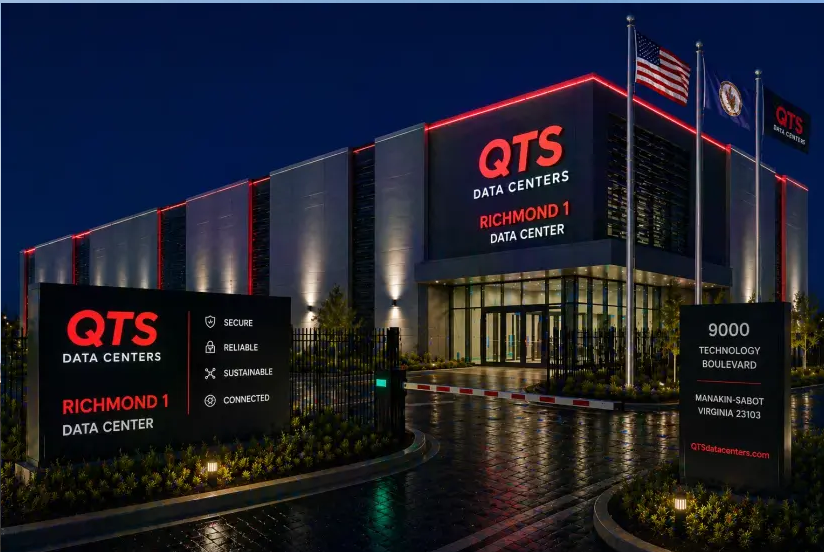
Well, about that.... Four and a half months after we reported that Blackstone was selling its stake in three Northern Virginia data centers , a move which we said may have "called the top in yet another commercial real estate segment", the private equity giant's own data center operator just found out what the other side of that top looks like. According to Bloomberg , QTS - a major data center operator acquired by Blackstone in 2021 for $10 billion - is slashing a planned private debt sale by about 60%, raising roughly $300 million instead of the $800 million it went looking for , after it struggled to find enough buyers and refused to pay much higher yields to bring them in.
Some investors didn't like the price. Others, per Bloomberg's sources, simply couldn't buy more because QTS has already been to the private placement market several times. In other words, the best credit in the data center business ran out of lenders before it ran out of things to finance .
And it has plenty left to finance. Below we go through what Blackstone actually refused to pay, every campus QTS is building or has promised to build (all 14 gigawatts of them), and, most importantly, why a $500 million shortfall at the top of the food chain is far worse news for everybody below it.
The deal was launched on Oct. 26 through a special-purpose entity called QTS Thunder Managing Issuer LLC, with Mizuho, Natixis, SocGen and Wells Fargo arranging notes of seven to 15 years. Pricing was expected within days. That was three weeks ago.
What finally got done on Friday: a $100 million seven-year private placement at 245bps over benchmarks , plus a $200 million five-year bank loan that still has to be priced over the coming weeks. With the 10-year Treasury at 5.15%, that probably works out to a coupon somewhere north of 7% for an investment grade landlord. For context, when QTS sold its first green project bond in April, a 10-year rated Baa2 by Moody's, initial talk was around 162.5bps . So Friday's print is some 80bps wider on a shorter maturity (different structure, so treat that as napkin math), and roughly 2.7x the 89bps where Goldman had the USD IG index earlier this month.
And that was the price Blackstone was willing to pay. The one the market wanted was higher still.
Blackstone was reluctant to offer significantly higher yields on its latest borrowing because it finances frequently across multiple markets and issuers, according to the people. Wider pricing on the QTS transaction could establish a more expensive reference point for investors evaluating other Blackstone-related debt, the people said.
Translation: Blackstone has too much paper out there to let any one piece of it print at the real clearing level . Which makes sense when you recall that QTS sits inside vehicles like BREIT and Blackstone Infrastructure Partners, where the sponsor has a say in the marks. When you grade your own homework, the last thing you want is a public test score.
So instead of paying up, Blackstone took what it could get at its price and left the rest. The original $800 million was meant to refinance existing five-year bank debt; with the smaller deal, that bank financing simply stays where it is. Put differently, the banks that were supposed to be taken out by insurers are still holding the loan , which regular readers will recognize from the lenders stuck with the Nexus/Anthropic bridge in Texas . Different rating, same plumbing problem.
How did the market get full? QTS did most of the filling itself:
Add up just the deals Bloomberg lists ($1.65 billion and $800 million in the private market, then $4.6 billion and $3.9 billion of green project bonds in April and August) and you get about $11 billion of debt in 18 months . Blackstone paid roughly $10 billion for all of QTS in 2021, debt included. So the company has now borrowed more than its entire purchase price in a year and a half, and that's before counting the CMBS and bank lines.
Maybe this is why Blackstone and the other lenders were in no hurry when Jensen Huang rushed out his $500 billion financing "platform" over the summer, at a time when their own data center debt deals were reportedly crawling along. As we said at the time:
So it was Jensen who rushed the Collateralized Compute Obligations.
Makes you wonder what NVDA purchase orders are now that (much) lower token prices are flowing through the frontier income statements pic.twitter.com/NA1vDUJQVl
— zerohedge (@zerohedge) August 14, 2026 First Junk, Now Investment Grade
Why does a $500 million shortfall matter in a year when hyperscalers alone have sold $296 billion of bonds?
Because of who the buyers are. The private placement market is the home of life insurers and long-only asset managers, the "sticky" money that buys long-dated paper and holds it to maturity ( this is, or rather was, the dumb money with "unlimited" funds CoreWeave's founder was chasing one month ago before the stock imploded ). It is also small: Bloomberg, citing Private Placement Monitor, puts last year's investment grade issuance at just over $200 billion. QTS was asking that market for 0.4% of a year's volume and couldn't get it.
We have been warning since October 2025 that AI had become a debt bubble, and for the past month we have been tracking, deal by deal, how the funding window is closing from the bottom up. First went the IPOs. Then the junk bonds: as we laid out on Thursday in " Who Funds The Data Center Pipeline Now That Junk Buyers Have Left The Building? ", the weekly high yield data center deal of the summer has gone to zero since the end of September. The answer to our question was supposed to be the investment grade buyer. Well, QTS just told us that buyer is getting full too.
Goldman saw it coming. Last weekend, in " Credit Crunch Imminent ", we showed how the hyperscalers had blown through the bank's full-year issuance forecast of $250 billion two months early, according to credit strategist Amanda Lynam's " AI-Related Supply: Outlining the Directional Risks " ( available to pro subs ). The cost of all that supply showed up in new issue concessions: Goldman's credit desk put the average at 7.8bps versus 3.4bps for the year, and north of 18bps for AI deals in November :
Then this week the bank's flagship Top of Mind report ( available to pro subs ) asked whether the AI investment cycle is durable, and landed on a conclusion that reads like a preview of Friday's QTS headline. As Goldman's sales desk summarized the report's credit section:
Investors are increasingly risk-averse, favoring top-tier developers with Investment Grade (IG) wrappers, strong leases, and secured regulatory permits. While the cost of capital has increased, the primary constraint for the AI debt issuance wave is market saturation.
That's the whole QTS story in one word. Price was only half of what killed the deal. The other half was that the people who buy this stuff already own too much of it .
Private markets were supposed to be the release valve, and Goldman still expects another $300 billion of AI project finance in 2027 on top of $440 billion of direct hyperscaler bonds. But as we pointed out when we went through Lynam's off-balance sheet primer, " Framing Off-Balance-Sheet Liabilities in the AI Ecosystem ", the bank's own chart shows private data center financing running at roughly $100 billion this year, below last year's $130 billion, with private credit a barely visible sliver:
Other banks have been circling the same drain. Barclays, in " The blue wave raises the bar for AI " ( also available to pro subs ), found its AI ecosystem trading about 44bps wide of the IG index, from 10bps tight a year ago:
The irony is that in the same note Barclays counted 27 data center bonds across IG and HY and found just two that were fully operational . One of them was a QTS deal. So the borrower that just got turned away happens to be the one whose buildings actually exist.
And Morgan Stanley? Its big AI financing note of Oct. 1 was titled " The State of AI Financing: A Pause, Not a Pullback ". Six weeks, one election and one Nvidia CEO later, the pause is alas looking rather permanent.
14 Gigawatts: Everything QTS Has Built, Is Building, Or Has Promised
So what exactly is all this debt paying for? We went back to the Bernstein/Aterio project database behind last week's " Gigawatts vs. Bragawatts " (the note itself, " Data Center Pipeline Probabilities: Separating the credible developers from dudes with PowerPoints ", is available to pro subs ) and pulled every QTS record in the United States. There are 257 of them.
First, the good news for bondholders: QTS is no Bragawatt dude with a PowerPoint. Bernstein gave it a perfect 5.0 credibility score and credits about 80% of its 14.3 GW book, which puts it in the top five developers in the country, right behind the hyperscalers themselves:
How much of each developer's data center pipeline actually gets built
Share of forward pipeline ranked by Bernstein as credible: META, MSFT, GOOGL, QTS, Vantage are top 5 https://t.co/PnaAKyjbRt pic.twitter.com/bbMCJmDb6d
— zerohedge (@zerohedge) November 11, 2026 Now the bad news: that book is enormous, and most of it has yet to be paid for. Here is the full map:
3.0 GW operating across legacy and new campuses: Richmond, Atlanta, Phoenix, Northern Virginia, Fayetteville, New Albany and others.
4.2 GW under construction , led by Eagle Mountain, Utah (1.05 GW), Cedar Rapids, Iowa (1.05 GW, tagged to Meta in the database), Fayetteville, Georgia (0.7 GW more for Microsoft and OpenAI, on the campus that backed April's $4.6 billion green bond) and York County, South Carolina (0.4 GW).
7.1 GW announced with no shovels in the ground : Blakely, Georgia (1.4 GW, with a completion target of late 2034), the Caprock campus near Midland, Texas (1.2 GW), Bessemer, Alabama (1.1 GW), the Lancium Clean Campus in Texas (0.9 GW), Glendale, Arizona and Van Wert, Ohio.
1.6 GW already cancelled : the Prince William Digital Gateway, which QTS walked away from in July , two days after the Northern Virginia sale. QTS also gave up on a Wisconsin campus in January.
— zerohedge (@zerohedge) July 2, 2026 That's before a $25 billion, 18-building campus in Berwick, Pennsylvania, which is in the database without a megawatt figure, and before Europe, where QTS is behind a £10 billion, 720MW conversion of a former power station in northern England and has plans in Finland.
Do the napkin math. At the roughly $49 billion all-in price of a gigawatt the tenant pays for most of the bill (chips, servers, networking), but the landlord's share of shell, power and cooling still runs well north of $10 billion per GW . On 11.3 GW of unfinished and unstarted US capacity, QTS is probably looking at a nine-figure sum per week for years, most of it borrowed . And on Friday the market balked at only $800 million.
Blackstone's answer to all this is that the tenants are money good. Here is Gray on the Oct. 22 call:
So the vast majority of that 7% is in data centers that have 15 to 20 year lease terms at initiation with 96% investment grade counterparties with an average market cap of $2.5 trillion.
Fair enough, and the buildings with named tenants bear it out. But the database can match a tenant to only about 1.6 GW of the 4.2 GW under construction, and to none of the 7.1 GW still on paper. Some of that is surely leases nobody has disclosed (QTS has always said it builds against signed contracts). Some of it, probably, is 2030 capacity for customers who are busy pulling the plug on rentals and tapping shareholders to fund the capacity they already ordered.
Then there is the map. Three quarters of the unbuilt pipeline sits in states where Bernstein now applies a political haircut:
Texas alone is 2.3 GW, and Texas is where the governor-elect has promised a freeze . The Caprock campus is a neat example of the bind: it plans to run on up to 1.2 GW of on-site gas engines until the grid shows up, which is exactly the behind-the-meter model we have been pounding the table on. It also needs an air permit from TCEQ, the agency that was ordered to halt data center permits . Georgia, home to another 1.8 GW, is next in line for a pause .
Blackstone's CEO has a theory about that too. On the same call, Steve Schwarzman told investors that " current public attitudes towards data centers will likely only amplify this scarcity ". It's a great argument for owning a finished, leased building. It's a rather awkward one when you are trying to borrow against 7 GW of buildings the public won't let you start.
Here's the part that should worry everyone further down the capital structure.
QTS is as good as it gets in this business: investment grade, the biggest sponsor on Wall Street, operating assets and hyperscale tenants. If that borrower gets 37 cents on the dollar at its price, what happens to the developers who score a 2 on Bernstein's scale instead of a 5? What happens to the junk-rated project bonds that need to be refinanced in 2027 and 2028, or to the $300 billion of project finance Goldman has penciled in for next year?
We'd also note the pattern with this particular sponsor. Blackstone sold fully leased Virginia capacity in June. It abandoned the Digital Gateway in July. Its AirTrunk unit pushed a $1.5 billion REIT IPO to 2027 in October. And the public data center vehicle it sold to investors at $20 in May, Blackstone Digital Infrastructure Trust (BXDC), closed Friday at $16.69, down about 17%, days after its lockup expired. Twice this year public investors were asked to put a price on Blackstone's data centers, and twice the answer came back lower than the one in the marketing deck. On Friday the firm decided it would rather not ask a third time.
Which means the latest entry on our running casualty list comes from the very top of the pyramid:
There are two ways to read Friday's news. The charitable one is that Blackstone showed discipline: it had no urgent need for the money, the bank debt can sit where it is, and a sponsor with $1.4 trillion under management can afford to wait for a better window. The less charitable one is that the window has been getting worse for two months, the Fed is hiking, the borrower has another 11 GW to fund, and "we'll wait" only works if waiting makes things better.
We lean toward the second, for the simple reason that every funding market for data centers has now given the same answer in the same order: equity first, then junk, then the banks' bridge books, and now the insurers . The only buyer nobody has tested yet is the one in Washington, and after the midterms and the Jensen shitshow, the Uncle Sam bailout window (which nobody talks about publicly yet, but everyone knows will be tested sooner or later), is now looking far more precarious.
Monday, before the open: BXDC reports its third quarter. Listen for what management says about cap rates and whether it is still buying.
Tuesday, after the close: Nvidia reports, its first quarter without Jensen.
The next few weeks: the $200 million bank loan still has to price. If that slips too, the 60% cut becomes something bigger.
Wednesday night: Anthropic prices one of the biggest IPOs in history, the one event that could reopen every one of these windows at once, or slam the rest of them shut.
The next QTS project bond. April's and August's deals raised $8.5 billion between them. The campuses under construction will need another one soon.
Back in June we wondered why Blackstone was pulling the cord just as doubts were creeping in about who would keep funding the AI buildout. Now we know. The largest landlord in AI spent the summer selling what it had finished, cancelling what it couldn't start, and borrowing against everything in between. On Friday, the lenders finally said enough .
Much more in the full Goldman " AI-Related Supply: Outlining the Directional Risks " and " Framing Off-Balance-Sheet Liabilities in the AI Ecosystem " notes, and Bernstein's " Data Center Pipeline Probabilities ", all available to pro subs .
منبع: ZeroHedge — متن کامل از فید رسمی منبع، با ترجمهی ماشینی عنوان و خلاصه