همه انرژی هستهای میخواهند، هیچکس سهام هستهای نمیخواهد: در درون موج بزرگ ارتقا
روز دوشنبه، شرکت X-energy (XE) دومین پروژه راکتور خود با حمایت Amazon را در ایالات متحده امضا کرد؛ یک نیروگاه ۹۶۰ مگاواتی ۱۲ واحدی در محل یک نیروگاه زغالسنگ بازنشسته AEP در ایندیانا. در همان روز، سهام آن در کف بازه ۵۲ هفتهای خود یعنی ۱۰.۳۶ دلار و ۷۱ درصد پایینتر از سقف خود قرار داشت. این، در یک جمله، وضعیت رنسانس هستهای است.
Everyone Wants Nuclear Power, Nobody Wants Nuclear Stocks: Inside The Great Uprate Rush On Monday, X-energy (XE) signed its second Amazon-backed reactor project in the US, a 960MW, 12-unit plant on the site of a retired AEP coal plant in Indiana. The same day, its stock sat at $10.36, the bottom of its 52-week range and 71% below its high .
That, in one sentence, is the state of the nuclear renaissance in October 2026: the customers have never been bigger, and the shareholders have never been more nervous .
Regular readers know we have been tracking the AI-nuclear trade since before Microsoft agreed to restart Three Mile Island back in September 2024 , and lately we have been fixated on the growing gap between the physical market and the tickers, first in " The Nuclear Renaissance Disconnect: Utilities Plan Big While Stocks Lag " (Sept 22) and then a week later in " Uranium Term Prices Hit A Record... So Why Is Nuclear Getting Nuked? " Since then the gap has only widened. Goldman's clean-tech team led by Brian Lee put a number on it in its latest Nuclear Nuggets: Global reactor tracker ( available to pro subs ):
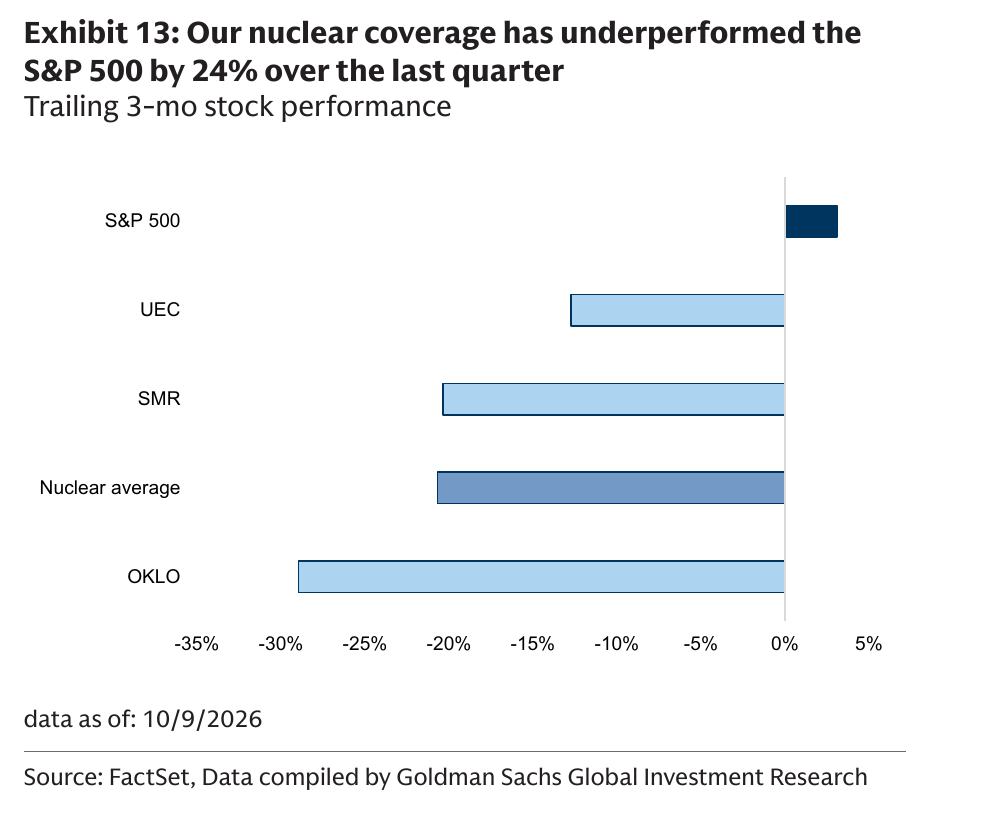
Nuclear equities materially underperformed the broader market over the past three months, with our nuclear coverage averaging a -21% return over the period compared to the S&P 500, which returned +3% . Similar to prior quarters, performance varied across the group, although weakness was broadly spread across both SMR and uranium-exposed names. In particular, OKLO declined 29%, the weakest performance in our coverage, which we attribute to continued risk-off sentiment toward advanced nuclear developers and limited near-term commercial catalysts. And the shorts smell blood: NuScale (SMR) saw the largest jump in short interest, up 16% in a month , while Uranium Energy (UEC) saw some covering (-14%), which Goldman reads as "relatively more constructive positioning toward uranium-focused names." Translation: if you must own nuclear, own the rocks, not the PowerPoints .
And that was the good part. Goldman's data run to Oct 9. The week that followed was much worse.
Start with what the buyers have done. Between Sep 22 and Oct 20, the hyperscalers and Washington signed, funded or floated at least nine US nuclear deals, from Google's uprates at Georgia Power to Amazon's 20-year Calvert Cliffs PPA with Constellation (CEG), the DOE's ~$4 billion uprate loan to Vistra and, the big one, Google's 3,590MW deal with Constellation , 890MW of which is new capacity squeezed out of 11 existing reactors.
The deal flow surprised even the people paid to forecast it. Here is Scotiabank's utilities team (Andrew Weisel et al) in its latest Scotiabank Circuit ( also available to pro subs ), with a rare mea culpa:
For each of these data center announcements, we admit that we incorrectly expected a news flow drought until after midterm elections , making these updates seem like more positive proof points that demand for long-term nuclear and data-center contracts remains robust. Scotia crudely estimates the Google deal alone could add "as much as $2/sh of EPS (+~10%)" for Constellation, and says the two contracts make CEG "the leading U.S. IPP by data center-contracted capacity." Taiwan's Yuanta went further, calling Google's multi-reactor deal the template for a "revaluation of existing nuclear power assets," and illustrating it with a chart it credits to, ahem, Zero Hedge.
So how did the stock react to becoming Big Tech's nuclear landlord? Well, CEG traded above $300 on the Google headline on Oct 6. Two weeks later it was at $263, down 7.4% last week alone and 26.4% YTD , per JPMorgan's Jeremy Tonet, whose Sparks & Quarks note offered the simplest explanation of all: on Wednesday, "our trading desk saw supply in CEG, with investors reducing exposure post contracting wins ." Sell the news, buy... some story stock with momentum and an Div/0 PE ratio.
Part of the problem is that the easy megawatts are spoken for. Raymond James (J.R. Weston), raising its CEG target to $341, notes that the Amazon and Google agreements " have largely committed the ~1 GW of nuclear uprates within CEG's ~5-GW PJM Cycle 1 pipeline , leaving ~4 GW of gas, storage and other development opportunities," and that additional uprates "likely face longer interconnection timelines." The other part is that pricing on the new PPAs is undisclosed, and the market (as it so often does) has assumed the worst.
CIBC, which initiated on both CEG ($358 PT) and Talen (TLN, $499 PT) last week, thinks that's a mistake: in its view the market "still assigns insufficient value to CEG's contracting upside," while TLN's valuation "implies minimal upside from data centre deals ." HSBC, launching coverage of 28 US utilities this week, rates all four IPPs (CEG, NRG, VST, TLN) a Buy. Echoing virtually every other sellside desk, then, the Street loves what the tape hates.
If there is one trade the past four weeks clarified, it is the uprate . New nuclear remains brutally expensive and slow; squeezing 5-20% more out of a reactor that is already licensed, already staffed and already on the grid is neither. As Scotiabank puts it, "though new nuclear build remains challenging, we're impressed with recent nuclear uprate activity." The NRC lists ~30 expected uprate applications through 2032, totaling ~2.4GW, led by Constellation (12), Duke (5), Southern (4) and Vistra (4). And that data predates the Amazon, Google and DOE deals.
We made the same point with numbers when the Google deal hit, when we put out this chart : gas is still the cheapest firm capacity on a $/kW basis, but the grid queue is now up to 4.5 years, while restarts and uprates sit on sites that are already connected.
UBS's Jon Windham lays out the full US pipeline in his latest X-energy note : 2,421MW of planned uprates against a 5,000MW target by 2030 , another 2,255MW of restarts (Palisades, Crane/TMI-1, Duane Arnold), and some 14GW of large new build that, apart from VC Summer, still has an FID date of "TBD." Put differently, the US is about halfway to its uprate goal with four years to go, which is why every federal dollar and every hyperscaler check is now chasing the same few reactors.
Why are the owners of those reactors suddenly so valuable? HSBC's Meike Becker answers in one sentence, in the bank's 210-page US Utilities initiation :
Between nuclear tax credits, which provide an inflation adjusted floor at c45USD/MWh and rising, the explosion of capacity payments in PJM, which provide an uplift of c14-15USD/MWh to market prices, rising PJM forward prices of 60+USD/MWh and now long-term PPAs, the profitability of US nuclear has dramatically increased and been derisked . HSBC models Constellation's implied nuclear price rising from the mid-$40s/MWh in 2022-24 to the mid-$80s by 2029/30 , assuming 75% of the fleet is contracted by 2032 at "c75+USD/MWh for existing assets and higher for extensions." The catch, as HSBC flags, is that the PTC is only guaranteed through 2032, and "affordability pressure and regulation" could slow contracting.
A word of caution on the bigger picture: BloombergNEF's latest outlook (via Needham) sees just 13.7GW of US nuclear additions through 2036 , mostly restarts, uprates and a handful of conventional projects, versus as much as 67.8GW of new gas through 2030. In other words, nuclear wins the contracts, gas wins the volume , at least for this decade.
Which brings us back to X-energy, and to the anchor of this week's flow, BTIG's Energy Transition Blog (Greg Lewis and team):
AEP signed a joint development agreement with X-energy to evaluate feasibility of a ~960MW nuclear energy project in Indiana. The project is backed by an Amazon funding agreement, and AMZN plans to enter a long-term PPA if the project reaches positive FID . Located at a former coal plant, XE would initially install 12 SMRs (~80MW each), part of a broader agreement with AMZN to add over 5GW of nuclear capacity to the US grid by 2039. Note the "if." UBS calls the AEP deal "a significant positive" and reminds us that Amazon owned ~23% of XE's Class A shares as of June 30, which helps explain who keeps signing XE's customer agreements. JPMorgan says the deal delivers on the 1GW announcement management promised on its 2Q call, but wants "firm contracted offtake, financing structure, capex, and licensing timeline" before investor confidence returns. Near term, UBS says, the focus stays on XE's Seadrift project in Texas, expected to receive construction approval in early 2027. Meanwhile XE, which filed for its IPO in March and listed in April, now trades at a $4.1 billion market cap, give or take a few Amazon PPAs.
Then there is Deep Fission (FISN), which plans to drop reactors a mile down a borehole. BTIG notes it firmed up a master energy purchase agreement with the Great Plains Development Authority for a 150MW first phase in Kansas, targeting COD in 3Q28 and up to ~2GW later. Canaccord's George Gianarikas, who rates it a Buy, read the fine print in his "Digging deeper" note: the agreement "binds Deep Fission to supply power once licensed and operating, while the GPDA has no minimum purchase obligation ." And the cash: ~$72 million at the end of 3Q, ~$40 million by year-end, overhead of ~$3 million a month and, per management, "about $90 million yet to get to spent" on the pilot. Canaccord expects "the company to need additional capital." So do we. The analyst's defense of the sector is worth quoting, if only for the prose:
In this nuclear arena, perfection is a ghost . Every contender bears its own vulnerability. The market's verdict was less poetic. Needham's Power & Infrastructure Weekly shows its nuclear reactor basket fell 19.2% in the week to Oct 16 , the worst subsector in its coverage, and is now down 50.6% over six months and 74.6% over twelve . The fuel-cycle basket is down 76.3% over a year.
Needham's diagnosis: "We view the weakness primarily as a repricing of financing and execution risk rather than deteriorating power demand ," with data center capex "increasingly being underwritten above $13MM/MW" and dilutive converts (CIFR's surprise $850 million) setting the tone. Oklo (OKLO), at $27.97, is now 84% below its 52-week high; NANO Nuclear (NNE) is 74% below; Centrus (LEU) 72% (more on that in the final chart below).
And the issuance pipeline isn't closed. Buried in the Nuclear Nuggets disclosure appendix: Goldman "is acting as a manager or co-manager of a pending underwriting" for Oklo (ironically, in the same note in which it cut its Oklo price target to $49 from $57).
It isn't all dilution and despair. Goldman's SMR tracker logged real licensing progress: the NRC issued the first US construction permit for a BWRX-300 at TVA's Clinch River site (Sep 30), Holtec filed its Preliminary Safety Analysis Report for two SMR-300s at Palisades, and Blue Energy filed its first construction permit application. On the other side of the ledger, Bechtel will step away as EPC contractor on TerraPower's Natrium project after the current phase ( as we covered when it hit), a reminder that the hardest part of nuclear is still pouring the concrete. Reuters reported this week that SMR developers are scrambling to lock in EPC partners precisely because, as the Breakthrough Institute's Adam Stein put it, most " have no internal knowledge of how to build a large facility ."
Indiana, meanwhile, is turning into the nuclear capital of the Midwest, at least on paper. Besides XE/AEP, AtkinsRéalis signed an MOU with the state and Hoosier Energy for up to eight CANDU reactors, or 6GW , which JPMorgan values at "~$12-24B." CIBC's Krista Friesen calls it a "modest positive," though "highly preliminary, with financing, offtake arrangements, and development timelines yet to be established," and "would not anticipate a near-term addition to backlog." And The Nuclear Company floated a 6.6GW, six-reactor "Prosperity One" campus in Kentucky, which so far consists of a site. Big numbers, small commitments.
Uranium: A Record Term Price On The Thinnest Volume Since 2009
The fuel market is telling the same story in miniature. Per Goldman, spot U3O8 hovered around $90/lb through September and into October, while the long-term price held at a record $96/lb. But look at the volume:
Despite broadly bullish sentiment following the WNA Symposium and expectations for stronger utility demand, spot market activity remained subdued, with September volumes falling to their lowest monthly level since December 2009 . The Sprott Physical Uranium Trust, the marginal spot buyer of the last cycle, "was absent from the market in September," and Goldman estimates 2026 term volumes are still tracking below the five-year average. A record price that nobody trades looks a lot like a standoff.
Which is what we were getting at when the Constellation news hit:
in light of today's Constellation news, a reminder on the Uranium market.
— zerohedge (@zerohedge) October 6, 2026 Goldman's commodity grid shows the rest of the chain flat to softer on the month, with spot conversion down 3% (and 6% over three months) , even as SWU is up 287% over five years.
Speaking of conversion: Yuanta singled out Solstice (SOLS), " the only nuclear fuel conversion facility in the US ," as the name that "merits attention." Activist Starboard apparently agrees. Jeff Smith unveiled a stake on Tuesday , calling the stock "stupid cheap" and urging management to focus on its refrigerants and nuclear businesses . When the activists show up, the bottom is either close or, well, still a ways off.
While US investors agonize over financing, the rest of the world keeps pouring concrete, and mostly in one country. Of the ~80 reactors under construction globally, 38 are in China , against eight in India and seven in Russia. All five 2026 grid connections on Goldman's list (most recently Tianwan-7 on Oct 8) are Chinese, as are half of the ten construction starts.
The phase-out crowd, meanwhile, is in full retreat. Barclays' sustainable investing team, in its "Nuclear Renaissance gathers steam" spotlight, counts the reversals:
Italy's Senate approved a return to nuclear nearly 40 years after the ban,
Switzerland's parliament lifted its ban on new plants (referendum pending in 2027),
Taiwan cleared Taipower's restart plan for Maanshan, which could restart as soon as 2028.
Goldman adds that the Dutch scrapped Borssele's 2033 shutdown date, paving the way for operations to 2054. Barclays' conclusion: "policy risk is continuing to ease for nuclear developers." Japan, too, is back, as we noted last month:
How it's done: This is TEPCO’s Kashiwazaki-Kariwa nuclear power station in Niigata. The seven-unit site has 8.2GW of capacity, making it the world's largest power plant. Unit 6 entered commercial operation on 16 April 2026, returning a 1.36GW Advanced Boiling Water Reactor to service and marking TEPCO’s first commercial nuclear operation since Fukushima. Expect a SoftBank/Oracle/OpenAI data center in its vicinity in the next few months.
— zerohedge (@zerohedge) September 30, 2026 Then there are the newcomers. BTIG flags that the Philippines, which has never operated a reactor (its Bataan plant has sat dormant since the 1980s), now targets ~1.2GW of nuclear by 2032, ~2.4GW by 2035 and ~4.8GW by 2050, mostly via SMRs; Vietnam recently approved a ~2.4GW plant for the early 2030s. The EU's Innovation Fund, in its latest €3.4 billion round, made its first-ever SMR award, to Calogena's 30MWt heat-only pilot in France. As BTIG puts it, " we expect the growing global emphasis on energy security and soaring energy demand (think AI data centers) will motivate more countries to look to nuclear as a stable source of power."
One late twist: Reuters reported on Wednesday that Hungary's new Magyar government is considering replacing Rosatom as main contractor on the Paks II expansion, whose first concrete was poured in February (it is on Goldman's 2026 construction-start list above). The project, originally estimated at €12.5 billion, has already cost Hungary more than €2 billion. Rosatom says it has received "no formal notification." Expect that one to end in court, much like Finland's.
Which leaves the one variable no PPA can hedge: Washington. With the midterms on Nov 3, Samsung Securities' energy team (in its midterm policy note expects the outcome to "influence the pace of nuclear power policy implementation rather than its strategic direction," since the core supports, from the 45U tax credit to the Nuclear Fuel Security Act and the ADVANCE Act, all passed with bipartisan votes. The soft spots are the executive-order initiatives: the $17.5 billion of conditional DOE loans for long-lead AP1000 components (seven sites signed LOIs, none disclosed) and the NRC overhaul, where Democrats have already questioned the departure of 400 NRC technical staff. A Democratic House " can conduct investigations, hold hearings, issue subpoenas ," which is about what we expected when we wrote that data centers and nuclear would be likely targets if Dems win the House .
Demand, for its part, keeps getting revised up. HSBC just raised its US data center demand forecast by 80% to ~900TWh in 2030, and JPMorgan notes SpaceX's "blue sky" scenario of adding 20GW of incremental power next year, with "high confidence in at least 10 GW." UBS sums up the hyperscaler side: their continued support of new nuclear "highlights the pace at which demand for clean energy is outstripping available supply."
So what explains the puke? Our take is that the market is finally drawing the line Goldman's numbers hint at. On one side are the owners of licensed, grid-connected reactors (Constellation, Vistra, Talen), whose megawatts are being bid up by the richest companies on earth with a federal tax floor underneath. On the other are the pre-revenue developers, who still need several more rounds of capital (and underwriters' fees) before the first electron, and whose "customers" in some cases have no minimum purchase obligation. The first group is probably oversold. The second has, in all likelihood, more dilution ahead before it bottoms.
We remain long-term believers that modular reactors, ideally deployed behind the meter, are the endgame for AI power. But between now and 2030, the cheapest, fastest nuclear megawatt is the one that already exists, while waiting for the ones that don't exist yet has been a costly exercise for shareholders:
Much more in the full Goldman " Nuclear Nuggets: Global reactor tracker - October edition; 3Q26 Preview " and the BTIG " Energy Transition Blog ", both available to pro subs , along with the Scotiabank, UBS, JPMorgan, HSBC, Needham, Raymond James, CIBC, Canaccord, Barclays, Samsung and Yuanta notes cited above, all available here .
تا این لحظه منبع مستقل دیگری این خبر را منتشر نکرده است.
بررسی خودکار: مقایسه با خبرهای ۷۲ ساعت اخیر منابع دیگر و اعتبار پایهی منبع؛ جایگزین داوری انسانی نیست.منبع: ZeroHedge — متن کامل از فید رسمی منبع، با ترجمهی ماشینی عنوان و خلاصه