حراجهای اوراق قرضه با شکست مواجه میشوند، حراجهای هنری نه: فروش نقاشیهای شاخص با بازگشت تقاضا برای آثار برتر ۷۶ درصد جهش کرد
این هفته نیز هفته دشواری برای حراجها بود. تمام سه فروش اوراق کوپندار در حراجهای بازپرداخت هفته گذشته با شکست مواجه شدند که با اوراق ۳ ساله در روز دوشنبه آغاز شد.
Bond Auctions Tail, Art Auctions Don't: Blue-Chip Painting Sales Soar 76% As The Trophy Bid Returns It was another rough week for auctions. All three coupon sales in last week's refunding tailed, starting with Monday's 3Y, which needed record Directs to save it. Tuesday's 10Y, which followed another hot CPI print, was downright ugly : it priced at 5.020%, tailing by a full basis point, the biggest tail since February. Indirects plunged from a near-record 80.3% to 61.2%, the lowest since October 2023, as foreign buyers staged a bit of a strike, and Directs soared to 29.0%, the highest since September 2013 :
10Y high yield 5.020%, WI 5.010%, 1bp tail, biggest tail since Feb
— zerohedge (@zerohedge) November 10, 2026 Thursday's 30Y then tailed too , at 5.441%, sending yields to session highs.
And yet there is one auction market where the buyers keep showing up. At Christie's and Sotheby's, 95% of all blue-chip post-war paintings offered in the first nine months of 2026 found a buyer, and 70% sold above their estimates. Here is how Swiss art-investment firm Partasio summed it up in its Q3 2026 Art Market Review :
"Confidence returned at the top end of the market. Sales of blue-chip post-war paintings priced above USD 500,000 reached USD 2.25 billion, up 76% from the previous year. The sell-through rate stood at 95%, while 70% of lots sold above expectations. Four paintings exceeded USD 50 million..."
So with the 10Y coupon at 5% for the first time since 2006, the art market is having its best year since, well, the last time anyone thought rates mattered.
A disclosure, before anyone rushes to bid: the report is, by its own fine print, an "advertisement" from a firm that sells blue-chip painting portfolios "starting at CHF 30,000", so it was probably never going to be bearish. The auction data underneath are hard numbers though, and with New York's marquee sales starting Monday, now is a good time to look at what they say. Even Partasio concedes that "the recovery has not been broad-based."
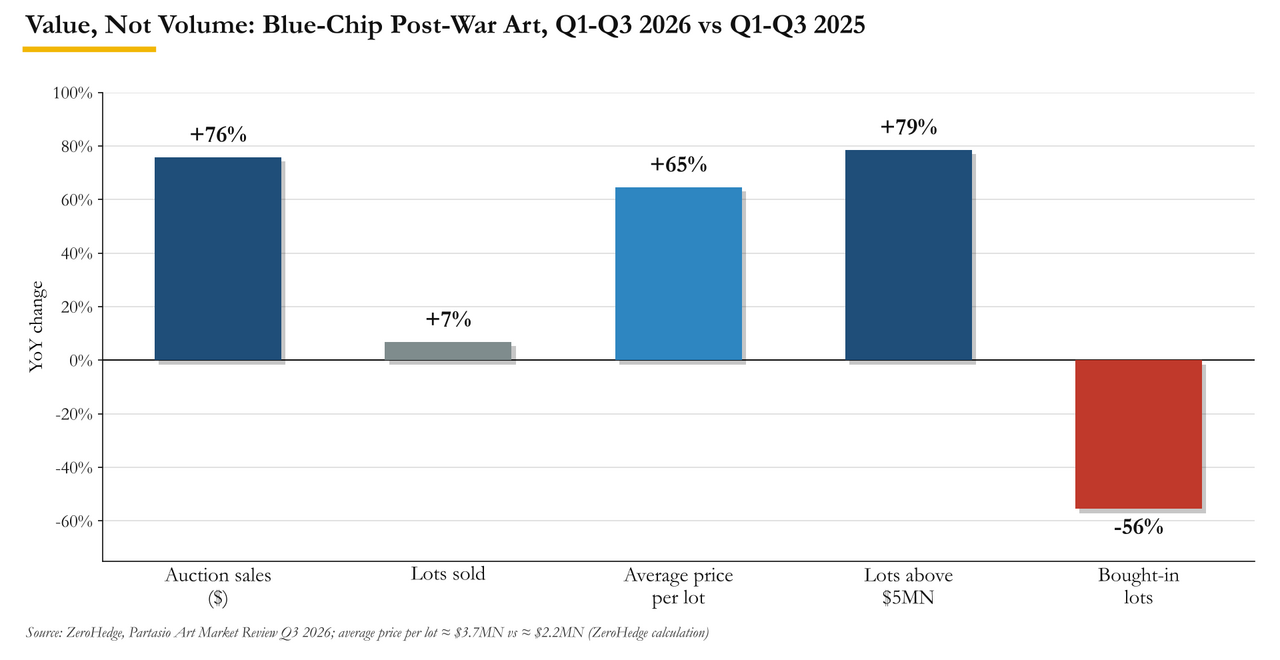
Partasio tracks paintings created after 1945 that sold for at least $500,000 (or, if unsold, carried an estimate of at least $500,000) at the four major houses: Sotheby's, Christie's, Phillips and Bonhams. In the first three quarters, 646 such lots were offered and 614 sold. Sales hit $2.25BN, up 76% from $1.28BN a year earlier, while the number of lots sold rose by just 7%, from 575 to 614.
Some back of the envelope math: that works out to an average price of roughly $3.7 million per painting, up about 65% from roughly $2.2 million a year earlier. Partasio says growth "came from value rather than volume, pointing to a deepening at the top rather than a speculative spike." We'll let readers decide where exactly a "deepening at the top" ends and a speculative spike begins, when the average painting costs 65% more than it did a year ago.
Estimates were blown away too. 432 lots sold above expectations, up from 348 in 2025, while lots below expectations fell from 133 to 96. Bought-in (unsold) lots plunged 56%, from 72 to 32, dropping the unsold rate to just 5%.
For context, the last time we were tweeting about Sotheby's buy-ins, just over a decade ago, it was for the opposite reason:
Art Bubble Also Cracking As 21 Of 71 Works Fail To Sell At Latest Sotheby's Auction http://t.co/XD2LnH5UUe
— zerohedge (@zerohedge) May 9, 2014 That's a roughly 30% buy-in rate then vs 5% now. And momentum built all year: results beat estimates by 21% at the March sales in New York and London, 19% in New York in May and 24% in London in June, before hitting 30% at the September sales in Hong Kong and London. Sell-through never dropped below 90% at any of the major sales.
But before anyone declares a new golden age, a word on the comps. The first nine months of 2025 were close to the trough: global auction sales fell 6% in H1 2025, with post-war and contemporary art down 19%, after the over-$10 million segment plunged 39% the year before ( per ArtTactic data cited by NBC ). Partasio's own data show zero paintings above $50 million sold in its universe in Q1-Q3 2025. Growth rates look a lot better off a base like that.
The turn came last November, when Sotheby's sold the Leonard Lauder Klimt for a record $236.4 million , the same night Maurizio Cattelan's 18-karat gold toilet "America" fetched $12.1 million (we previewed that particular masterpiece in " Flush With Value " (Nov 4, 2025)).
Klimt Painting "Portrait of Elisabeth Lederer" Became the Most Expensive Work of Modern Art at Auction at $236.4 Million in Nov, 2025 The trophy bid carried into 2026, with Christie's selling Jackson Pollock's Number 7A for $181.2 million in May as part of the $630.8 million S.I. Newhouse collection, per The Art Newspaper .
Strip out the top end, though, and the art market barely grew at all.
The number of paintings sold between $500,000 and $1 million actually fell, from 259 to 251. Between $1 million and $5 million, it inched up from 260 to 263. All in, sales of paintings between $500,000 and $5 million slipped from 519 to 514. Above that line it was a different universe: lots between $5 million and $10 million jumped 63% to 65, the $10-50 million band nearly doubled to 31 from 16 , and four paintings cleared $50 million, versus none last year.
If that shape looks familiar, it should: it is the K-shaped economy in oil on canvas. Back in January we wrote that the " K-Shaped Economy Is Here To Stay " (Jan 11), as Goldman's consumer dashboard showed asset owners pulling away on the back of the AI-fueled stock rally. Goldman's Joseph Briggs noted at the time that "the net worth-to-disposable personal income ratio remains near its all-time high on the back of strong equity price gains." Ten months later, that wealth has clearly found its way to the salerooms, but only the ones with velvet ropes.
It is also the same story we told about earnings in " The S&P 2 " (Oct 6), where Goldman's Ben Snider expected the top 10 stocks to deliver over two-thirds of Q3 S&P 500 earnings growth while the median stock barely grew. Swap Micron and Nvidia for a Pollock and a Rothko, and you have the 2026 art market.
Partasio's niche has company. The Art Basel and UBS Global Art Market Report 2026 found that global art sales rose a modest 4% in 2025 to $59.6BN, but sales above $10 million grew 30% . Bank of America's 2026 U.S. Art Market Report (compiled with ArtTactic) shows the same split in New York: the $10 million-plus segment snapped back after a 46.9% contraction in 2024, even as works under $50,000 still made up 61.3% of all lots sold.
Concentration shows up among the sellers as well. Christie's and Sotheby's accounted for about 95% of sales. Christie's led with $1.17BN (52% share), up 80% from $650 million, and Sotheby's matched that pace, also up 80% to $967 million (43%). Phillips grew 23% to $108 million, though its share slipped from 7% to 5%, while Bonhams was flat at $7 million. Diversification at its finest.
Geographically, it was all about New York, where sales rose 88% to $1.45BN, lifting its share of the total to 64% from 60%. London rose 68% to $466 million, while Hong Kong grew a more modest 49% to $283 million and saw its share slip from 15% to 13%.
Further down the food chain, things look a lot less festive. Partasio notes that "smaller galleries continue to face financial pressure and elevated shipping costs" (no thanks to diesel prices), and London's Stephen Friedman Gallery, which represented 39 artists and estates, went into administration in February owing creditors £7.8 million, more than £800,000 of it to artists, according to The Art Newspaper .
Since Partasio published, two of the four Q4 tests it flagged have come and gone, and both told the same K-shaped story.
At Frieze London (Oct 14-17), blue-chip stands were "largely conservative," and collectors kept taking longer to decide than before the downturn. Art adviser Judith Greve summed it up: "It's the very high and the very low stuff that is selling the best, it's still a strange time." The Fine Art Group's Philip Hoffman put it more bluntly: " the serious money is going to Paris, we are sending our whole team there with few on the ground in London. "
Paris, meanwhile, was busy burning . With rioters looting luxury stores across France the weekend before the fair, Art Basel Paris opened on Oct 20 behind anti-ram barriers and guard dogs, and shut early on the evening of Oct 23, scrapping its weekend days, on the advice of the Paris police prefect. Did it hurt sales at the top? Probably not: Hauser & Wirth sold a 1965 Gerhard Richter for $10.5 million on the first VIP day, and a Modigliani nude was on offer at over $100 million, per The Art Newspaper . Billionaires, it turns out, can always find a way through the barricades.
One more reason the top end looks so strong: it has never been easier to borrow against a painting, or to get the auction house to take the risk. Sotheby's completed a $900 million securitization in January , now including collectible cars alongside art, while Christie's financing arm has expanded into watches, handbags and wine ( per TAN ). Regular readers will recall that we flagged the art lending boom back in August 2024, when the rich were pledging their art for liquidity on account of " Margin Calls, Death, Divorce & Bankruptcy."
Then there are the guarantees. According to Bank of America's report, the guaranteed share of New York evening sales hit 78.3% in 2025, up from 36.4% in 2016 , and the bank notes that "Sellers are similarly cautious, relying more on auction guarantees and private sales than in previous years." In other words, the 95% sell-through rate comes with a lot of pre-arranged buyers. Art-backed ABS and guaranteed lots, sold into a market where Treasury auctions keep tailing... what could possibly go wrong?
Here is the chart that maybe says the most. Bank of America's data show that the average annual resale return on art sold at New York auction fell to 4.4% in 2025, from 5.3% in 2024. And for anyone who bought a work in the hope of a quick flip, works resold within five years returned minus 5.7% . Meanwhile, the Treasury is now paying a 5% coupon on the 10Y, and last week's 30Y cleared at 5.441%.
Put differently, the average resold painting now earns less than the 10Y it competes with for the same capital, before insurance, storage, and a buyer's premium that can run well into the double digits. Rate-insensitive, maybe... but not exactly a carry trade. Which is probably why the art market's bid is coming almost entirely from people who don't need to care about carry.
The art market's link to the stock market is nothing new either. When the S&P stumbled in 2016, Christie's first-half sales plunged 27% . And when FAANG was the only game in town, the reaction to a soft night at Sotheby's was this:
— zerohedge (@zerohedge) June 19, 2018 In 2026, everyone has been buying NVDA... and the Rothko.
Which brings us to Monday. Sotheby's, Christie's, Phillips and Bonhams expect at least $2.04BN in New York sales this week, and potentially more than $2.4BN, according to The Art Newspaper . Sotheby's alone projects more than $1.1BN, a house record for a marquee season, about 40% of it from Wednesday's (Nov 18) sale of the Blaquier-Arrieta collection: 12 Impressionist and Modern paintings, all fully guaranteed, expected to fetch about $450 million. The headline lot is Van Gogh's Blossoming Chestnut Trees (1890), estimated at around $180 million, which would blow past the artist's $117 million auction record; Cézanne's Arlequin carries an estimate of around $120 million, just shy of his $137.8 million record. (Small irony: since every one of those works predates 1945, none of them will even count in Partasio's post-war tally.) Christie's expects $823 million to $1.1BN, led by its Nov 17 20th Century evening sale, where a Kandinsky and a Klimt are each estimated at $60-80 million.
The timing could be better. A week after the midterms crashed the AI trade, Jensen Huang resigned as Nvidia's CEO on Thursday, CPI ran hot for a third straight month, Waller floated a 50bp December hike, and gold tumbled below $3,900 while bitcoin puked under $70,000 (all recapped in Friday's " Everything Bad, Everywhere, All At Once... Except Stocks "). The auction houses insist none of that matters to evening-sale buyers. Christie's Kat Widing told The Art Newspaper that " People aren't day-trading Picassos. "
"If estimates are met, the sale would provide further evidence of strong demand at the upper end of the market and could close the year on a high note, carrying renewed confidence into 2027."
Our take: the 2026 art boom is a derivative of the AI equity boom, propped up by guarantees and art-backed loans, and the bottom of the market, and the galleries that serve it, haven't recovered at all. A painting that returns 4.4% a year is a luxury good competing with a 5% risk-free coupon, and the moment the AI wealth effect fades for real, history (2008, 2016) says the trophy end is where the bids vanish first. Then again, a Treasury auction needs a deep pool of foreign buyers, and as last week showed, it can't always find one. A Sotheby's evening sale just needs two billionaires in the same room, and one of them is probably the guarantor.
We'll check back after the Van Gogh hits the block on Wednesday night.
منبع: ZeroHedge — متن کامل از فید رسمی منبع، با ترجمهی ماشینی عنوان و خلاصه