موج آبی، همان راکتورها: انرژی هستهای تنها منبع انرژی است که واشنگتن هنوز روی آن توافق دارد
سهام بخش هستهای در سه روز پس از انتخابات میاندورهای به گونهای معامله شد که گویی دموکراتها با شعار تعطیلی راکتورها کمپین انتخاباتی راه انداخته بودند...
Blue Wave, Same Reactors: Nuclear Is The One Energy Source Washington Still Agrees On Nuclear stocks spent the three days after the midterms trading like Democrats had campaigned on shutting down reactors :
By Thursday it had hit a fresh 52-week low and closed at $19.20
On Friday it ripped almost 23% and finished at $23.55, six cents above where it started
Nuclear stocks finally soaring: attention once again turning to viable, baseload power for data centers.
It's been three days of nuclear-grade high-beta price action, with most of the nuclear group looking the same as Oklo.
Wednesday was supposed to be easy. Democrats took the House and Senate, the election hedges came off, and the Dow jumped over 1,500 points.
Reactor names rallied with everything else early, then rolled over. Oklo, NuScale (SMR), and Nano Nuclear (NNE) each closed down 4% to 6%, and Constellation (CEG) lost almost 7%, as traders dumped anything tied to AI power demand .
On Thursday, stocks tied to the AI data center buildout cratered , knocking 5.5% off the Nasdaq, and tech hedge funds wiped out their entire 2026 gain.
On Friday, Oklo's earnings and a blowout jobs report flipped the tape again . Centrus (LEU) jumped 17%, NuScale 16%, and Nano 15%.
What spooked the market was data centers, not reactors. As we wrote last week , Democrats spent the year demanding data center moratoriums, and Goldman estimates the states most likely to restrict them hold about 45% of planned U.S. capacity .
Thinking a dead data center means a dead nuclear renaissance implies that a history lesson is needed.
The polling data alone could shut down the AI bubble concerns.
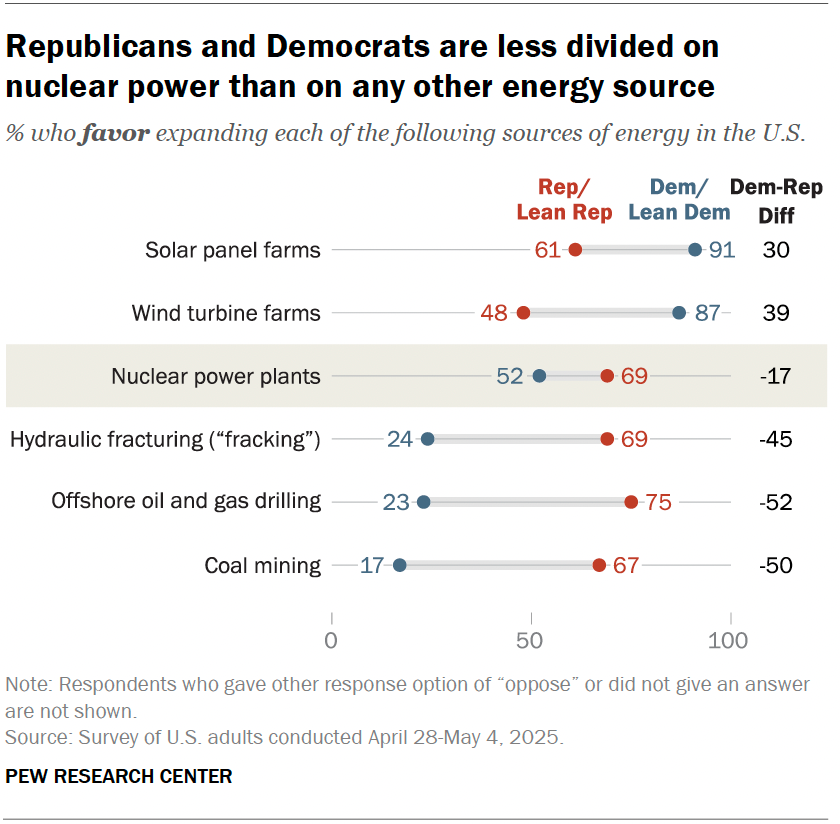
In Gallup's latest energy survey , 46% of Americans said the U.S. should put more emphasis on nuclear , the highest Gallup has ever recorded. Nuclear was also the only one of six sources to gain support since 2021, while solar and wind slipped.
More important for a divided government: " The current 10-point partisan gap in views of nuclear power is the narrowest of any energy source in the survey ," Gallup wrote. The gap on solar is 49 points. On wind, it's 59.
A year earlier, 61% of Americans told Gallup they favor nuclear, one point shy of the 2010 record . Pew found support for more nuclear plants climbed to 59% from 43% in 2020, up 16 points among Republicans and 15 among Democrats.
Some people clearly forget who signed up the U.S. for the nuclear renaissance in the first place…
It was Biden, not Trump, who put the U.S. behind the COP28 pledge to triple global nuclear capacity by 2050. Even the renewable energy poster boy, John Kerry , said at the time , "You can't get to net zero 2050 without some nuclear.”
The ADVANCE Act, which pushed the NRC to speed up licensing and cut fees for advanced reactors, was introduced by Democrats Tom Carper and Sheldon Whitehouse with Republican Shelley Moore Capito. It passed the House 393-13 and the Senate 88-2, and Biden signed it in July 2024.
Opposition in the Senate came from longtime anti-nukes Sanders and Markey, but in the House, 12 of the 13 No’s were from Republicans .
The enrichment money comes from the same timeframe. Biden signed the ban on Russian uranium imports in May 2024, unlocking billions of dollars Congress had set aside for domestic enrichment.
Biden’s DOE picked the companies eligible to compete for it, and Trump's DOE handed it out .
$2.7 billion went out in January of this year, $900 million each to Centrus, General Matter and Orano . Centrus CEO Amir Vexler thanked "Republicans and Democrats in Congress who came together to provide this urgently needed funding."
And in September, the House Energy and Commerce Committee advanced six nuclear bills covering enrichment, fuel recycling, licensing hearings and NRC pay, by votes of 41-0 to 44-0.
Let's not pretend though that a Democratic Congress is going to rubber stamp a thousand SMRs into existence across the US.
When we looked at what a Democratic House would go after, Capital Alpha flagged the administration's plan to license reactors through DOE and the Pentagon . Pumping the brakes on that bridge program could lead to headaches in the microreactor space.
The House Energy & Commerce Committee could potentially look to push for increased NRC independence, out of concern that the White House is possibly pushing the NRC to go faster than they are able to do so safely.
At the same time, Capital Alpha also noted that "surging electricity demand is shifting Democrats toward stronger support for increasing nuclear capacity ."
The market is pricing nuclear as a leveraged bet on AI capex rather than as a policy both parties own . We've already flagged the disconnect here, last time noting that "the customers have never been bigger, and the shareholders have never been more nervous."
The push for nuclear energy showed up before anybody cared about the potential electricity demand from data centers that might never even get built, long secured by ambitions to meet climate goals and national energy security objectives .
None of that changes just because the jerseys have swapped over in Congress.
منبع: ZeroHedge — متن کامل از فید رسمی منبع، با ترجمهی ماشینی عنوان و خلاصه