آنتروپیک عرضه اولیه عمومی (IPO) ۱۰۰ میلیارد دلاری با ارزش ۱.۴ تریلیون دلار... یا ۱.۰ تریلیون دلار، بسته به نظر شمارشکننده را آغاز میکند
خلاصه: آغاز تور معرفی IPO شرکت Anthropic. گزارش CNBC حاکی از اختصاص ۲۰ درصد سهام به سرمایهگذاران خرد است. گلدمن ساکز بانک سرمایهگذاری پیشرو در این IPO است. آغاز به کار IPO پنجشنبه آینده، ۱۹ نوامبر. آنتروپیک عرضه اولیه ۱۰۰ میلیارد دلاری با ارزش ۱.۴ تریلیون دلار... یا ۱.۰ تریلیون دلار را راه اندازی میکند. گلدمن ساکز بانک پیشرو در عرضه اولیه آنتروپیک، درآمد را پیشبینی میکند.
Anthropic Launches $100 Billion IPO Worth $1.4 Trillion... Or $1.0 Trillion, Depending On Who's Counting Summary:
Anthropic Launches $100 Billion IPO Worth $1.4 Trillion ... Or $1.0 Trillion
Goldman Lead Bank On Anthropic IPO Projects Revenue Of $600 Billion By 2030
Goldman Sachs is the lead investment bank on the Anthropic IPO, with shares set to debut Thursday, Nov. 19. CNBC notes that 20% of shares have been allocated to retail investors and that pricing will be determined on IPO day.
With Anthropic's IPO roadshow underway, Goldman projects that Dario Amodei's chatbot company could generate more than $600 billion in annual revenue by 2030 , according to a Financial Times report.
Goldman expects revenue of about $52 billion this year, $136 billion in 2027 and $442 billion in 2029. The 2030 target would represent more than 130 times the company's $4.6 billion in 2025 sales .
That extraordinary pace of growth comes with massive cash demands. Goldman projects free cash outflows of $12.8 billion in 4Q26 and $65.7 billion in 2027. It expects annual free cash flow to turn positive in 2030 , reaching $33.6 billion, as Anthropic works through a staggering $900 billion in computing commitments.
Operating losses are projected to peak at around $40.4 billion in 2027 before turning into an operating profit in 2029. Goldman estimates operating income will reach $65.2 billion in 2030.
Notably, Goldman led the SpaceX IPO in June . At the time, it expected revenue from SpaceX's AI division to jump to $322 billion by 2030 from $3.2 billion in 2025.
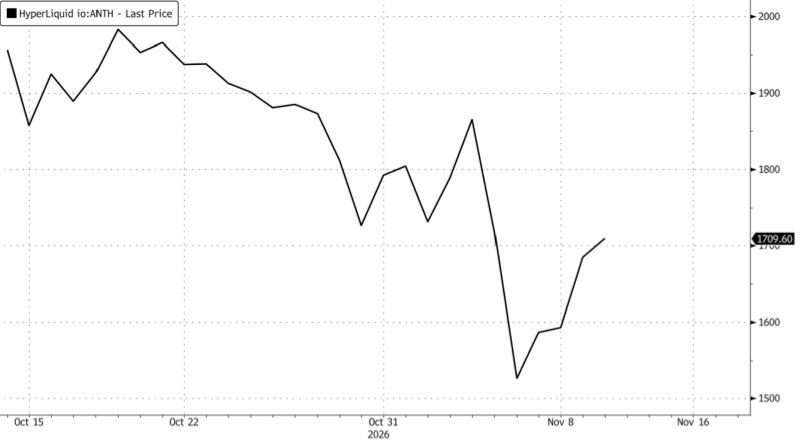
Hyperliquid's pre-IPO Anthropic contract has an implied market value of $1.7 trillion as of mid-morning .
Amazon and Google hold significant minority stakes that could be worth a whopping $411 billion at $78 a share.
Anthropic Launches $100 Billion IPO Worth $1.4 Trillion... Or $1.0 Trillion, Depending On Who's Counting
After five weeks in which the "fair value" of the biggest IPO ever slid from $2 trillion to $1.5 trillion and then to $1.2 trillion , Anthropic this morning filed an amended S-1 and kicked off its roadshow: 825 million shares at $70 to $78 each , ticker ANT, pricing next Wednesday night and trading on Thursday, Nov. 19. At the top of the range that is a $64.4 billion IPO, and with a concurrent $26 billion private placement from the company's biggest suppliers AMD, Broadcom, Google, Micron, Microsoft, Nvidia and Taiwan Semi (yes, more circular financings, don't ask), the total comes to $90.4 billion, more than SpaceX's $86.2 billion even after Elon's greenshoe. Throw in the Anthropic greenshoe, which will certainly be exercised, and the total capital raise will be north of $100 billion.
And the valuation? Depending on which headline you read this morning, the Claude maker is seeking either $1.4 trillion or about $1.0 trillion . Both are right, which probably tells you all you need to know about how the AI trade counts things. Either way, it is 30% to 50% below the $2 trillion being whispered in early October :
The Deal: $100 Billion, If You Count Everything (And After One Overnight Trim)
First, the terms, as recapped by Goldman , which is lead-left on the deal alongside Morgan Stanley and 20 other banks (when there is this much in fees, nobody stays home):
Anthropic itself is selling 801.4 million new shares, or 97% of the deal. The other 3%, some 23.6 million shares, comes from selling holders, and here the filing gets interesting: according to Bloomberg, each of the seven co-founders, CEO Dario Amodei included, is selling 3.38 million shares . Seven times 3.38 million is 23.66 million, which means the entire secondary tranche is the founders, cashing out about $264 million apiece at $78. That's a rounding error next to stakes of roughly 1.4% each (worth about $14 billion at the top of the range on our math), but it is still a quarter-billion-dollar founder payday on day one .
Add the 123.75 million share greenshoe (another $9.7 billion, all primary) and the placement, and the grand total rounds to $100 billion . Which just happens to be the number the bankers were targeting all along.
It almost looked different. Late on Monday, Reuters reported that a draft circulated to banks showed about 867 million shares at $70 to $80, or up to $69.3 billion, only for the company to pull it back within hours:
According to Reuters, the AI company first sent a copy of a filing that showed Anthropic aimed to sell about 867 million shares in a price range of $70 to $80 per share, then followed up with an email saying details about the pricing were inaccurate.… https://t.co/WJwrO9Fn1m
— zerohedge (@zerohedge) November 10, 2026 The version that reached the SEC has 42 million fewer shares and a top end that is $2 lower. In other words, the deal shrank by roughly $5 billion between dinner and breakfast . Maybe a typo, maybe one last haircut. In this tape, we know which way we lean.
Now for the confusion. Reuters and Bloomberg both put Anthropic's market value at about $1 trillion at $78, and both also say it is seeking $1.4 trillion. CNBC went with $1.405 trillion. So which is it?
We went through the share counts in the filing, and here is the bridge:
Start with the 11.93 billion shares that exist today (after the preferred stock and part of Amazon's convertible notes turn into common). Add the 801 million new IPO shares and the roughly 333 million going to the placement buyers, and you get 13.07 billion shares outstanding. At $78, that's $1.02 trillion. This is the actual market cap , the number an index provider would use.
To get to $1.4 trillion you have to add stock that isn't trading yet:
1.77 billion employee options with an average strike of $2.91 (no, that's not a typo, and yes, they are 96% in the money): +$138 billion
29 million shares issued since Sept. 30 for acquisitions and the donation-matching program: +$2 billion
and 2.05 billion shares reserved for future grants under the 2026 equity plan and the employee purchase plan: +$160 billion
That last one deserves a second look. Some $160 billion of the "$1.4 trillion valuation" is stock that hasn't been granted to anyone yet . Strip it out and the fully diluted figure is about $1.24 trillion. (And if you want to go the other way, the greenshoe and a 934 million share donation-matching reserve sit outside the $1.4 trillion and would add another $80 billion or so.)
$70 (low) $74 (mid) $78 (high) Shares outstanding only $917BN $968BN $1.02TN Fully diluted $1.26TN $1.33TN $1.40TN Two things stand out. On shares outstanding, the midpoint works out to $968 billion, or all of $3 billion above the $965 billion post-money of May's Series H (assuming that round was quoted on the same basis, which of course nobody ever specifies). And on a fully diluted basis the filed range of $1.26 to $1.40 trillion lands squarely inside the $1.25-$1.50 trillion bracket that Polymarket had made its favorite by last Friday. As usual, the prediction market got there before the prospectus did.
Then there is the $26 billion private placement, which goes off at the IPO price. The buyers, per the filing (share counts assume the $74 midpoint):
Investor Amount What it sells Anthropic Google $10.0BN Cloud, TPUs Nvidia $10.0BN GPUs AMD $2.5BN GPUs Broadcom $1.0BN Custom chips Micron $1.0BN Memory Microsoft $1.0BN Cloud TSMC $0.5BN Makes the chips for all of the above Total $26.0BN Regular readers, who have followed our coverage of AI circularity since we first called AI a debt bubble last October, will notice that every single cornerstone investor is also a supplier . The money goes from Nvidia to Anthropic as equity and comes back to Nvidia as a purchase order, and the same goes for the other six. Nothing says "arm's-length price discovery" like your seven biggest vendors setting the floor under your IPO.
It gets better. According to the filing, Google's $10 billion goes toward funding obligations it had already committed to under an earlier 2026 agreement. So, well, the genuinely new money in the placement is probably closer to $16 billion. And one name is missing altogether: Amazon, whose notes convert only up to its ownership cap.
The pitch to public investors rests on one number: a revenue run rate of $81 billion as of Oct. 31, up $10 billion in a single month . That is the reacceleration that was missing when we looked at the investor day numbers . At the top of the range, buyers are paying about 17x that run rate fully diluted, or 13x on shares outstanding. At $2 trillion it would have been 25x.
Q3 revenue rose 47% sequentially to $16.96 billion. The quarter before, it rose 144%.
Operating income flipped from a $974 million profit in Q2 to a $567 million loss in Q3 , as operating expenses hit $17.5 billion.
Price cuts and contractual discounts took about $600 million out of Q3 revenue growth, and that was before Monday's 20% cheaper Fable .
Commitments, mostly for compute and chips, climbed to nearly $901 billion , of which about $71 billion comes due in the 12 months through September 2027 .
Put differently, the entire $90 billion raise, the biggest in history, covers about 15 months of the bills already signed, and one-tenth of the total . A good chunk of it will end up with the same seven companies in the table above.
The prospectus itself speaks of a mission to "bring forth an age of miracles," while warning of existential risks to humanity, and the risk factors don't hold back either.
Our models have in the past behaved , and may in the future behave, in unintended, misaligned, or autonomous ways, including by taking harmful actions that no user or third party directed, which could adversely affect our reputation and brand, business, financial condition, and results of operations.
An age of miracles, existential risk and a 15% greenshoe. Only in 2026.
So will it clear? CNBC, citing sources, says the book is already covered across the range, which would be impressive for a deal that looked like it might be delayed as recently as Friday (Goldman's own term sheet helpfully reminds clients that a covered book is no assurance a deal gets fully distributed). The crypto crowd is even more enthusiastic: Hyperliquid's pre-IPO Anthropic contract, which had sunk from $1.9 trillion to about $1.5 trillion implied after the midterms, dipped to $1.55 trillion on the filing before ripping back to around $1.7 trillion.
That is some 20% above the top of the filed fully diluted range, so either the perp traders are already pricing the first-day pop, or they are counting shares differently than everyone else. Probably both.
The backdrop hasn't improved since Thursday, when the Nasdaq 100 suffered its worst day since Covid on fears that the Democratic sweep will freeze as much as 45% of planned data center capacity . OpenAI, which is raising at $1.25 trillion and has pushed its own listing to 2027, will be watching every tick.
H.C. Wainwright's Mike Colonnese summed up the stakes for everyone else in the AI complex (before today's official reveal):
Anthropic's potential IPO valuation comes under pressure amid broader AI equity selloff , though underlying demand remains strong. Prospective investors in Anthropic's upcoming IPO are reportedly discussing a valuation of $1.2T- $1.3T, down from the previously contemplated $1.4T-$1.5T range, following Thursday's sharp selloff in AI-linked equities (Nasdaq-100 -6.4%, NVDA -9.2%).
Importantly, Anthropic's annualized revenue run rate reportedly exceeded $80B in October, suggesting the recent valuation reset reflects broader market sentiment and concerns around AI investment returns rather than a clear deterioration in underlying demand.
In our view, a successful IPO would provide an important valuation benchmark for the AI sector and could serve as a positive catalyst for AI infrastructure equities, although near-term market volatility may complicate the timing and pricing of the offering.
We agree it's a benchmark. We are less sure it's the one the bulls want. A company that grew its run rate by $10 billion in a month just had to take 30% off its price tag, trim the deal overnight and line up its own suppliers as anchor buyers to get to the starting line. If that is what it takes to sell the best asset in AI, the more interesting question is what everything else is worth .
منبع: ZeroHedge — متن کامل از فید رسمی منبع، با ترجمهی ماشینی عنوان و خلاصه