پس از از دست دادن ۶۵ درصد سرمایه، لئوپولد آشنبرنر نامه ۱۶۷ صفحهای نوشت و پیشبینی کرد: انویدیا بیارزش میشود، طلای سیارکی و ۱ تریلیون دلار درآمد هوش مصنوعی... تا سال آینده
بیشتر مدیران صندوقهای پوشش ریسک که دو سوم پول سرمایهگذاران خود را در یک ماه از دست میدهند، یک عذرخواهی کوتاه مینویسند و بیسروسامان به سایهها پناه میبرند تا شاید پیش از پایان دوران حرفهایشان دوباره شانس بیاورند. لئوپولد آشنبرنر...
After Losing 65%, Leopold Aschenbrenner Pens 167-Page Letter Predicting Worthless Nvidia, Asteroid Gold And $1 Trillion In AI Revenue... By Next Year Most hedge fund managers who lose two-thirds of their investors' money in a month write a short apology, and quietly slink away into the shadows hoping they will be lucky good again some time before they are redeemed out of their career.
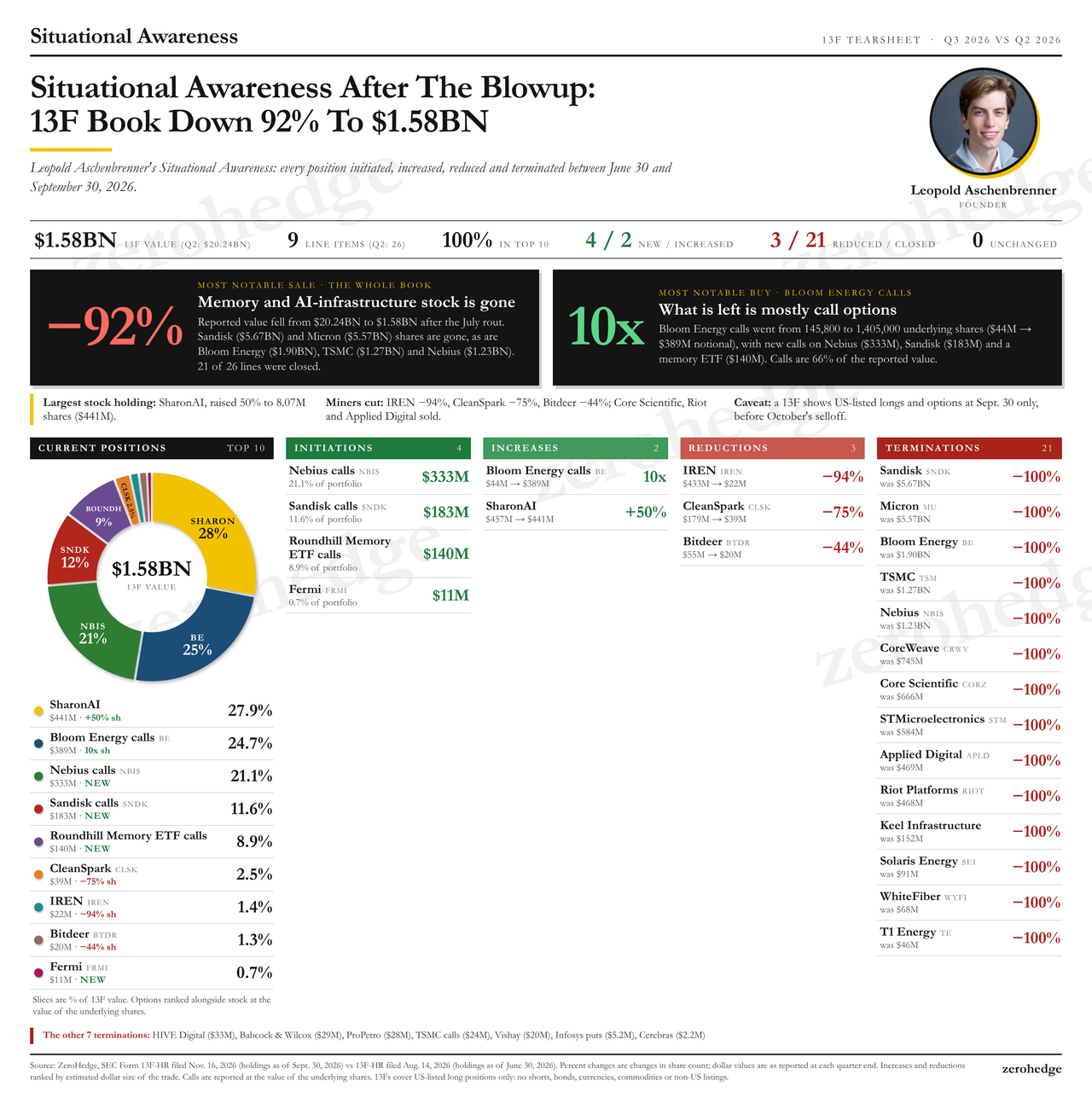
Earlier this week we learned, courtesy of the WSJ and Bloomberg , that the 25-year-old's hilariously misnamed Situational Awareness (technically it's 2 Situational 2 Awareness now) lost 65% in the third quarter , which followed our own post-mortem of the fund's $18.7 billion 13F vanishing act .
What we didn't have at the time was the full document. We do now ( the complete letter, for those who have way too much free time on their hands, is available to pro subs ), and having read all of it (ok, most of it) so that you don't have to (the author helpfully suggests reading it in pieces, and we suspect the only "readers" who will finish it run on a H100), we can report that the summer's near-death experience has done nothing to dent the forecasting.
If anything, the forecasts got bigger and more ridiculous as the fund got smaller . Superintelligence arrives in 2028. The AI labs will be doing more than $1 trillion in revenue by the end of next year. Some 400 of the S&P 500's members, Nvidia included, will be worth little. Bonds will crater, real estate will collapse and gold, well, gold is finished because robots are going to mine the asteroids.
The one asset he really likes for the long run? The Mona Lisa.
Credit where due: the letter does not hide the numbers . The fund launched in November 2024 with a bit over $100 million, opened 2026 with NAV a bit above $4 billion, and then multiplied that almost 10x in six months (about 90% of it P&L), which is how a firm of a few people ended up running something like $40 billion (we had it at $45 billion at the peak). Then came July: down 67% net in one month , and down 65% net for the quarter.
In July, we drew down 67% net from our end-of-June high. I wrote to you then that we had let you down, and the responsibility was mine. AI stocks fell dramatically, and our fund should have experienced a severe drawdown—but the fund itself should never have been at risk. That was a failure in how I built it.
The post-mortem section is probably the most readable part of the whole thing, and it confirms what we said in real time ( which if the fund's brilliant founder had read at the time, he would have certainly avoided collapse ). The fund came into July running 1.6x long and 1x short. The "hedges" didn't hedge: short Micron fell about 30% while long Hynix and Kioxia fell 55% to 65%, and the crash puts were sitting on the names that crashed the least. Meanwhile the book of software and IT-outsourcing shorts (think Cognizant and Workday) ripped 30% to 50% higher. By July 22 the fund was down 31% gross for the month, rumors were flying around New York, and on July 29/30 one giant block trade, which made Ken Griffin a few billion dollars richer, covered every short and sold half the public longs. The letter never names the buyer (Citadel shows up only as the former employer of the new head of treasury strategy), but regular readers know exactly whose flagship soared 6% that month and who had flipped almost all of it three weeks later.
Leopold's explanation is that the July crash had no fundamental trigger and was worse than the worst weeks of the dot-com unwind in his model. Of course, that's bullshit: we first flagged what was happening in mid-June , one month before the fund collapsed due to massive crowding and leverage , when swap funding costs were exploding:
Unprecedented surge in S&P funding costs by dealers lending out futures and Total Return Swaps (remember Archegos) to institutional clients. Think of it as lending costs for long positions. pic.twitter.com/x9KQu4r9MK
— zerohedge (@zerohedge) June 15, 2026 Which brings us to the other 160 pages.
The intellectual core of the letter is SSDD for those familiar with Leopold's worldview, only this time it's on steroids: as his latest strawman to supercharge his optimism, he assumes that AI is now improving itself. Leopold calls it RSI, for recursive self-improvement, and he thinks overall AI progress is already running at 1.5x to 2x its old pace because the labs' own models are doing the research. Next year, he says, will pack three years of progress into one, with a modeled range of two to six.
Some of the specifics, all from the letter and all stated with a straight face:
Claude will have fully automated half of Anthropic's R&D work by June 2027 and 95% of it by November 2027 . This comes from fitting S-curves to a chart and extrapolating seven months at a time, kinda like what he did with the market in H1 2026. For the last and most important curve, the source note concedes that no task has ever been rated at that level and that the line is an assumption.
Superhuman automated AI researchers by the end of 2027, full superintelligence in 2028. The letter's last page promises an entire civilization of non-human geniuses by then, barring a ban (yes, there's the whole "politics" thing). Exhibit A is this year's brute force machine proofs of two Millennium Prize problems.
From 2028, the robots build the fabs and the data centers, and the robots build more robots.
A reasonable chance next year of the first rogue agent swarms that escape, copy themselves across the internet, and steal bitcoin to rent more servers to steal more bitcoin.
A 10% chance of a total government shutdown of AI after a catastrophe, in which case stocks could fall 80%. He labels this scenario after the anti-machine crusade in Dune .
We are headed to full-on superintelligence in 2028. Things will get pretty crazy.
Note the investment conclusion Leopold draws from all of this. Regulation and a slower, so-called paced rollout would be good for the AI trade, since slowing a 3x year to a 2x year still beats what he says the market is pricing (a 0.3x to 0.6x year). In other words, the bull case now includes a one-in-ten chance that the product gets banned for killing people . We have read a lot of investor letters... that's a new one.
$1 Trillion In Revenue, Or 50,000 Of Leopold's Closest Friends
Anthropic went from $1 billion of annualized revenue at the start of 2025 to $81 billion in October. The buyside, according to the letter, expects $120 billion to $200 billion by the end of 2027. Leopold thinks that estimate is the truly radical one. His number for Anthropic and OpenAI combined is north of $1 trillion , with Anthropic plausibly getting close to that on its own, and what he himself calls a naive curve fit says $6 trillion. For context, that last figure is roughly a fifth of US GDP, to be billed by two companies... thirteen months from now.
How do you get there? The letter offers two routes. One is that agents take about 3% of the world's $30 trillion white-collar wage bill (give or take a few hundred million unemployed workers). The other is our favorite chart in the document:
That's right: all it takes is 50,000 people spending about $20 million a year each on Claude , the way the letter estimates the typical Anthropic researcher already does. Leopold's evidence that this many whales exist:
I personally know dozens of people using the AI models at this intensity with HPMA or precursors today, and expect that many hundreds of people I know personally will productively do so sometime next year. (Remember: We only need 50,000 of them for $1T in revenue.)
Three problems jump out, and we are probably being generous in stopping at three.
First, the benchmark customer is Anthropic's own staff, whose usage is "priced" at list but is a cost to the company, not revenue. Nobody at Anthropic is writing Anthropic a $20 million check (although the company may certainly be including it in the ARR calculation: we'll find out soon enough).
Second, the next data point is Situational Awareness itself, whose Claude bill peaked at a $23 million annualized pace on October 30, which is quite a tab for a 30-person firm coming off a 65% quarter (the letter notes the spend is a management company expense, and also that until recently Claude kept getting confused about why memory stocks had gone up so much). That said, the fact that Claude appears to be running pretty much everything at the "hedge" fund does explain its performance.
Third, Anthropic's actual revenue growth just fell from 144% in Q2 to 47% in Q3, which the letter files under lumpiness: a bottom-quintile quarter, nothing more. Ignore it please.
I’m sure Leopold is a very smart guy, but that letter was wildly ignorant and it’s very clear he’s still living in a bubble. I’m not bearish on AI, but I would be quite concerned reading that as an LP.
So much of it was “The smartest and richest people I know are eating more…
— Green Dot Cap (@GreenDotCap1tal) November 28, 2026 The Portfolio: One Times Earnings, Forever
So what does one buy for the singularity? The letter's answer is a sequence of bets that rotates as the market catches up, and right now there are three.
Anthropic , the largest private position since a $60 billion round in early 2025, now a trillion-dollar-plus public company and up 14.8x for the fund to the IPO price. Leopold says it could be the most profitable company in the world by the end of next year, calls it cheap at 9.3x sell-side 2027 revenue (under 2x on his revenue), and waves off the $900 billion of compute commitments sitting against $81 billion of (annualized) revenue . He also volunteers the conflict everyone was already whispering about: his wife is chief of staff to Dario Amodei. The letter says the two never discuss confidential company information, that trades in the stock now need preclearance, and that the SEC has been asking questions about July.
Memory . Give him this one: he bought SK Hynix at around ₩180K when it was a $100 billion company and rode it to ₩2.9 million, a 16-bagger. And then he gave back almost two-thirds. Sandisk went from $11 to $292 and back under $80 (post-split). Kioxia is down 80%. And here the argument is that these names now trade at 1x to 2x next year's earnings, so everything after 2027 is free, with the letter's summary of the Hynix buyback math: "Either the multiple will expand or we will be the last external shareholders left. . ." His remaining LPs will be thrilled to read that.
Anyone who has traded memory for more than one cycle knows that these stocks always look cheapest at the top , because peak earnings are what make the multiple low. It's literally the oldest trap in semis (which are just as well known for double and triple-ordering before the bottom falls out). And there is a bigger hole, which one reader flagged in the replies to the Majmudar thread further down: the same letter says algorithmic efficiency is now improving 30x a year. If the labs really can squeeze 30 times more out of every chip annually, the case for a permanent shortage of chips is not obvious.
Spot compute . An H100, the letter reasons, has about the processing power of a human brain, so it should eventually earn what a smart human earns. Short-term GPU rental has already gone from $1-2 an hour to more than $5 (SpaceX, he says, repriced its Anthropic lease about 60% higher in October), and Leopold sees hundreds of dollars an hour ahead, with thousands in the extreme case. By 2029, he reckons the market is pricing $1.66 per kWh. His number is $26. Somebody is off by a factor of 15... and only one of the two got margin called this summer.
Atreides' Gavin Baker, who liked the letter, put his finger on the assumption that holds all three bets up: the frontier has to stay a cozy oligopoly with pricing power. If Google, Meta, xAI and the open-source crowd keep pace (not to mention China and its penchant for price dumping to grab market share), intelligence gets priced near cost and the surplus goes to everyone except the labs .
The most important assumption in the SALP letter is that RSI creates an oligopoly at the frontier with real pricing power. TLDR; market structure at the frontier might be the single most important variable for tech investing over the next 2-3 years.
— Gavin Baker (@GavinSBaker) November 28, 2026 Everything Else Goes To Zero (Including Gold, Because Asteroids)
This is where the letter goes from aggressive to, well, uhm... something else. The section on investing for superintelligence argues that more than $500 trillion of wealth will be created and about $500 trillion destroyed, and that the destroyed pile includes nearly everything you own. Of the S&P 500, maybe 400-plus names end up worth little. The roll call:
Nvidia : tens of thousands of engineers, the chip IP and CUDA all get commoditized by models that design better chips. Can't survive in its current form for more than a few years. (The letter makes a point of noting that NVDA is up just 5% since the fund launched.)
ASML : AI reinvents lithography and the entire supply chain behind it.
Microsoft : Windows and Office replaced. Apple : leapfrogged, App Store bypassed by agents. Eli Lilly : patents intact, drugs obsolete.
TSMC : prints money for a couple of years, then robots build better fabs.
Bonds : crater as real rates soar. Real estate : collapses, because robots make buildings cheap and factories can go in the desert, the ocean or space.
• Gold. With your long-duration bond portfolio wiped out, you park your wealth in gold. Unfortunately, if AI-accelerated technological progress means that we are able to mine the asteroids in the early 2030s, gold will become ample, and prices will collapse.
We will just note that central banks appear to be unaware of the incoming supply, and that a man who could not get a Micron short to hedge a Hynix long is now modeling the delivery schedule of 16 Psyche .
SPCX and TSLA. Elon's incredible track record of entrepreneurship and management commands a premium multiple today, but ASI will provide superior leadership at scale: omnidisciplinary superstar CEOs on the spot throughout every part of the company with access to all corporate information. They would be especially advantaged in leading swarms of ultrafast superhuman agents.
The ASML passage alone was enough for some readers to close the PDF, and the best reply to it, from one Sophy Yan, was nine words long: "You cannot prompt-engineer an industrial supply chain into existence."
The sharpest critique so far comes from Adam Majmudar, who notes that the letter is full of one recurring trick: misdescribe where a business gets its pricing power, announce that AI replaces that part, and conclude the moat is gone. Real estate is his example. The letter claims most property value is the structure. Anyone who has priced a teardown in Greenwich knows it is the dirt. As Majmudar puts it, "You aren't going to create another Manhattan, Shenzhen, Deer Valley, Hamptons" by making drywall cheaper, and if everything else gets cheaper, scarce locations get more valuable. Physical networks, regulation and positional scarcity do not care how smart the model is.
New Situational Awareness letter is littered with many instances of the same flawed trope that has become very common in AI market predictions:
step 1. heavily mischaracterize the essence of a business or asset class and where its pricing power comes from
— adammaj (@MajmudarAdam) November 28, 2026 There is also a contradiction sitting in plain sight (actually there are dozens). Nvidia is a zero because AI makes its engineers worthless. Anthropic is the most valuable company on earth because it has the best engineers.
Situational Awareness is bearish Nvidia because AI makes human talent (NVDA engineers) worthless.
It's bullish Anthropic because Anthropic has the best talent.
— The AI Investor (@The_AI_Investor) November 28, 2026 And one more for the road: skyrocketing real rates are supposed to crush the present value of every bond and building on the planet, yet somehow spare a $1.5 trillion IPO trading on positive free cash flow some time in the next decade.
So what is safe? Leopold's best buy-and-hold idea is the Mona Lisa: a historical artifact that no AI can obsolete, a luxury good for a rich post-scarcity civilization, and, he adds, portable and therefore hard to tax or expropriate. He regrets that France isn't selling. (On "portable and secure" we would gently point to the Louvre's recent track record .)
The last 40 pages are about the fund, and to his credit the mea culpa is real:
We had an arrogant West Coast attitude of "we know better, we can just ignore these East Coast people who have insane views about AI". But the market humbled us. Even if we (think we) are smarter in the long run, the market is smarter than us in the short term. To make money, we have to respect that.
The fixes: no shorting, no prime broker leverage, a book of stock and options with nothing borrowed against it, a chief risk officer (still being hired, four months later), and a firm that has gone from three people and a Bloomberg terminal to almost 30, most of them in compliance, treasury and operations. The old fund, he writes, was run like an experimental Formula 1 car. The new one will be a Porsche 911, with airbags.
A few things the letter leaves out. It says the book has carried no financing leverage since the end of July. It does not mention the roughly $315 million of deep out-of-the-money calls that showed up in September, the day JPMorgan reportedly cut him off , or the FT's report confirming what we observed previously, namely that "Situational Awareness 2.0" involves a return to leveraged trading (the letter does allow that some long-side leverage may eventually come back). Here's a little lesson in finance, Leopold: an options book is leverage that somebody else has already margined for you. Well, as of September 30 about two-thirds of the 13F was calls, and every underlying has fallen 36% to 58% since.
Confirmed: he blew up, loaded up on calls hoping to make it all back quick, then blew up again. https://t.co/JDaH1lQBCi pic.twitter.com/XPV6JOQzav
— zerohedge (@zerohedge) November 17, 2026 Then there is the hiring. A fund whose central thesis is that human capital is about to be worthless has grown headcount tenfold, reports that no AI analyst on the Street could pass its interview (so it hired a healthcare PM), and runs an internal swarm of hundreds of Claudes that includes a coach Claude whose job is to motivate the other Claudes. As Baker dryly observed, "Humans might turn out to have a longer shelf life than expected."
A document this long was always going to produce a highlight reel, and X did not disappoint. Here are the lines that made us put the PDF down for a minute, in page order, with our two cents in italics ( with a hat tip for some of these pearls ).
On the scale of things: " >$500T of wealth will be created, and ~$500T of wealth will be destroyed. "
Global household wealth is roughly $500 trillion, so the forecast is that an amount equal to everything everyone owns gets vaporized and replaced with a slightly larger pile owned by somebody else. Presumably his LPs.
On the future of work: "In not so many years, the entire economy will be fully automated."
Stated between a paragraph about his friends' chatbot bills and a chart of his own. Meanwhile the fund has gone from three humans to almost 30.
On his largest position: "The last two years at Anthropic are, in our view, probably the most extraordinary run of any company in the history of capitalism."
Bigger than Standard Oil, the East India Company and Nvidia, according to a shareholder. Same letter also contains a 65% quarter, so capitalism has range.
On valuations: "Where is the AI bubble we hear so much about?"
He went looking for the bubble in a letter explaining how his fund went from $40 billion to a firesale in four weeks. Found it.
On next year's risks: "We think there is a reasonable chance that next year we see our first "agent plagues": rogue agent swarms that not just escape their sandbox, but exfiltrate their weights and start "surviving and spreading" on the internet. They might hack some bitcoin and use that to buy cloud compute, to run more copies of themselves, to hack even more bitcoin and buy even more cloud compute and run even more cloud compute—all the while wreaking havoc."
Self-replicating rogue AI that steals crypto to buy servers to steal more crypto is listed as a risk factor. A few pages later it is part of the bull case.
On regulation: "In that sense, from our point of view, serious regulation and so on would likely be good for the AI trade."
The first hedge fund letter we can recall that is long the product and long the government stepping in after the product causes a catastrophe.
On the labor market: "Then, AI can work through human hands: any unskilled worker can become a skilled worker (executing on much-better-AI-plans) with an AI coach and Meta glasses."
The plan for building fabs before the robots show up: day laborers in Zuckerberg's sunglasses taking orders from a chatbot. TSMC Arizona could not be reached for comment.
On AI borrowing as much as the US Treasury: "American capitalism is a marvel!"
Our readers may have a different word for an industry whose funding needs rival Uncle Sam's. Bond vigilantes definitely do.
On the consumer: "People stopped being able to afford PlayStations and Xboxes as memory prices soared." "Carl predicted this (no more PlayStations because of AI. . . ) to me a half decade ago. . . it was very memorable!"
Pricing gamers out of consoles is offered as a victory lap, complete with a footnote crediting his partner for calling it half a decade ago.
On July: "Given how much AI stocks fell, July should have been a 50%+ drawdown. But while we delivered the drawdown, we came too close to failing on survivability."
Only in this letter is losing half of your investors' money the outcome that should have happened. The actual number was 67%.
On lessons learned: "The singularity may be happening, but I've learned that sometimes the right response is not working harder, but stepping back."
It took a roughly $30 billion drawdown to discover the concept of taking a break.
On hiring: "No existing tech/AI analysts could pass Carl's interview, so we expanded our search further. Ultimately, we found RunLin Wang, a top performer at Farallon, where he was managing a successful healthcare book."
Not one AI analyst on Wall Street was good enough for the fund that lost 65% in AI stocks. So they hired a healthcare guy.
On his own research assistant: "Up until a generation ago, Claude always seemed confused that memory prices and memory stocks had risen so much—it seemed unfathomable to Claude."
The $23 million-a-year AI could not understand why memory stocks had gone up so much. It may have been the only one in the building asking the right question.
On what comes next: "By 2028, barring a regulatory ban, a civilization of alien geniuses will arrive."
And those are just the ones that fit. The asteroid gold, the superhuman CEOs coming for Elon and the painting are all quoted in full above.
Leopold's own framing of the stakes: " Either we or the market will have an extraordinary amount of egg on the face in a year. "
On that we agree, and at least it's testable. By next December the labs will either be running at a trillion dollars or they won't, GPUs will rent for $26 or for $1.66, and Claude will or will not have automated 95% of Anthropic.
He may even be right about some of it. He was early and right on memory, on Anthropic, and on capex, and plenty of smart people think the direction is correct. The trouble is everything between the idea and the P&L. The letter's answer to "the market is pricing a slowdown" is that the market is wrong by 5x on revenue, 15x on compute prices and about 400 companies on the S&P, and its answer to "you lost 65%" is that now is the best opportunity in the fund's history. Every blown-up manager says the second part, but only the most self-absorbed narcissists with delusions of grandure need 167 pages to say it.
Our guess is that the truth lands a lot closer to the boring buyside number than to the asteroid, and that a strategy which needs every AI winner to mint cash for exactly three years and then die on schedule is going to require far better timing than this fund has shown so far . But hey, if it all works out he has promised his LPs a painting. The letter signs off its investing section with the only price target that needs no model: "See you at the Louvre."
One last chart. It shows what you would have made by owning each year's single best AI stock in sequence, picked with hindsight, which the fine print confirms is not the fund's return. The answer is 167x. One for every page.
Much more in the full 167-page Situational Awareness letter, available to pro subs .
منبع: ZeroHedge — متن کامل از فید رسمی منبع، با ترجمهی ماشینی عنوان و خلاصه
گفتوگو