AA, For Now: S&P Threatens Nvidia Downgrade As CDS Blows Out To Record Wide
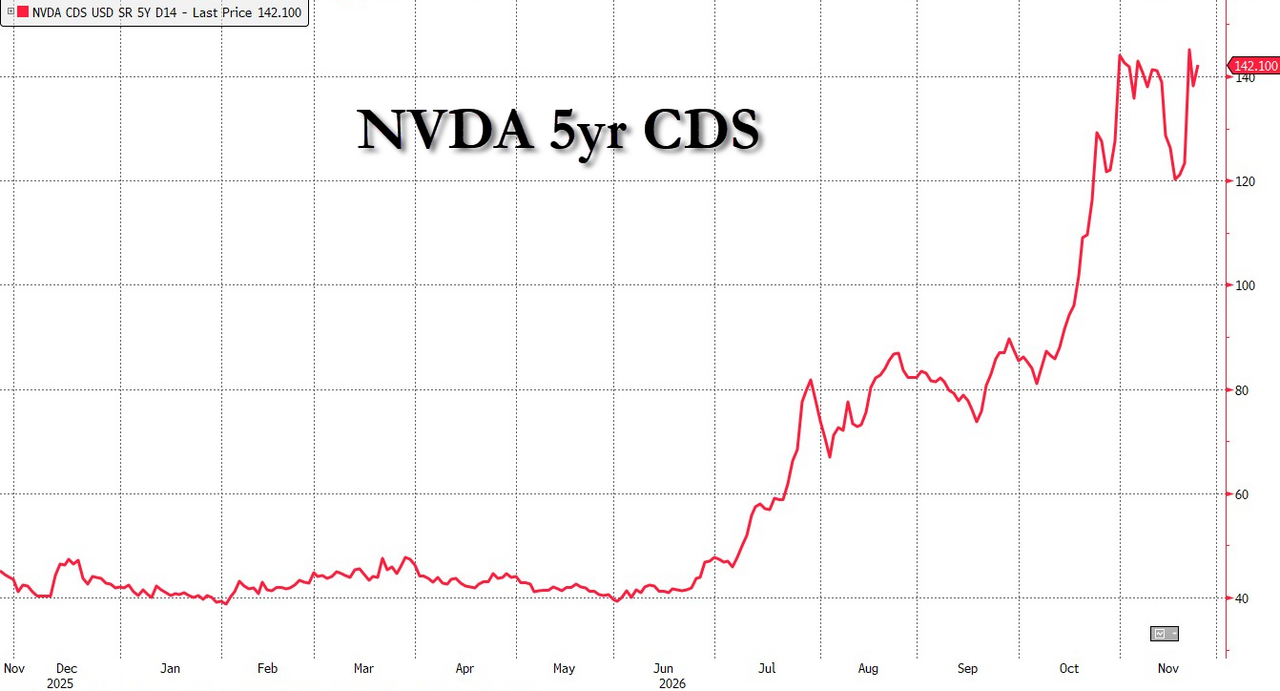
AA, For Now: S&P Threatens Nvidia Downgrade As CDS Blows Out To Record Wide The credit default swap market has been marking Nvidia lower since June. On Wednesday, the rating agencies finally started to catch up.
Shortly after 1:30pm ET, Bloomberg reported (and we flagged ) that S&P Global Ratings has placed Nvidia's AA issuer rating, the third-highest grade it hands out, along with the AA on its senior unsecured debt, on CreditWatch with negative implications . The agency says recent, well-publicized developments have raised questions about the effectiveness of Nvidia's management and governance framework, including board independence and "key man" risk, i.e., the departure, and then the return, of CEO Jensen Huang. S&P could cut Nvidia over the next 90 days if it determines those deficiencies remain (narrator: they do), and expects any downgrade to be limited to one notch, unless investigations or disclosures lead it to believe Nvidia's reputation or future business prospects have been harmed.
News regarding the CEO and questions regarding potential export control violations have exposed vulnerabilities in NVIDIA's management and governance framework, especially in regard to its board structure, composition, and effectiveness. We believe the long tenure of certain board members may have compromised their independence. The company's corporate governance practices may also not have kept pace with NVIDIA's rapid growth and its role as a critical global technology enabler.
In other words, S&P has a problem with the board , and since nobody fired the board, the problem is still there. And as for what the directors have done about it since Huang walked back in on Monday, S&P is blunt:
At this time, S&P Global Ratings is unaware of any remedial action enacted by the board to address what could be meaningful M&G deficiencies.
Translation: the downgrade is the default outcome , and the only obvious off-ramp is a board shakeup. Considering that this is the same board that took 11 days to fire and rehire its CEO, we won't be holding our breath.
On the Huang saga itself, S&P doesn't mince words either. Having credited management with decades of shareholder returns, it goes straight for the "key man" problem:
While NVIDIA management has delivered significant returns for its stakeholders over decades, weak executive oversight and lack of succession planning have brought questions around the "key man" risk to the forefront. The departure, then reinstatement of the CEO, does not sufficiently answer our questions regarding board oversight of executive code of conduct.
Put differently, bringing Jensen back fixed the stock, but did nothing to fix the board's oversight of him . And S&P has already acted on that view in one small but telling way: it cut its management and governance modifier on Nvidia to neutral from positive , effective today. Next, the agency plans to sit down with the board and management to hear their plans for board independence, oversight of management and a credible succession plan, with S&P's own wording making clear it isn't sure such plans exist yet.
Meanwhile, a key measure of Nvidia credit risk hit a fresh high on Wednesday: the cost to protect Nvidia's debt for five years rose as much as 6bps to 147.27bps, an intraday record , according to ICE Data Services. For context, back in June the same protection traded around 40bps, near its record tights. Put differently, insuring $10 million of Nvidia debt cost about $40,000 a year in June; today it costs $147,000 .
Which is why we have spent so much of the past year on the credit plumbing behind the AI supercycle, something we have been warning about since last October , when AI quietly became the largest debt sector in the market. Nvidia was supposed to be the one name in that sector nobody had to worry about. Well...
A quick recap for anyone who spent the past two weeks in a cave. Huang resigned on Nov 12 after reports of multiple extramarital affairs, including one with a subordinate and another with a woman the US government has investigated for spying on behalf of China. Nvidia chairman Harvey Jones said every director voted to accept the resignation and that the board would not bring Huang back. The company repeated as much on its Nov 17 earnings day .
Six days later, the board reinstated him anyway, shortly after Trump bragged that he had convinced them . The stock ripped 31% , adding a record $952 billion in market cap in one session. On Tuesday, according to the NYT, Huang apologized to employees for violating the company's code of conduct and then spent much of an hourlong all-hands defending Nvidia's unusual, ultra-flat management structure as the thing he is proudest of.
Nothing says "AA" quite like a board that needed the President to make up its mind.
And the governance overhang did not leave with Huang, and did not come back with him either. There is the DOJ's criminal probe into Megaspeed, the Singapore company tied to Huang's mistress and suspected of diverting Nvidia chips to China (Commerce blacklisted it hours after Jensen returned ); there is the SEC inquiry into Nvidia's past disclosures ; and there is the board's own continuing investigation. Even Goldman's Jim Schneider, who kept his Buy rating in his note on the reinstatement , available to pro subs ), flagged the problem:
In addition, press reports have also suggested that an SEC investigation into the company's past disclosures is underway. We believe these investigations are likely to serve as an overhang on the stock until they are resolved, and/or the company provides more disclosure on these items.
Which brings us to the escape clause in S&P's one-notch cap. The agency says Nvidia's competitive position, technology leadership and financial profile are unchanged for now, while warning that its China exposure also raises questions about geopolitical risk management and internal controls. If S&P comes to believe export control rules were circumvented or violated, or that Nvidia's past disclosures on its exposure to China and nearby regions were misleading or understated, that would weigh on its view of Nvidia's overall credit quality. Those two scenarios map one-for-one onto the DOJ's Megaspeed probe (Singapore being one of those nearby regions) and the SEC's look at past disclosures. In other words, the investigations that Goldman calls an equity overhang are exactly what could turn a one-notch cut into something bigger .
Equity analysts, of course, can look through an overhang for 12 months. Bond investors lend for five, ten and thirty years, and they have been looking straight at it.
S&P is not alone. Last Wednesday, Moody's cut Nvidia's outlook to stable from positive , affirming the Aa1 rating (the second-highest rating on its scale) but citing the governance fallout from Huang's ouster and the lack of a formal succession plan. Moody's analyst Raj Joshi said the exit had clouded Nvidia's business strategy and financial policies, while still calling the company's market position and finances "exceptionally strong." Translation: no upgrade for the next 12 to 18 months , which, considering Huang has since returned, makes the agency's original reasoning somewhat moot. The governance concerns, however, are not.
The CDS market didn't need a press release. Regular readers will recall that Nvidia's spreads started to break out over the summer, as the company's balance sheet morphed into the financing arm of the entire AI trade, a shift we discussed in "Nvidia's Balance-Sheet-As-A-Service: Why Credit Investors Are Far More Concerned About The 'Central Bank Of AI'" (Aug 27). Nvidia's 5Y CDS hit a then-record 82bps on July 27, and the divergence between stock and credit got so absurd by late August that it was best summarized in two lines:
— zerohedge (@zerohedge) August 28, 2026 By mid-October the stress had spilled over into the highest-rated names in the sector:
Credit stress spilling over into highest rated names: NVDA, AVGO CDS all time wides pic.twitter.com/LK7NK4M8aT
— zerohedge (@zerohedge) October 19, 2026 And by early November, according to IFR, which cited data from S&P Global Market Intelligence, Nvidia's CDS was trading at levels more typical of a double-B credit. That's right: one part of S&P was showing Nvidia priced like junk, while another part of S&P had it at AA , its third-highest grade. As we noted in "Oracle's CDS Is Now Wider Than Bear Stearns' Was In January 2008" just yesterday, the swaps across the AI complex have blown out while the agencies have moved, well, once. Now it's twice.
Note the timing, too: Nvidia sold $25 billion of bonds in June, its first bond sale in five years, right around the record tights. Whoever bought that paper has had a lousy five months .
Why One Notch At The Top Matters: The Bank Of Nvidia Lends Its Rating
On its own, a one-notch cut from AA to AA- for a company sitting on Moody's projected $240 billion-plus of cash by the end of fiscal 2028 sounds like a rounding error, and as far as Nvidia's ability to pay its own bonds goes, it probably is. Nobody seriously thinks Nvidia is going to default.
The problem is everybody else's debt. As Bloomberg itself notes, Nvidia is an important source of financing for much of the AI world, and its rating is the collateral behind a growing pile of structures that borrow it. As Nvidia disclosed on its Q3 call, its guarantees totaled $118 billion at the end of the quarter , including $105 billion of credit support for land, power and shell capacity at the Portspike campus. That's on top of the hundreds of billions in supply, cloud and equity commitments we have mapped as the "Bank of Nvidia" ; here is how it looked at the end of Q2:
This is exactly where Goldman's credit strategists see the next leg of AI financing. In "From Shell to Compute" ( available to pro subs ), which we covered in "Goldman Sees $545 Billion Of AI Project Finance Next Year..." (Nov 17), the bank expects $320 billion of chip and compute financing in 2027 , almost seven times this year's pace, much of it in structures that lean on a guarantee from the chipmaker. The chipmakers themselves have issued less than $35 billion of bonds, with just $94 billion of index-eligible paper outstanding between them, so their credit exposure has grown through guarantees rather than balance sheet debt. That leaves anyone who wants to hedge that exposure with only one place to go: the CDS. Which is why the premium of chipmaker CDS over their own cash bonds has gone from below zero a year ago to about 75bps, against roughly 45bps for the hyperscalers , and why Goldman expects that gap to keep widening (and note that the chart stops on Nov 12, the day Huang resigned):
That's also why, as we reported on Nov 9 , a basket of chip CDS (Nvidia, Broadcom, AMD, Intel) flipped wider than a basket of hyperscaler CDS for the first time in at least three months. JPMorgan, which kept its Underweight on Nvidia credit on the very day Huang resigned, made the same point from the other side: the borrowers most exposed are the ones that need outside capital, or that are counting on Nvidia's support to close their financing.
Put simply: when the guarantor gets downgraded, so does everything it guarantees . Nvidia can shrug off a notch. A neocloud whose GPU loan was priced off an Nvidia backstop maybe can't.
None of this is happening in a vacuum. Last week Goldman's credit strategists told clients in their 2027 Global Credit Outlook ( also available to pro subs ) to move down in quality, because the highest-rated borrowers are the ones drowning in AI debt (we wrote it up in "Are AAs The New Junk?" ). The bank expects AI-related spreads to keep underperforming the broader market, and its own chart shows AI investment grade bonds roughly 40bps wide of non-AI paper (chart read approximate):
And Tuesday, just as Huang was apologizing to his staff, the rest of the AI complex was back to its regularly scheduled programming:
Back to your regularly scheduled credit meltdown: hyperscaler CDS just blew out to record wide pic.twitter.com/JYdJehkFCs
— zerohedge (@zerohedge) November 24, 2026 By the close, Nvidia's 5Y CDS was at 142bps, just shy of its all-time wide, in what we dubbed "Yet Another Huangover" . Barely 24 hours after the stock's record $952 billion one-day gain, the credit market had given back every basis point of the relief and then some.
So what happens next? S&P has given itself 90 days, and promised that any cut will be limited to a single notch unless Nvidia's business takes a hit. We'd be surprised if the CreditWatch resolved any other way than a downgrade, unless Nvidia brings in a slate of fresh independent directors before February (watch for that, it's the tell): the board that S&P is worried about is the same board, with the same long-tenured members whose independence S&P now questions, the investigations are still open, and as of Monday Citi noted the 10-Q was still delayed. If anything, the CDS at 147bps has already priced several notches more than S&P is threatening , which makes sense once you notice that the cap comes with an escape clause written around the two probes that are still open.
The bigger question is what a downgrade of the AI ecosystem's de facto lender of last resort does to the $320 billion of chip financing Wall Street plans to sell next year, much of it wrapped in that lender's credit. Regular readers know our answer. The ratings were always the lagging indicator; the swaps were the leading one, and they have been screaming since June.
Then again, when the guarantor itself needs someone to vouch for its board, maybe it's time to ask who is guaranteeing the guarantor.
Much more in Goldman's "From Shell to Compute" , its 2027 Global Credit Outlook and Schneider's note on the reinstatement , all available to pro subs .
خبرهای مشابهی در منابع دیگر هست، ولی داور خودکار هنوز همخوانیشان را بررسی نکرده است.
همین رویداد در منابع دیگر:
- اس اند پی گلوبال رتبهبندی انویدیا را به دلیل افزایش ریسکهای مدیریتی و حاکمیتی در 'CreditWatch Negative' قرار میدهد
- ریسک اعتباری CoreWeave و Nvidia به بالاترین سطح جدید رسیدند با افزایش ترسهای هوش مصنوعی
- در پی ادامه مشکلات سهام انویدیا، این شرکت به سمت نخستین «صلیب مرگ» از ماه مارس ۲۰۲۵ حرکت میکند
- سهام انویدیا بیش از نیمی از رشد دوشنبه را پس میدهد چون خریداران در پایینترین قیمتها سود میکنند
- Stock Market Today: Dow Slammed 800 Points; Dell Falls Hard Despite Big Earnings (Live Coverage)
- بازار سهام امروز: داو جونز 1,100 امتیاز از ضرر خود را کاهش میدهد، صندوق S&P 500 با وزن برابر افزایش مییابد (پوشش زنده)
منبع: ZeroHedge — متن کامل از فید رسمی منبع، با ترجمهی ماشینی عنوان و خلاصه
گفتوگو